Rubbing Out Old Age: A Rapamycin Skin Cream Erases a Key Marker of Cellular Aging in Human Hands
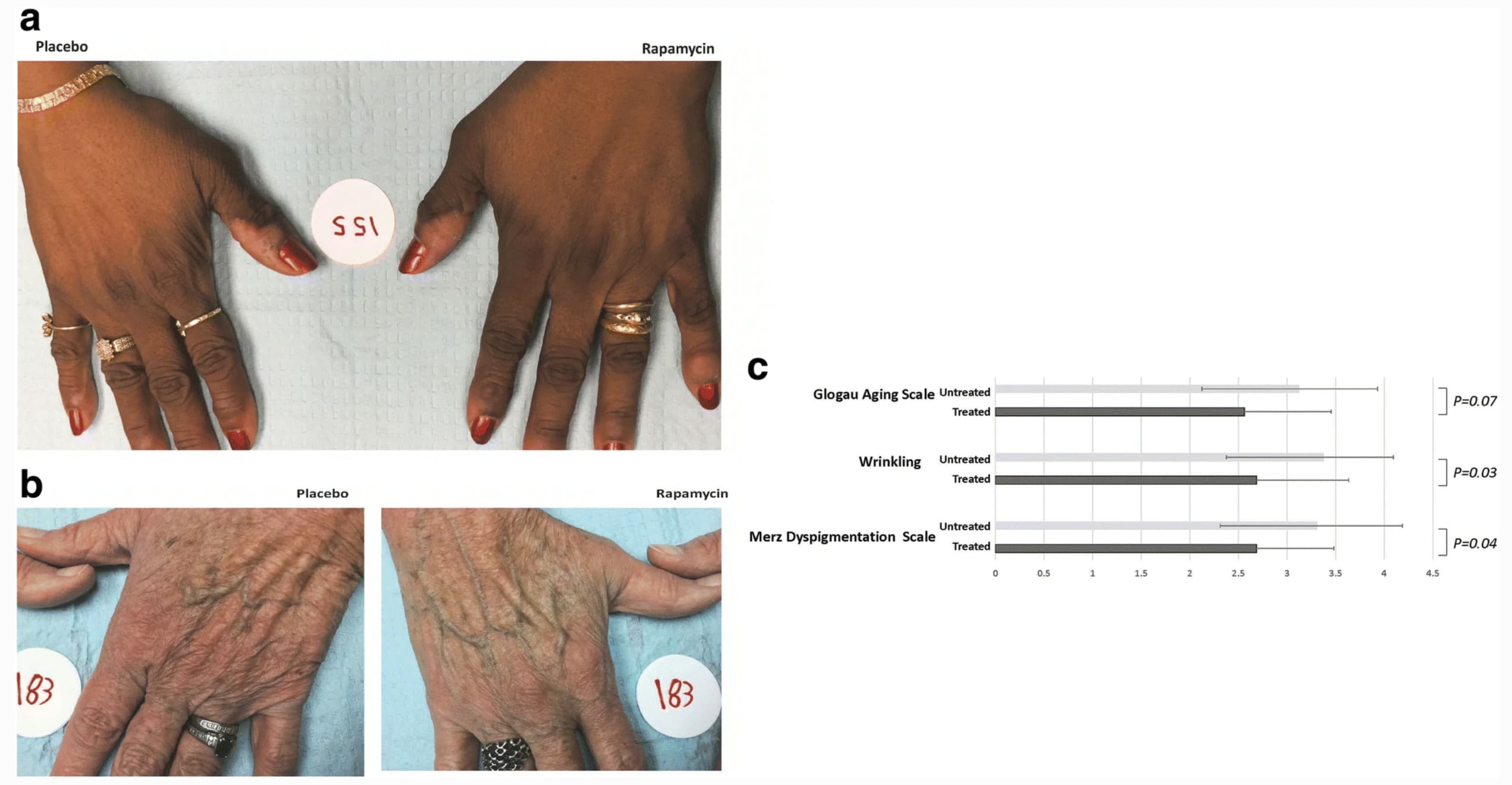
A small exploratory clinical trial from Drexel University tested whether a very low dose rapamycin cream, applied to the backs of the hands, could reduce cellular senescence and visible aging in human skin. Using each participant as their own control (rapamycin on one hand, placebo on the other), the researchers report a statistically significant drop in p16INK4A, a protein that flags senescent “zombie” cells, along with a rise in collagen VII, a protein that anchors the skin’s layers together. Clinical appearance and tissue histology also improved in most participants. This is one of the first demonstrations that an mTOR inhibitor can shift molecular aging markers in living human tissue, though the study is small, heavily attrition-affected, and exploratory rather than definitive.
For two decades, rapamycin has been the most consistent pharmacological way known to extend lifespan in laboratory mice. The catch has always been that it is a powerful immunosuppressant, and no one wants to take a transplant drug systemically just to chase longevity. This study asks a clever question: what if you could get the anti-aging benefit locally, in one tissue, without the drug ever reaching the bloodstream?
The team recruited people over 40 with sun-damaged, thinning skin on their hands. Each person received two identical creams to use nightly, one containing rapamycin at 10 micromolar (about 0.001 percent, a strikingly low dose) and one containing only the vehicle. Neither participant nor the primary lab measurements were meant to distinguish which hand got which. After six to eight months, skin biopsies were taken and analyzed.
The headline finding concerns p16INK4A, a molecular badge worn by senescent cells. These cells have stopped dividing but refuse to die, and they leak inflammatory signals that degrade the tissue around them. In the rapamycin-treated skin, p16INK4A levels fell significantly. That matters because in skin, the density of p16-positive cells tracks with wrinkling, elastic fiber damage, and how old a person looks. A parallel finding was a rise in collagen VII, a protein critical to the basement membrane that anchors the outer skin to the layer beneath it and which normally declines with age and beneath wrinkles.
Importantly, blood tests found no detectable rapamycin in any participant. The drug appears to have acted locally, which is the entire point. No treatment-related adverse events were reported.
The big idea is not that this cream is a proven wrinkle cure. It is that a longevity drug validated in animals produced a measurable molecular anti-aging signal in a real human organ, at a dose far below what causes side effects. If cellular senescence is a root cause of aging rather than a mere symptom, then interventions that reduce senescent cell burden locally could become a template for treating age-related decline tissue by tissue. This study is a proof of concept, not a product, and the numbers are small enough that healthy skepticism is warranted.
(image source: here)
I’ve pulled this old topic out to its own thread since there seems to be some significant interest in it, and it was previously buried in the general “Rapamycin for Hair Growth and Repigmentation” thread.
In the current Drexel-led study, 13 participants over age 40 applied rapamycin cream every 1-2 days to one hand and a placebo to the other hand for eight months. The researchers checked on subjects after two, four, six and eight months, including conducting a blood test and a biopsy at the six- or eight-month mark.
After eight months, the majority of the rapamycin hands showed increases in collagen protein, and statistically significant lower levels of p16 protein, a key marker of skin cell aging. Skin that has lower levels of p16 has fewer senescent cells, which are associated with skin wrinkles. Beyond cosmetic effects, higher levels of p16 can lead to dermal atrophy, a common condition in seniors, which is associated with fragile skin that tears easily, slow healing after cuts and increased risk of infection or complications after an injury.
If you have any friends who are chemists / biologists and have access to reagent suppliers, you can order rapamycin powder from suppliers like LC Laboratories. I’ve heard that some people crush up their sirolimus tablets to make rapamycin cream. See instructions here: DIY Rapamycin Cream.
Lower purity rapamycin powder (e.g. from China) may also work in this application and be ok because the rapamycin skin study showed that topically applied rapamycin does not get into the blood stream, so you don’t have to worry about contaminants in lower quality rapamycin powder getting into your body.
Here is the best paper I’ve found that has detailed instructions on making a topical rapamycin cream. I imagine we could just use the Transcutol and rapamycin (mixed with a blender) in a formulation with a dropper to put it on the scalp for the “hair tonic” approach.
For topical / serum applications I used Transcutol to dissolve the rapamycin in. [I tried rapamycin cream for skin for 6 months, it works to reduce fine wrinkles but it wasn’t a huge benefit and new research came out later (see bottom of this post) that suggests that it may do some negative things to the skin also].
Note: Transcutol has a number of different chemical names/identifiers. Here is a list: 2-(2-Ethoxyethoxy)ethanol: 3,6-dioxa-1-octanol, DEGEE, diethylene glycol monoethyl ether, Carbitol, Carbitol Cellosolve, Transcutol, Dioxitol, Polysolv DE, Dowanal DE
Transcutol Chemical Identifier: CAS Number 111-90-0
Where you can order Transcutol from:
LotionCrafters: Transcutol / Ethoxydiglycol
Laballey.com: Transcutol / Diethylene Glycol Monoethyl Ether
The mTOR/Rapamycin/Hair research was previously identified by Matt Kaeberlein and Peter Attia:
https://twitter.com/mkaeberlein/status/1392277845699792897?s=20
See this thread for more information on Rapamycin for Hair Growth and Repigmentation.
But there is also research that suggests rapamycin may not be that good for the skin, increasing inflammatory markers (which is not a good sign), and triggering a breakdown of the extracellular matrix:
"Rapamycin is a long studied molecule affecting mTOR/nutrient signaling and has recently been shown to decrease P16 levels of aging skin21, therefore it was chosen as a positive control of senotherapeutic effect in aging skin models. " … “Rapamycin induced a significant increase in P16 expression, a trend towards increased expression of inflammatory markers (IL6 and IL8), and a significant decrease in Keratin 1 gene expression levels (Fig. 3B). In the dermis, peptide 14 treatment promoted a significant reduction in B2M gene expression, a pro-aging factor, as well as in the expression ofIL8. Rapamycin treatment induced no significant changes in these markers and increased Matrix Metalloproteinase-1 (MMP1) gene expression, indicative of breakdown of the extracellular matrix (Fig. 3C).”
Source:
Senotherapeutic peptide reduces skin biological age and improves skin health markers
https://www.biorxiv.org/…/10.1101/2020.10.30.362822v2.full
More Rapamycin for Aging Skin reading:
It appears that a company has been formed that is working at commercializing this type of treatment for skin aging. For more information see Bionca Therapeutics: https://www.boincatx.com/
Related Reading: Senolytics Topically Administered to Skin for Antiaging Effects
Oral Rapamycin and Skin Aging
We have also had some good reports on skin health from people that even just oral rapamycin (which most of the people on this forum take via sirolimus tablets. Additionally, I believe there is significant evidence that rapamycin prevents a great deal of facial / skin aging more broadly defined (the changes in an aging face include loss of muscle tone in the face, fat distribution changes, etc.) and there is evidence that rapamycin slows many of these types of changes; for example rapamycin has been shown to slow muscle aging: Even with Calorie Restriction, Rapamycin Slows Muscle Aging. Studies have also shown that oral rapamycin slows the aging of most organs of the body, and our skin is the largest organ of our body, so it seems a reasonable bet that rapamycin will also have a significant impact in terms of slowing skin aging and the sagging of facial features that is common in aging humans.
Here is an example of one of our forum members here describing his experience with oral rapamycin helping with aging skin (from this post in our discussion forums):
I had suffered chronic actinic keratoses for decades because of my extreme exposure to sunlight when I was young. We did not have the benefit of the high SPF suntan lotions that are now available.
Rapamycin taken internally has had a truly remarkable effect on my skin. Actinic keratoses are precursors to cancer and are cancerous in nature. I saw my dermatologist 3 to 4 times a year. I have not seen a dermatologist since I started taking rapamycin.
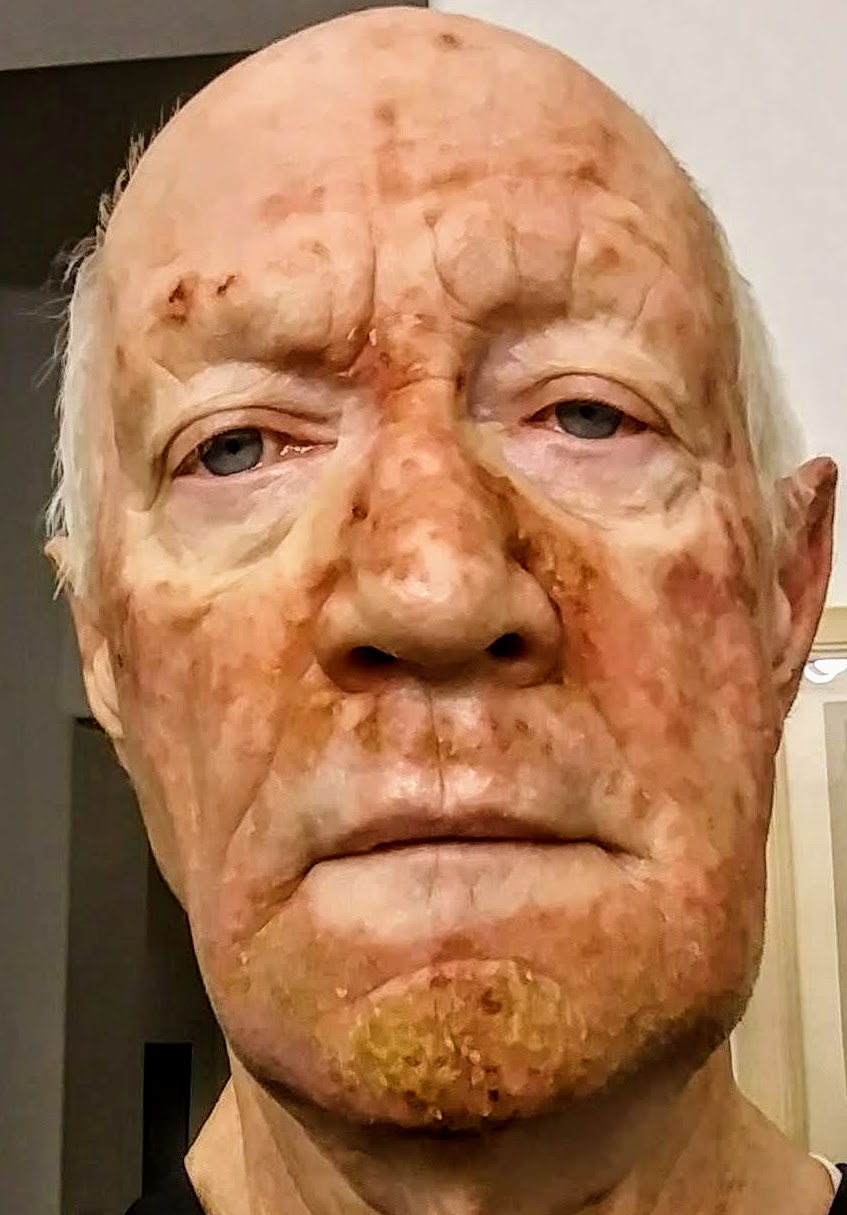
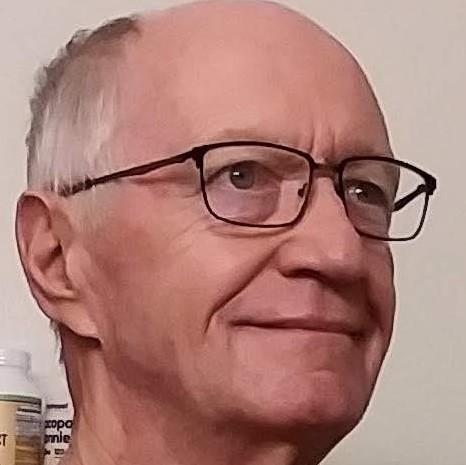
Here are the before and after photos. The first one is not as bad as it looks. It just is the way it looks after typical “Blue Light” therapy.