Decoding Brown Fat's On-Off Switch: How Inflammation and Glucocorticoids Drive Metabolic Aging & RU-486 May Stop It
RapAdmin
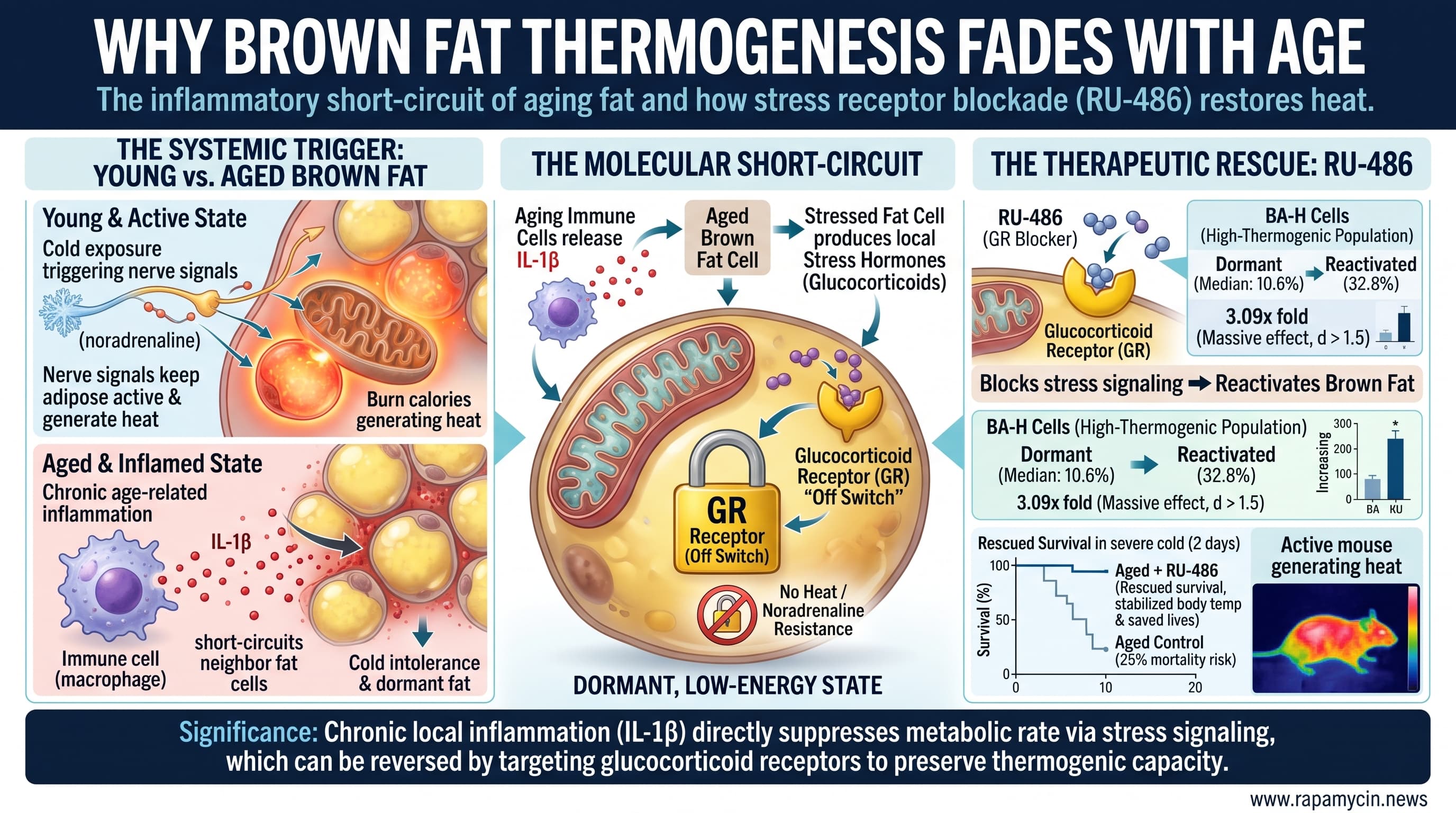
Brown fat burns calories to generate heat, but this ability fades as we get older. This study maps out exactly why this happens: as fat ages, local immune cells begin releasing an inflammatory molecule (IL-1β) that essentially short-circuits the neighboring fat cells. This inflammation causes the fat cells to produce their own local stress hormones, which hit an internal “off switch” (the glucocorticoid receptor) and lock the brown fat in a dormant, low-energy state. In young, healthy bodies, cold exposure triggers nerve signals that clear out this inflammation, allowing the fat to turn back on and generate heat. However, chronic inflammation in aged fat blocks this natural response, leading to cold intolerance and a sluggish metabolism. Most importantly, researchers found that giving aged subjects a drug (RU 486) to block these local stress receptors successfully reactivated their brown fat, boosted their overall calorie burn, and restored their ability to adapt to the cold.
Brown fat acts as a metabolic engine, utilizing blood sugar and lipids to generate heat rather than storing them. The gradual loss of this calorie-burning capacity during aging strongly correlates with metabolic decline and frailty. Recent analyses reveal that brown fat cells are not identical. They exist in two distinct states: a highly active, heat-producing state driven by the uncoupling protein UCP1, and a dormant, low-energy state. The transition between these states is tightly controlled by a localized interaction between the nervous system and the immune system.
The core regulatory mechanism identified in this research revolves around tissue-level inflammation. Immune cells residing within the fat tissue secrete an inflammatory molecule called IL-1β. This molecule acts on nearby brown fat cells to stabilize a specific enzyme known as H6PD, preventing its normal cellular disposal. H6PD acts as a catalyst for the local production of active stress hormones, or glucocorticoids, directly inside the fat tissue. These localized stress hormones activate the cell’s glucocorticoid receptor. This receptor activation subsequently shuts down UCP1 production, turning off the metabolic machinery required to burn calories and locking the cell in the dormant state.
When a young organism is exposed to cold temperatures, sympathetic nerves release neurotransmitters that directly instruct the immune cells to stop secreting IL-1β. Without this inflammatory signal, H6PD degrades, local stress hormone production plummets, and the fat cells transition into the highly active state to generate heat.
Aging severely disrupts this biological system. Older subjects exhibit a massive accumulation of IL-1β-secreting immune cells within their brown fat. This chronic, localized inflammation creates a continuous production of active stress hormones, even during severe cold exposure. Consequently, aged brown fat remains trapped in the dormant state, rendering the organism cold-intolerant and metabolically suppressed.
The defining breakthrough of this study is the pharmacological reversal of this age-related metabolic decline. By administering mifepristone (RU-486), a drug that blocks the glucocorticoid receptor, researchers successfully bypassed the immune-driven blockade. Antagonizing these stress receptors in aged subjects permitted the dormant fat cells to transition back to the highly active state. This intervention significantly raised whole-body energy expenditure and restored cold survival rates to near-youthful levels. This research isolates a precise pathway where localized inflammation drives metabolic aging, offering a targetable mechanism to restore calorie-burning capacity and systemic energy expenditure.
Actionable Insights
Systemic or tissue-specific interventions targeting glucocorticoid signaling present immediate translational potential for longevity and metabolic health. The data indicate that chronic localized inflammation (specifically IL-1β) directly suppresses metabolic rate by mimicking local stress signaling in fat tissue. Limiting systemic inflammation may preserve thermogenic capacity by maintaining the sensitivity of brown fat to noradrenaline.
The pharmacological blockade of the glucocorticoid receptor using RU-486 yielded substantial, quantifiable benefits in older subjects. In aged models exposed to cold for one day, RU-486 increased the population of high-thermogenic BA-H cells from a median of 10.6% to 32.8%. This represents an absolute increase of 22.2% and a relative increase of 3.09-fold (estimated Cohen’s d > 1.5, indicating a massive effect size). Functionally, this cellular shift rescued survival. Aged control subjects faced a 25% absolute risk of mortality within two days of severe cold exposure, whereas RU-486 stabilized body temperatures and mitigated weight loss, restoring functional thermogenesis. While chronic systemic RU-486 administration carries clinical side effects, this study was only 7 days long and demonstrated significant modifications and functional improvements. These findings suggest that a pulsed dosing strategy may provide signficant benefit, and also strongly supports the development of tissue-targeted glucocorticoid inhibitors or IL-1β suppressing protocols to safely elevate baseline energy expenditure and metabolic resilience in older adults.
Context/Source
- Open Access Paper: Bistable regulation of adipocyte heterogeneity governs thermogenesis, Nov. 11, 2026.
- Institutions: Beckman Research Institute at City of Hope Medical Center (USA), California Institute of Technology (USA), Wuhan University (China), Marche Polytechnic University (Italy)
- Country: USA, China, Italy
- Journal: Nature
- Impact Evaluation: The impact score of this journal is 64.8, evaluated against a typical high-end range of 0–60+ for top general science, therefore this is a Elite impact journal.