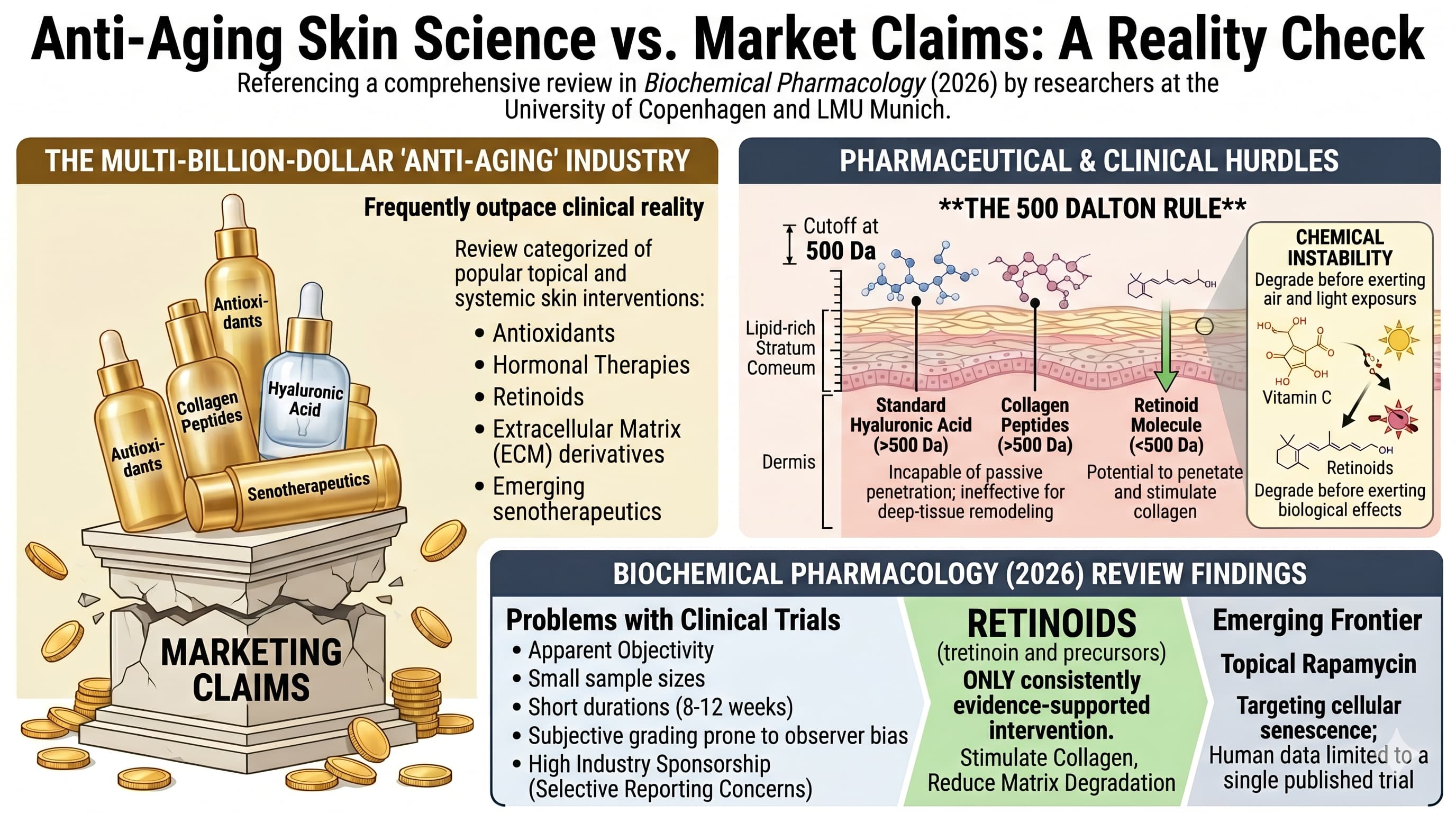
The multi-billion-dollar skin “anti-aging” industry rests on a precarious foundation of marketing claims that frequently outpace clinical reality. A comprehensive review published in Biochemical Pharmacology (2026) by researchers at the University of Copenhagen and LMU Munich provides a sobering assessment of the most popular topical and systemic skin interventions. The “Big Idea” is a significant disconnect: while molecular pathways for skin aging are increasingly understood, the ability to deliver active compounds effectively into human skin remains a formidable pharmaceutical hurdle.
The review categorizes interventions into antioxidants, hormonal therapies, retinoids, extracellular matrix (ECM) derivatives, and emerging senotherapeutics. Despite their popularity, most interventions—with the notable exception of retinoids—suffer from “apparent objectivity” in clinical trials. Many studies rely on small sample sizes, short durations (8–12 weeks), and subjective grading systems prone to observer bias. Furthermore, a high prevalence of industry sponsorship raises concerns about selective reporting.
Pharmaceutical delivery is the primary bottleneck. The researchers emphasize the “500 Dalton rule” : most molecules larger than 500 Da cannot passively penetrate the skin’s lipid-rich stratum corneum. This renders many high-molecular-weight “hydrators” like standard Hyaluronic Acid (HA) and collagen peptides largely ineffective for deep-tissue remodeling when applied topically. Even for smaller molecules, chemical instability—particularly with Vitamin C and Retinoids—often results in products that degrade before they can exert biological effects.
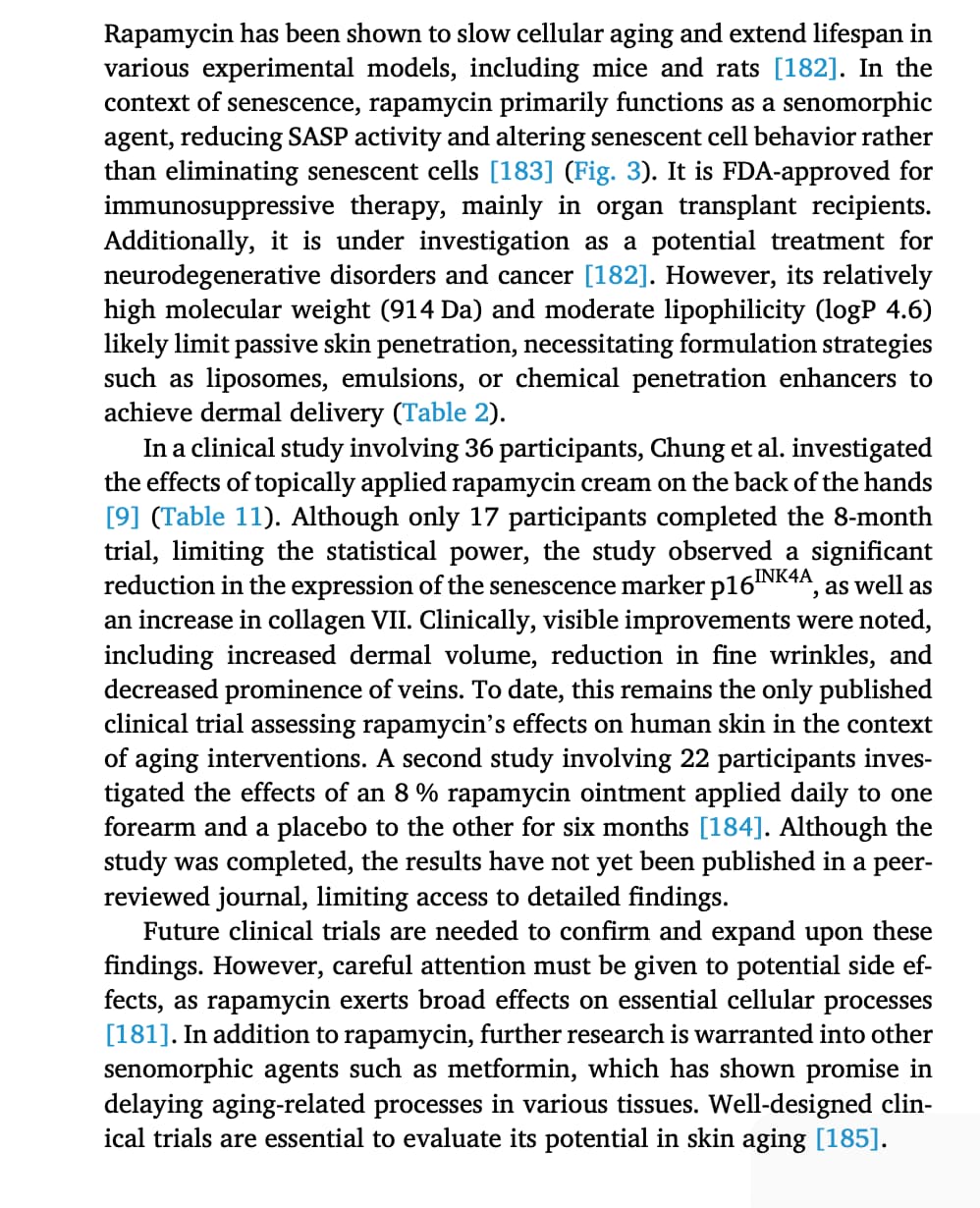
The review identifies retinoids (tretinoin and its precursors) as the only consistently evidence-supported intervention for stimulating collagen and reducing matrix degradation. Emerging data on topical rapamycin suggests a potential new frontier in targeting cellular senescence, though human data is currently limited to a single published trial. Ultimately, the paper calls for a shift toward independent, long-term trials with standardized, objective endpoints to bridge the gap between commercial hype and evidence-based geroscience.
Actionable Insights
-
Prioritize Retinoids: Tretinoin remains the “gold standard.” If irritation is a barrier, use stabilized precursors like retinaldehyde or retinol , but ensure they are in opaque, airtight packaging to prevent photodegradation.
-
Manage Collagen Expectations: Oral collagen peptides may show modest benefits for hydration and elasticity, but the mechanism is likely through general amino acid provision rather than direct “incorporation” into the skin. There is no “universal effect” established.
-
The 500 Dalton Constraint: Be skeptical of topical products containing large proteins or polymers (like high-molecular-weight Hyaluronic Acid) claiming deep-tissue repair; they typically act only as surface humectants unless paired with delivery tech like microneedling.
-
Environmental Defense: Regular use of broad-spectrum sunscreen is the most effective, evidence-based strategy for preventing the extrinsic UV damage that accounts for the majority of visible skin aging.
-
Emerging Senomorphics: For advanced biohackers, topical rapamycin (0.001%) represents a promising but preliminary intervention to reduce senescent cell markers (p16) and increase collagen.
Context
-
Open Access Paper: Topical and systemic skin aging interventions: Evidence, pitfalls and perspectives
-
Institutions: LEO Foundation Center for Cutaneous Drug Delivery, University of Copenhagen (Denmark); Department of Pharmacy, Ludwig-Maximilians-Universität München (Germany).
-
Country: Denmark and Germany.
-
Journal Name: Biochemical Pharmacology (BCP).
-
Impact Evaluation: The journal has a CiteScore of 9.3 and a Journal Impact Factor (JIF) of approximately 5.8, evaluated against a typical high-end range of 0–60+ for top general science; therefore, this is a High impact specialist journal in the field of pharmacology and biochemistry.
Related Reading:
3 Likes
Top 10 Prioritized Skin Aging Interventions
- Photoprotection (Sunscreen)
-
Rationale : Identified as the most effective preventive measure, regular sunscreen application significantly reduces UV-related skin damage and is essential for long-term skin health.
- Retinoids (Tretinoin)
-
Rationale : Described as the “gold standard,” it is the most consistently supported intervention for stimulating collagen production and inhibiting matrix-degrading enzymes.
- Healthy Lifestyle (Low-Sugar Diet & Exercise)
-
Rationale : Systemic lifestyle habits, specifically a balanced low-sugar diet and regular physical activity, are cited as meaningful ways to slow the visible aging process.
- Vitamin B3 (Niacinamide)
-
Rationale : Functions as a precursor to NAD+, which declines with age; clinical studies demonstrated increased epidermal thickness and improved barrier function.
- Vitamin C (Ascorbic Acid)
-
Rationale : Essential for collagen synthesis and effective at neutralizing free radicals, though its rank is limited by extreme chemical instability and poor skin penetration.
- Rapamycin (Topical)
-
Rationale : A novel senomorphic agent that showed significant clinical reduction in the senescence marker p16INK4A and increased dermal volume in preliminary human trials.
- Vitamin E (Tocopherols)
-
Rationale : Effective at neutralizing free radicals and protecting the extracellular matrix, though clinical evidence for its efficacy as a standalone treatment remains weak.
- Oral Collagen Peptides
-
Rationale : Some studies reported improved skin hydration and elasticity, but results are heterogeneous and often constrained by industry sponsorship and methodological weaknesses.
- Hyaluronic Acid (Topical Hydrators)
-
Rationale : Effective for improving surface hydration and skin volume; however, its inability to penetrate deeper skin layers limits its capacity for structural remodeling.
- Coenzyme Q10 (CoQ10)
-
Rationale : Plays a vital role in mitochondrial energy and antioxidant protection, but its high molecular weight necessitates specialized nanocarrier delivery for topical efficacy.
Critical Biohacker Note: Interventions Lacking Evidence
Hormonal therapies (estrogen-based) were excluded from this list because the largest and most rigorous trials showed no meaningful clinical benefits for wrinkles or elasticity. The authors explicitly state they cannot be recommended solely for age-related skin changes.
Better Skin Penetration:
To bypass the skin’s natural barrier—specifically the 500 Dalton limit for passive absorption—and stabilize volatile compounds, the research paper identifies several critical pharmaceutical delivery strategies.
1. Mechanical & Physical Enhancement
These strategies focus on physically breaching or circumventing the stratum corneum to deliver high-molecular-weight substances like Hyaluronic Acid (HA) and large peptides.
-
Microneedle Patches : Used to deliver high-molecular-weight HA and adenosine deeper into the skin. Dissolving microarray patches have been shown to improve dermal density and reduce wrinkles where passive creams fail.
-
Active Physical Methods : Techniques such as iontophoresis (using electrical current) and electroporation are required for larger hydrophilic molecules like HA to penetrate the lipid-rich skin barrier.
-
Laser-Assisted Delivery : Ablative or fractional laser treatments create micro-channels in the skin, allowing for the delivery of Vitamin C and growth factors that would otherwise remain on the surface.
-
High-Intensity Focused Ultrasound (HIFU) : Evaluated as a method to enhance the efficacy of topical agents like glutathione and HA, potentially by increasing local tissue permeability.
2. Advanced Carrier Systems
Encapsulation technologies protect unstable molecules from environmental degradation and improve the solubility of highly lipophilic compounds.
-
Liposomes & Emulsions : Essential for delivering Rapamycin (914 Da), which exceeds the standard penetration limit and requires specialized vehicles to achieve therapeutic dermal concentrations.
-
Lipid Nanoparticles (SLN/NLC) : Proposed for highly lipophilic antioxidants like Vitamin E. Without these, Vitamin E tends to become “trapped” in the skin’s outer lipid layers and fails to reach the deeper dermis.
-
Nanocarriers : Specifically recommended for Coenzyme Q10 , whose high molecular weight (863 Da) and extreme lipophilicity make it nearly impossible to absorb through standard topical application.
-
Multilamellar Vesicles : Used in formulations of retinaldehyde and retinol to increase stability and provide controlled release into the skin.
-
Vectorization (Bentonite Clay) : One study attempted to vectorize high-molecular-weight HA with bentonite clay to improve penetration, though the review authors remain skeptical that such large complexes actually enter the skin.
3. Chemical Optimization & Stabilization
Modifying the molecular structure of an active ingredient can improve its lipophilicity (logP) and chemical resilience.
-
Lipophilic Derivatives:
-
Vitamin C : Esters like tetrahexyldecyl ascorbate and tetra-isopalmitoyl ascorbic acid are significantly more lipophilic than L-ascorbic acid, enabling better skin barrier penetration.
-
Vitamin B3 : Myristyl nicotinate is a lipophilic niacin derivative that successfully increases NAD+ levels in photodamaged skin.
-
pH Modulation : For native Vitamin C (L-ascorbic acid) to remain uncharged and stable enough to penetrate the skin, the formulation pH must be kept below 3.5.
-
Stabilizing Additives : Formulations containing retinoids or Vitamin C must be stabilized with antioxidants (like tocopherol ) and chelating agents (like EDTA ) to prevent up to an 80% loss of active ingredient during storage.
Comparison of Delivery Challenges
| Ingredient |
Molecular Weight |
Primary Strategy Required |
| Vitamin C |
176 Da |
Acidic pH (<3.5) or lipophilic derivatives |
| Rapamycin |
914 Da |
Liposomes, emulsions, or chemical enhancers |
| CoQ10 |
863 Da |
Nanocarrier-based formulations |
| Hyaluronic Acid |
>1000 kDa |
Microneedling, iontophoresis, or electroporation |
| Vitamin E |
430 Da |
Lipid nanoparticles or lipid-based emulsions |
1 Like