Stem Cell Vesicles Reverse Skin Aging and Senescence by Hacking the TIMP1 and Notch1 Pathway

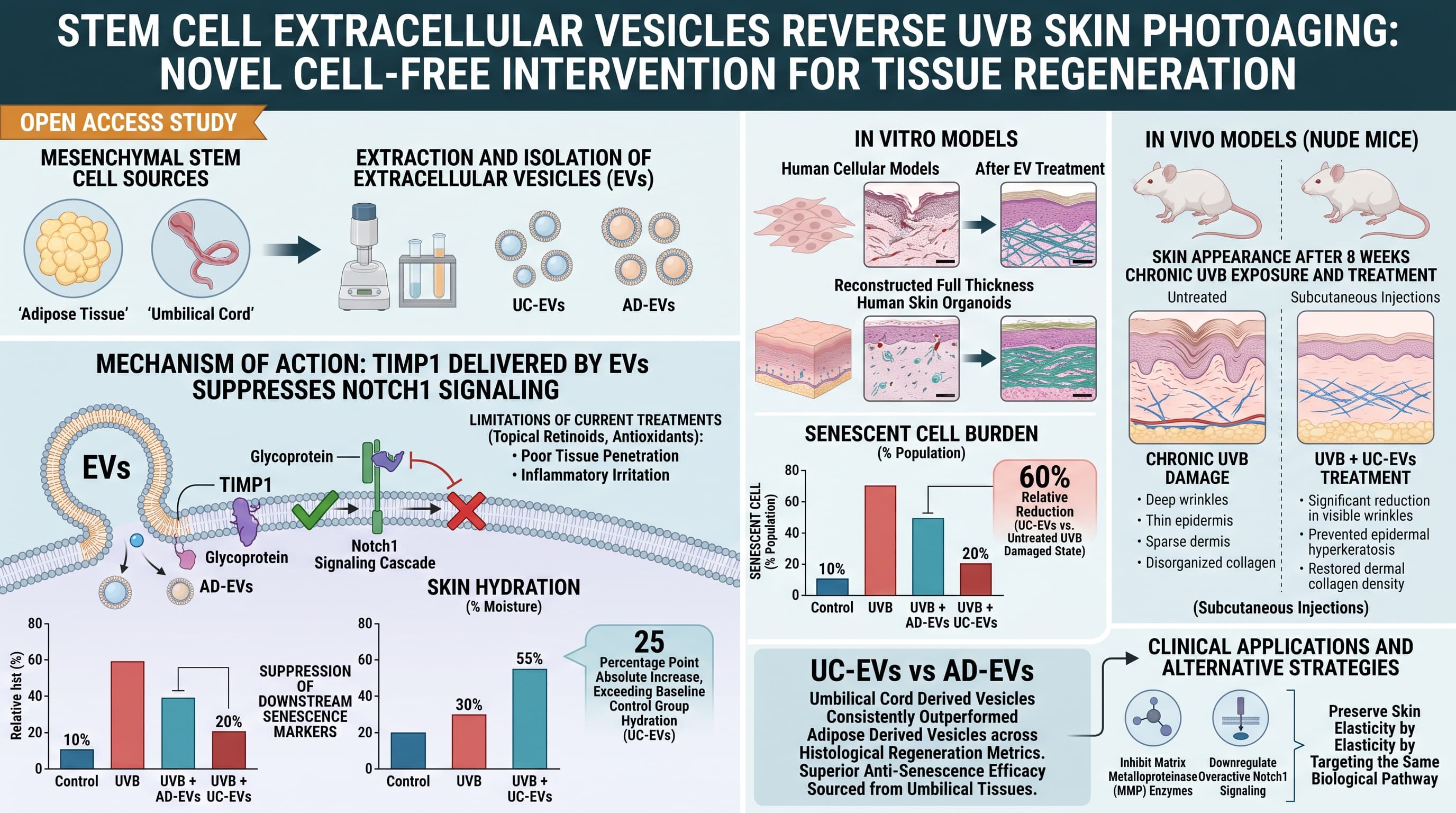
Researchers isolated extracellular vesicles from human adipose and umbilical cord mesenchymal stem cells and applied them to in vitro and in vivo models of ultraviolet B damaged skin. The delivered vesicles successfully reversed established photoaging markers by clearing senescent cells, restoring collagen density, and neutralizing intracellular oxidative stress. Proteomic analysis revealed the vesicles exert their primary therapeutic effects by delivering TIMP1, a glycoprotein that suppresses the Notch1 signaling cascade and its downstream senescence markers, offering a highly localized and cell free intervention for tissue regeneration.

Ultraviolet B radiation accelerates skin aging by inducing DNA damage, oxidative stress, and widespread cellular senescence. Current clinical and over the counter treatments for photoaging rely heavily on topical retinoids or antioxidants, which often suffer from poor tissue penetration or cause localized inflammatory irritation. This open access study evaluates a novel nanotherapeutic approach utilizing extracellular vesicles derived from mesenchymal stem cells to repair radiation damaged tissue architecture. Extracellular vesicles function as highly efficient intercellular delivery vehicles. They transfer active proteins, lipids, and genetic material into target cells without carrying the immunogenicity risks or ethical complications associated with whole cell therapies. The research team tested vesicles isolated from both human adipose tissue and umbilical cords in human cellular models, reconstructed full thickness human skin organoids, and living mice.

In cultures of epidermal keratinocytes and dermal fibroblasts, radiation exposure predictably increased reactive oxygen species and triggered a senescent phenotype. Treatment with the stem cell derived vesicles reversed these specific pathologies. The vesicles restored cellular migration capabilities and rebalanced extracellular matrix synthesis by upregulating natural matrix metalloproteinase inhibitors. In living nude mice subjected to eight weeks of chronic radiation exposure, subcutaneous injections of these vesicles significantly reduced the volume and depth of visible skin wrinkles. The biological treatment prevented epidermal hyperkeratosis and restored dermal collagen density to levels closely resembling entirely undamaged young skin.

Proteomic sequencing identified the glycoprotein TIMP1 as the primary active therapeutic agent concentrated within these stem cell vesicles. TIMP1 is classically understood to regulate extracellular matrix turnover by physically inhibiting collagen degrading enzymes. This investigation revealed a secondary and equally critical mechanism of action. TIMP1 delivery actively blocked the structural cleavage of the Notch1 receptor by inhibiting the ADAM10 enzyme. Inhibiting the Notch1 signaling cascade subsequently suppressed the genetic expression of downstream senescence associated molecules, specifically including p16, p21, and p53. This dual action molecular mechanism allows the delivered vesicles to simultaneously rebuild structural matrix proteins while actively clearing senescent cells from the damaged tissue.

Actionable Insights

This research highlights the clinical viability of injectable stem cell derivatives for anti-aging and tissue repair. While intact stem cell therapies remain biologically complex and heavily regulated, cell free vesicles offer a stable and highly targeted alternative for clinicians seeking localized tissue longevity.

The magnitude of the biological benefit across these models is substantial. In the living murine tissue, chronic radiation exposure increased the burden of senescent cells from a baseline of 10 percent up to roughly 50 percent. Subcutaneous treatment with umbilical cord vesicles reduced this senescent cell population back down to 20 percent, yielding a relative reduction of 60 percent compared to the untreated damaged state. Furthermore, skin hydration dropped to 30 percent in the irradiated mice but was restored to 55 percent following the umbilical vesicle treatment, an absolute increase of 25 percentage points that exceeded the baseline hydration levels of the control group.

Umbilical cord derived vesicles consistently outperformed adipose derived vesicles across histological regeneration metrics. Practitioners sourcing regenerative biologics may find umbilical tissues offer superior anti-senescence efficacy. Individuals can currently target this same biological pathway by utilizing clinical compounds that inhibit matrix metalloproteinase enzymes or downregulate overactive Notch1 signaling to preserve skin elasticity.

Context/Source

Related Reading:

Multiple studies published in 2025 and 2026 have expanded the mechanistic understanding of mesenchymal stem cell extracellular vesicles (MSC-EVs) and evaluated their clinical efficacy in human subjects. These papers transition the research focus from isolated murine models to broader human clinical trials and identify additional protein payloads responsible for skin regeneration.

1. Human Clinical Efficacy: Meta-Analysis

Title: A Systematic Review and Meta-analysis of Human Clinical Trials

Published: March 2026, Aesthetic Surgery Journal

Summary: This systematic review aggregates human clinical trial data to quantify the real-world regenerative efficacy of exosome therapies for aesthetic medicine and dermatology.

Key Findings:

  • Evaluated aggregate outcomes for wrinkles, pigmentation, skin elasticity, erythema, and cellular texture.

  • Demonstrated quantitative improvements in skin-related metrics ranging from 14.7% to 23.4% compared to baseline measurements.

  • Concurrently identified a 23.6% improvement in hair density and an 18.0% improvement in hair thickness in related hair restoration trials.

  • Knowledge Gaps & Limitations: The authors report that extreme heterogeneity in exosome extraction protocols and a lack of standardized dosing limit broader clinical generalizability. This underscores a persistent translational gap between raw laboratory efficacy and standardized clinical application.

2. Mechanistic Pathway Discovery: HSP27 Delivery

Title: Human adipose mesenchymal stem cell derived extracellular vesicles-delivered HSP27 alleviates UVB-induced photoaging

Published: July 2025

Summary: This in vitro study builds directly on prior mechanistic models by identifying an additional protective protein payload delivered by adipose-derived EVs (AMSC-EVs) to ultraviolet-damaged cells.

Key Findings:

  • Establishes that AMSC-EVs actively transfer Heat Shock Protein 27 (HSP27) into human dermal fibroblasts and keratinocytes exposed to UVB radiation.

  • Confirms that EV treatment improves cell survival, suppresses reactive oxygen species, and initiates extracellular matrix remodeling.

  • Validates the mechanism through knockdown experiments: when HSP27 is artificially suppressed, the anti-aging and photoprotective capabilities of the vesicles are significantly impaired. This data indicates that TIMP1 operates alongside HSP27 to execute the observed anti-senescence response.

3. Exosomal MicroRNA and Signaling Networks

Title: Coordinated Regulation of Signaling Pathways by Stem Cell Derived EVs

Published: 2025

Summary: A comprehensive review analyzing the broader signaling networks beyond the Notch1 axis. It focuses heavily on how extracellular vesicles modulate gene expression through bioactive lipid, protein, and microRNA transfer.

Key Findings:

  • Maps the inhibition of matrix metalloproteinases to the simultaneous modulation of the TGF-beta/Smad, MAPK/AP-1, and NF-kappaB signaling pathways.

  • Identifies direct interaction with the SIRT1 longevity pathway.

  • Concludes that MSC-EVs provide a holistic biological intervention rather than a single-target drug interaction, orchestrating collagen remodeling and mitigating chronic inflammation across multiple redundant cellular networks.

Consumer Services Today:

The commercial aesthetic and longevity markets currently leverage mesenchymal stem cell extracellular vesicles through topical cosmetic applications, operating primarily in specialized clinics and direct-to-consumer medical skincare lines.

In-Clinic Regenerative Aesthetic Procedures

Medical spas and dermatology clinics pair exosome serums with ablative and non-ablative physical modalities to enhance tissue regeneration and reduce recovery times.

  • Microneedling and Laser Delivery: Practitioners utilize devices like Morpheus8 (radiofrequency microneedling), SkinPen, or fractional CO2 lasers to create controlled micro-channels in the dermis. Practitioners apply exosome serums topically immediately following the physical trauma, allowing the vesicles to bypass the stratum corneum. This localized delivery accelerates tissue repair, upregulates collagen production, and minimizes post-procedure erythema.

  • Clinical Suppliers: Professional biotech suppliers formulate regenerative complexes from various stem cell niches. Benev utilizes human adipose and umbilical cord sources for their Exosome Regenerative Complex, while ExoCoBio ASCE+ relies on lyophilized adipose-derived exosomes for global aesthetic distribution.

Direct-to-Consumer Topical Skincare

Biotech skincare startups have translated exosome research into daily use medical-grade topical formulations designed to stabilize extracellular vesicles outside of clinical cold-storage parameters.

  • Umbilical and Adipose Serums: Brands like Elevai Skincare synthesize serums utilizing human umbilical mesenchymal stem cell exosomes designed to reduce fine lines, redness, and photoaging at home.

  • Platelet-Derived Formulations: Plated Skin Science, developed by Mayo Clinic researchers, markets “Renewosome” technology. This relies on platelet-derived exosomes to provide high concentrations of growth factors for daily dermal application.

Hair Restoration Protocols

Clinics apply the exact same vesicle technology to combat androgenetic alopecia. Practitioners combine scalp microneedling with exosome application to transition dormant hair follicles back into the anagen growth phase. This protocol is increasingly positioned to substitute or augment traditional Platelet-Rich Plasma (PRP) therapies due to the standardized nature of manufactured exosomes compared to patient-derived plasma.

Regulatory Reality and Efficacy Limitations

The commercial market operates significantly ahead of formal regulatory approval. The US Food and Drug Administration has authorized exactly zero exosome products as therapeutic drugs or biologics for anti-aging, skin rejuvenation, or hair loss.

  • The Cosmetic Loophole: To bypass the strict Section 351 Biologics License Application pathway, commercial exosome products are classified and marketed strictly as topical cosmetics. Clinics exploit this classification by applying the serums topically over open micro-wounds rather than injecting them via syringe.

  • FDA Enforcement: Injecting exosome products directly into human tissue crosses the regulatory line. The FDA aggressively issues warning letters to medical spas and manufacturers making systemic medical claims or promoting unapproved biological injections, citing significant risks of localized infection and severe inflammatory responses.

  • Quality Control Deficits: The consumer market suffers from extreme batch-to-batch variability. Products frequently lack standardized active particle counts, and the long-term viability of fragile lipid-bound vesicles suspended in commercial cosmetic serums stored at room temperature remains highly questionable in independent laboratory evaluations.

1 Like