A Rapamycin Relative for Your Skin: Trial Reports Gains in Firmness, Wrinkles and Glow

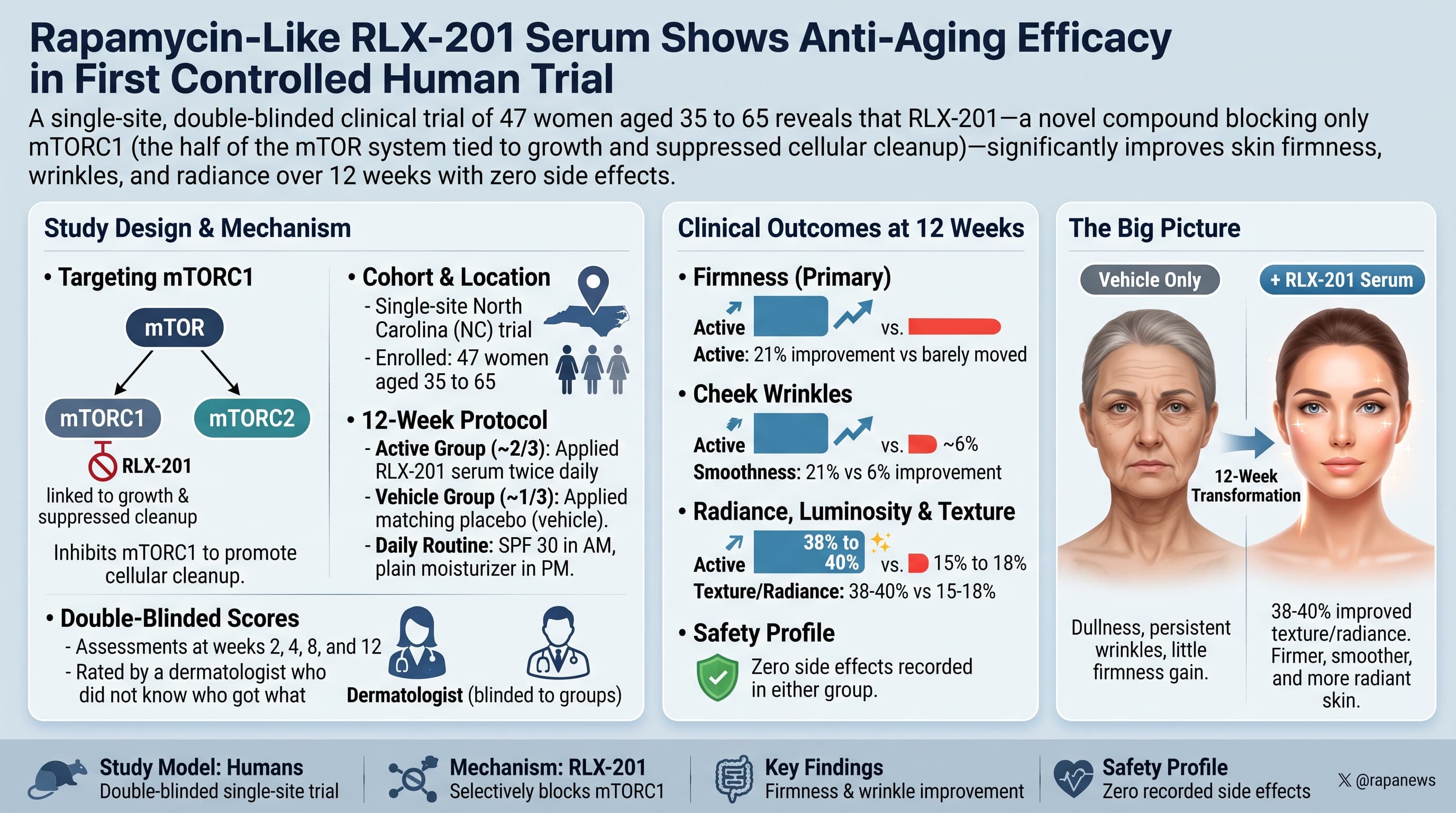
A company-run, 12-week, double-blind trial in 47 women with moderate-to-severe facial photoaging tested a serum containing RLX-201, described as a selective mTORC1 inhibitor, against a vehicle. A blinded dermatologist graded firmness 21% better than baseline in the active group versus roughly 0% for vehicle, and radiance and texture gains were about twice those of vehicle. The instrument-measured difference was much smaller, and the headline “91% mTORC1 suppression” comes from lab-grown skin, not from the participants.

For a decade, longevity researchers have wondered whether the anti-aging effects of rapamycin could be captured in skin without swallowing an immunosuppressant. A 2019 Drexel University trial hinted that they could, showing that topical rapamycin lowered a senescence marker in the hands of older adults. Now a New York company, Rapalogix Health, reports the first controlled human trial of its own compound, RLX-201, which it describes as blocking only mTORC1, the half of the mTOR system tied to growth and suppressed cellular cleanup.

The trial enrolled 47 women aged 35 to 65 at a single North Carolina site. About two-thirds applied the RLX-201 serum twice daily and the rest applied a matching vehicle. Everyone also used the same SPF 30 moisturizer in the morning and a plain moisturizer at night. A dermatologist who did not know who got what scored each face at weeks 2, 4, 8 and 12.

On the primary measure, firmness, the active group improved 21% from baseline by week 12, while the vehicle group barely moved. Cheek wrinkles improved 21% against about 6%. Radiance, luminosity and texture improved 38 to 40%, against 15 to 18% for vehicle. No side effects were recorded in either group.

Those are respectable numbers for a cosmetic, but three things temper them. First, the vehicle group’s gains show how much a consistent sunscreen and moisturizer routine achieves alone: close to half of the headline radiance and texture improvement. Second, the only objective instrument in the trial, a suction device measuring skin mechanics, showed a far narrower gap. At week 12 the active group had changed 13% and the vehicle group 7%, and the paper’s own chart does not mark that difference as statistically significant, although the text says it was. The gap was widest at week 8 and shrank afterward, which sits awkwardly with the authors’ story of steadily accumulating structural repair.

There are disclosure problems. Three of the five authors work for Rapalogix, the company holds the copyright, and the serum is already on sale, yet the paper declares no conflicts of interest. The compound’s structure and concentration are not given.

The big idea is plausible and worth pursuing. Skin is the one human tissue where a longevity drug’s effect can be watched and biopsied directly. This paper shows a serum that outperformed its base on a dermatologist’s scorecard.

Actionable Insights

What the numbers mean in practice:

  • The firmness gain was 21% of baseline on a 0 to 4 grading scale. The paper does not report baseline scores, but for a typical moderate score that is roughly half a grade or less: visible to a trained eye, modest in a mirror.
  • For radiance and texture, the active serum delivered about 22 to 24 percentage points more improvement than vehicle (roughly 39% versus 16%). Sunscreen plus moisturizer alone produced the first 15 to 18 points.
  • On the instrument reading, the advantage was 6 percentage points (13% versus 7%), and this was not clearly distinguishable from chance at week 12.
  • The paper gives no standard deviations, so a proper standardized effect size cannot be calculated. Working backward from the sample size, the true benefit could plausibly range from trivial to large.

Take-home messages:

  • Daily SPF and moisturizer are the cheapest proven part of this protocol.
  • There is no comparison with retinoids, which have decades of histological evidence, so this is not grounds to replace them.
  • The 12-week safety data are reassuring but thin.
  • You can buy and try the Rapalogix product at this site: https://www.reqhealth.com

Context and Source

  • Open Access Paper: A Novel TORC1 Inhibitor, RLX-201, Improves Skin Health, Biomechanics, and Extracellular Matrix Integrity in a Double-Blind Clinical Study
  • Institutions: Dermatology Consulting Services (High Point, North Carolina); Rapalogix Health Inc. (New York); Day Dermatology and Aesthetics (New York)
  • Country: USA
  • Journal: Journal of Cosmetic Dermatology (Wiley)
  • Impact evaluation: The impact score of this journal is 2.5, evaluated against a typical high-end range of 0 to 12+ for top dermatology journals (0 to 60+ for top general science), therefore this is a Medium impact journal within its specialty.
  • Commercial context: Rapalogix Health is a spinout from Cambrian Bio, and RLX-201 is its proprietary small molecule. The Re-Q Pro-Longevity Face Serum is reported to have launched in May 2026, which is after the paper was submitted and before it was accepted.

Related Reading:

1 Like

Biomarker Data (Effect Sizes)

The paper reports only mean percent change from baseline. It gives no baseline scores, standard deviations, confidence intervals or exact p-values. The table below shows week 12 values. Vehicle values are read off the bar charts and are approximate.

Outcome RLX-201 Vehicle Net difference (points) Marked significant vs vehicle in figure
Firmness (primary) 21% about 0% about 21 Yes
Cheek wrinkles 21% about 6% about 15 Yes
Sagging 14% about 0% about 14 Yes
Orbital elasticity 14% about 0% about 14 Yes
Tone 14% about 6% about 8 No
Radiance 39% about 15% about 24 Yes
Luminosity 38% about 17% about 21 Yes
Texture 40% about 18% about 22 Figure yes; text says weeks 4 and 8 only
Moisturization about 47% about 23% about 24 No
Elastometer viscoelastic component minus 13% minus 7% about 6 No per figure; text claims yes
pRPS6 in 3D skin models (in vitro) 91.7% reduction vs water n/a n/a n/a

How to read this:

  • Absolute size. Grades run 0 to 4. If baseline firmness averaged 2 to 3, a 21% change equals 0.4 to 0.6 of one grade. This is an estimate because baselines are not reported. [Confidence: Medium]
  • Standardized effect size. Cohen’s d expresses the group difference in units of person-to-person variability, where 0.2 is small, 0.5 medium and 0.8 large. It cannot be calculated here without standard deviations. A back-calculation is possible: with 29 versus 15 subjects, a result only reaches p of 0.05 if the observed d is about 0.64 or more. So the “significant” endpoints imply a medium-to-large observed effect, meaning a randomly chosen treated subject beat a randomly chosen vehicle subject about two times in three. [Confidence: Medium]
  • Uncertainty. At this sample size, the 95% confidence interval on d is about plus or minus 0.64. An observed d of 0.8 is compatible with a true effect anywhere from about 0.15 (barely noticeable) to 1.4 (very large). Small trials that clear the significance bar also tend to overestimate the true effect. [Confidence: High]
  • Instrument versus eye. The objective net difference (6 points) is a fraction of the graded differences (14 to 24 points). When subjective grades and instruments disagree, the instrument deserves more weight. [Confidence: Medium]
  • Time course. The elastometer gap was about 17 points at week 8 (minus 18% versus minus 1%) and fell to about 6 points at week 12. The effect faded over the final month; it did not build. [Confidence: Medium]
  • In vitro marker. Residual pRPS6 was 2.7%, 17.0% and 5.1% of water control in the three donors. From those values, the mean reduction is 91.7% with a standard deviation of 7.7 points and a 95% interval of about 73% to 100%. The suppression is large and consistent but rests on three samples. [Confidence: Medium that the formulation lowers pRPS6 in vitro; Low that RLX-201 itself is the cause]
  • Self-reports. The figures of 86% (hydration, radiance, texture), 72% (more youthful) and 90% (optimistic about the future) are given without vehicle-group numbers, so no relative risk can be calculated. They are uninterpretable as evidence of efficacy. [Confidence: High]
  • Responder rates and number needed to treat are not reported.

Mechanistic Deep Dive

  • mTORC1. The only pathway readout is phospho-S6 in reconstructed skin. There is no total S6, no 4E-BP1 or S6K readout, no dose-response, no rapamycin positive control and no cell viability assay. A 91% loss of pS6 normalized to total protein could also reflect stressed or dying tissue. [Confidence: Low that the 91% figure reflects clean target engagement]
  • Selectivity. The paper repeatedly calls RLX-201 mTORC1-selective but presents no mTORC2 readout (such as Akt S473). Selectivity rests entirely on a citation to the company’s earlier journal supplement. [Confidence: Low]
  • Wrong comparator. The in vitro control was water, not vehicle. Any ingredient in the formulation could account for the pS6 drop.
  • Autophagy, AMPK, cGAS-STING, senescence, mitochondrial dynamics. None were measured. The discussion’s claims about restored autophagy and proteostasis are inference from the pathway literature. The authors list these as future work. From a mitochondrial standpoint, there is no data at all on mitophagy, respiration or mtDNA.
  • The collagen paradox. mTORC1 drives protein translation, including collagen, and rapamycin is antifibrotic in fibroblasts. A claim that 91% mTORC1 suppression increases collagen and elastin synthesis therefore needs an indirect route, most plausibly lower senescence burden and reduced matrix-degrading SASP output. That is a reasonable hypothesis and consistent with the 2019 topical rapamycin trial, but this paper tests none of it. [Confidence: Low]
  • Kinetics. Graded firmness separated from vehicle at week 2. Dermal collagen and elastin turn over far too slowly for matrix remodeling to explain a two-week effect. Early gains more likely reflect hydration, film-forming or optical effects of the formulation. [Confidence: Medium]

Novelty

  • First vehicle-controlled human trial of a non-rapamycin compound marketed as mTORC1-selective for skin aging.
  • Adds an instrumental biomechanical endpoint, which the 2019 topical rapamycin study lacked.
  • It does not add what would matter most: in vivo evidence of target engagement. The 2019 rapamycin study, though smaller, did measure molecular markers (p16INK4A, collagen VII) in participants’ own skin. On mechanism, this paper is a step backward from that standard.

A comparison between the Rapamycin Skin study by Drexel University, and the Rapalogix Paper:

Both papers argue that turning down mTOR signaling in skin improves visible aging, but they make different central claims, support them with different kinds of evidence, and describe very different molecules. The rapamycin paper (Chung et al., 2019) shows a molecular change in participants’ own skin with weak clinical data. The RLX-201 paper (Draelos et al., 2026) shows stronger clinical data with no molecular evidence from participants. Neither paper measured mTOR activity in the skin of the people treated.

Molecule differences as described

Feature Rapamycin (Chung 2019) RLX-201 (Draelos 2026)
Identity Known, FDA-approved drug Proprietary; structure not disclosed
Target as described “The mTOR complex,” no claim of complex selectivity “Selective” mTORC1 inhibitor said to spare mTORC2
Concentration 10 micromolar (0.001%), stated Not stated
Dosing Once every 24 to 48 hours, evening Twice daily
Dose rationale Deliberately far below the 0.1 to 1% used for tuberous sclerosis, to improve cell function without blocking proliferation “Recalibrate” nutrient sensing while “preserving anabolic balance”
Degree of mTOR inhibition shown Not measured About 91% drop in pRPS6, in lab-grown skin only
Selectivity evidence in the paper None offered or claimed None; rests on a citation to the company’s earlier supplement
Systemic absorption Tested in 13 people; none detected (limit 1 ng/ml) Not tested
Vehicle DMSO-based placebo cream “Matching vehicle,” composition not stated
Regulatory framing Drug, investigational use Marketed cosmetic serum

Points worth noting:

  • The RLX-201 paper’s main differentiation is that broad mTOR inhibition may hit mTORC2 and disrupt epidermal homeostasis. It does not name rapamycin as the broad inhibitor, and it presents no head-to-head or mTORC2 data. [Confidence: High]
  • There is a tension in the dosing logic. Chung argues for gentle, partial inhibition. Draelos argues for preserving anabolic balance but reports near-complete (91%) suppression of the mTORC1 marker. Those two positions are hard to reconcile. [Confidence: Medium]
  • Chung calls its dose “ten-fold lower” than tuberous sclerosis preparations, but 0.001% against 0.1 to 1% is 100 to 1,000 times lower.
  • Outside these two papers: rapamycin is generally regarded as mTORC1-preferring with short exposure, with mTORC2 effects emerging under chronic exposure. If that holds in skin, the practical selectivity advantage of RLX-201 at low topical doses is unproven. [Confidence: Medium]

Key claims compared

Dimension Rapamycin (Chung 2019) RLX-201 (Draelos 2026)
Central claim Reduces cellular senescence in human skin Improves skin biomechanics and matrix integrity via mTORC1 suppression
Primary endpoint p16INK4A protein in biopsies (molecular) Dermatologist-graded firmness and elasticity (clinical)
Skin layer emphasized Epidermis and basement membrane Dermal extracellular matrix
Structural protein Collagen VII protein up (scored 1 to 4, n = 6) Collagen and elastin “increased” (qualitative images, 6 participants)
Proposed mechanism Fewer cells entering senescence; possible autophagy-assisted collagen processing Restored proteostasis and autophagy leading to matrix remodeling
Onset of visible change About 4 months 2 weeks
Duration 6 to 8 months 12 weeks
Site Back of hands Face
Design Within-person: one hand drug, one hand placebo Parallel groups: 31 active, 16 vehicle
Enrolled / analyzed 36 enrolled, 17 completed, 8 biopsies usable 47 enrolled, 44 completed
Clinical result About 0.6 to 0.7 grade better on 0 to 4 scales 21% firmness gain versus about 0% for vehicle
Self-description “Exploratory” “Translational evidence”

Where the evidence differs

In-participant molecular data

  • Chung has it: p16-positive nuclei fell from roughly 3% to about 1.3% in the treated hand (P = 0.008), though in only 8 people.
  • Draelos does not: the mTORC1 readout came from three lab-grown skin models compared against water.
  • Neither measured pS6 or any direct mTOR marker in participant biopsies. Chung’s senescence finding is a downstream consequence; Draelos’s pS6 finding is an upstream event in a dish. Each paper is missing the other one’s half of the causal chain. [Confidence: High]

Clinical data

  • Draelos is stronger here: explicitly blinded grader, low dropout, an instrument measure, face as the target site.
  • Chung is weaker: 53% dropout, assessor blinding not described, and borderline statistics (P = 0.03, 0.04 and 0.07 across the three scales).
  • Chung publishes every subject’s scores, which allows checking. From its Table 2, the treated hand scored better in 11 of 16 on the hand grading scale, 12 of 16 on wrinkling, and 9 of 16 on pigmentation. Draelos gives no individual data, baselines or variances. The table lists 16 subjects, while the text refers to 13 and 17 completers.

Internal consistency

  • Chung: collagen VII mRNA went down while protein went up, explained after the fact as feedback. Abstract and figure give slightly different P values.
  • Draelos: text and figures disagree on whether the instrument result beat vehicle at week 12, and group sizes differ between text and table.

Time course

  • A 2-week onset (Draelos) and a 4-month onset (Chung) are not easily explained by the same biology. Senescent cell reduction and basement membrane changes plausibly take months. A 2-week firmness change more likely reflects formulation effects than matrix remodeling. [Confidence: Medium]

Transparency

  • Chung: trial registered (NCT03103893), public and university funding, authors’ shareholding in Boinca Therapeutics disclosed.
  • Draelos: no registration cited, no funding statement, three company-employed authors, and a declaration of no conflicts.

Summary

  • The two papers do not test the same hypothesis. Chung asks whether low-dose rapamycin lowers senescence markers in skin. Draelos asks whether a branded serum improves graded appearance and mechanics.
  • Draelos cites Chung for the general point that mTORC1 hyperactivation drives aging phenotypes, but Chung’s actual finding (lower p16, higher collagen VII) is neither replicated nor tested in the RLX-201 trial.
  • The claimed advantage of RLX-201 over rapamycin, selectivity, is asserted and not demonstrated in either paper.
  • Rapamycin has the advantage of a known molecule, known dose, measured absence of systemic exposure and in vivo marker data. RLX-201 has the advantage of a cleaner, better-retained clinical trial on the face.
  • A trial that would settle the comparison would put both compounds and a vehicle side by side, with biopsies stained for pS6, an mTORC2 marker and p16. Neither paper comes close to that.

References

  1. Draelos ZD, Mehta RC, Jha M, Day D, Randhawa MK. A Novel TORC1 Inhibitor, RLX-201, Improves Skin Health, Biomechanics, and Extracellular Matrix Integrity in a Double-Blind Clinical Study. Journal of Cosmetic Dermatology. 2026; 25:e71219. https://doi.org/10.1111/jocd.71219
  2. Chung CL, Lawrence I, Hoffman M, et al. Topical rapamycin reduces markers of senescence and aging in human skin: an exploratory, prospective, randomized trial. GeroScience. 2019; 41:861-869. Topical rapamycin reduces markers of senescence and aging in human skin: an exploratory, prospective, randomized trial | GeroScience | Springer Nature Link

More Details on RLX-201

No public source states the RLX-201 concentration, so the figure below is an inference. The search did turn up the molecule’s identity, which neither paper discloses: RLX-201 is itself a rapamycin analog. That changes the molecule comparison.

What RLX-201 is

  • Retail ingredient lists for the serum name it as Dioxothiazetidinyl Demethoxyrapamycin (RLX-201). In plain terms, it is rapamycin with one methoxy group replaced by a four-membered cyclic sulfonamide ring. skinfoShopbostonskinclub
  • A forum summary of the company’s 2025 paper says that paper also describes RLX-201 as a dioxothiazetidinyl derivative of rapamycin. I could not open the full text (paywalled) to confirm. rapamycin
  • Novartis rapalog patents describe rapamycin derivatives carrying exactly this ring (1,1-dioxido-1,2-thiazetidin-2-yl) at the C16 position. usptouspto
  • Cambrian licensed selective mTOR compounds from Novartis in February 2022, and Rapalogix says its approach builds on Cambrian’s TORnado platform, from which it was spun out. 1stoncologyBioSpace
  • My inference: the substitution is at C16, giving a molecular weight of roughly 975 to 990, against 914 for rapamycin. The INCI name does not say whether the C32 ketone is also removed, as it is in the Novartis examples.

[Confidence: High that RLX-201 is a rapalog; Medium that the change is at C16]

Concentration in the serum

Where I looked without finding a number:

  • The Draelos paper, the company’s product and science pages, and retailer listings.
  • The Novartis compound patent. It lists topical administration only as one possible route, with no weight-percent range. google
  • Patent searches for a Rapalogix formulation filing. None surfaced. Applications publish about 18 months after filing, so a 2025 filing may not be visible yet. The company site calls the molecule patented, while a company database profile calls it patent-pending. reqhealthDealroom.co

Indirect clues:

Clue What it implies
Label position: 8th, right after the emulsifier and solvent base, ahead of the botanicals and hyaluronate US rules require descending order only above 1%. This is the usual spot for a featured active at the head of the sub-1% block. Upper bound about 1%.
Cell potency: reported fibroblast effects at 10 nM, with assays up to about 1 micromolar (secondary summary) Topicals usually need 100 to 10,000 times the cellular concentration to cross skin, which points to micromolar to low-millimolar product levels.
Rapamycin precedent: 0.001% in Chung; 0.003 to 0.015% reported effective for facial angiofibromas; 0.1 to 1% for tuberous sclerosis The company’s “recalibrate, not suppress” positioning matches the low-dose end.
Exposure: 1 fl oz bottle, 1 to 2 pumps twice daily, refills offered every 4 to 8 weeks, so about 0.5 to 1 mL per day At 0.01% that is 50 to 100 micrograms a day. At 0.1% it is 0.5 to 1 mg a day, which in applied-dose terms approaches weekly oral rapamycin longevity dosing. That is unlikely for a cosmetic with no absorption data.
Cost: a custom semi-synthetic macrolide (the patent’s bench-scale yields are around 10%) Favors small amounts per bottle.

My estimate:

  • Most likely range: about 0.001% to 0.02% by weight, roughly 10 to 200 micromolar. [Confidence: Low]
  • Above 0.1%: unlikely. [Confidence: Medium]
  • Below 1%: very likely. [Confidence: Medium-High]

To pin it down, ask the corresponding author directly, or have a lab run HPLC-UV near 278 nm against a sirolimus standard. The triene that gives rapamycin its UV signature should be intact in this analog, so that would give a usable molar estimate.

Molecule differences

Feature Rapamycin (Chung 2019) RLX-201 (Draelos 2026, plus search findings)
Class Natural macrolide, FDA-approved drug Semi-synthetic rapamycin analog, sold as a cosmetic ingredient
Structure Disclosed, MW 914 Not in the paper; INCI name indicates a cyclic sulfonamide replacing a methoxy group
Target as described “mTOR complex,” no selectivity claim Selective mTORC1 inhibitor that spares mTORC2
Selectivity evidence None offered None in the 2026 paper; the 2025 paper reports cell-culture data only
Concentration 10 micromolar (0.001%), stated Not stated; estimated 0.001 to 0.02%
Dosing Every 24 to 48 hours Twice daily
Systemic absorption Tested, none detected Not tested
mTOR inhibition shown Not measured About 91% pRPS6 drop, lab-grown skin only
Price Generic $259 per ounce

Notes on selectivity:

  • The company’s 2025 paper reports that RLX-201 inhibited mTORC1 without suppressing mTORC2 in fibroblasts, unlike high-dose rapamycin, which reduced both. A secondary summary says everolimus was also a comparator and that the work used cells from two donors. ResearchGaterapamycin
  • That comparison is against high-dose rapamycin. Chung deliberately used a very low dose, so an advantage over low-dose topical rapamycin has not been shown. [Confidence: High]
  • The Novartis patent offers a rationale for the chemistry. It says rapamycin is hard to formulate stably, and that swapping the C16 methoxy for a cyclic amine, amide or sultam gives a balance of potency, stability and bioavailability. It also says a less potent rapalog can be desirable for achieving only partial mTORC1 inhibition. googlegoogle

Key claims differences

Dimension Chung 2019 Draelos 2026
Central claim Lowers cellular senescence in skin Improves biomechanics and matrix integrity via mTORC1 suppression
Primary endpoint p16INK4A in biopsies Dermatologist-graded firmness
Molecular evidence in participants Yes: p16 fell (P = 0.008, n = 8); collagen VII rose None; pRPS6 measured in three lab-grown skin models against water
Clinical evidence Weak: 53% dropout, about 0.6 to 0.7 grade gain Stronger: 6% dropout, firmness up 21% versus about 0% for vehicle
Skin layer Epidermis and basement membrane Dermal matrix
Onset About 4 months 2 weeks
Design Split-body, hands, 6 to 8 months Parallel groups, face, 12 weeks
Transparency Registered; funding and shareholdings disclosed No registration; “no conflicts” despite company authors

In summary:

  • Chung shows a biological change in treated people with thin clinical data. Draelos shows a better clinical result with no biological confirmation in treated people.
  • Neither measured mTOR activity in participants’ skin, and neither tested mTORC2.
  • The two-week onset in Draelos does not fit the months-long timeline of senescence and matrix change seen in Chung.

Findings that affect how to read the Draelos paper

  • The “novel TORC1 inhibitor” is a close chemical relative of rapamycin, so the two papers compare a parent drug with its analog, not two drug classes.
  • The serum contains other actives. The ingredient list includes tetrahydrocurcumin, an Artocarpus wood extract, Sophora extract, cress sprout extract, sodium hyaluronate and synthetic fluorphlogopite, the last being a light-reflecting mineral. The paper does not say whether the vehicle contained them. If it did not, the radiance and tone gains, and the pRPS6 drop measured against water, cannot be attributed to RLX-201 alone. [Confidence: Medium] skinfo
  • Reference 13 in Draelos gives the wrong journal. The 2025 paper appeared in Dermatologic Surgery 51(9S): S33–S37, not the Journal of Drugs in Dermatology. rapamycin
  • The company site describes the trial as n = 45; the paper reports 47 randomized and 44 completers. reqhealth

Sources: