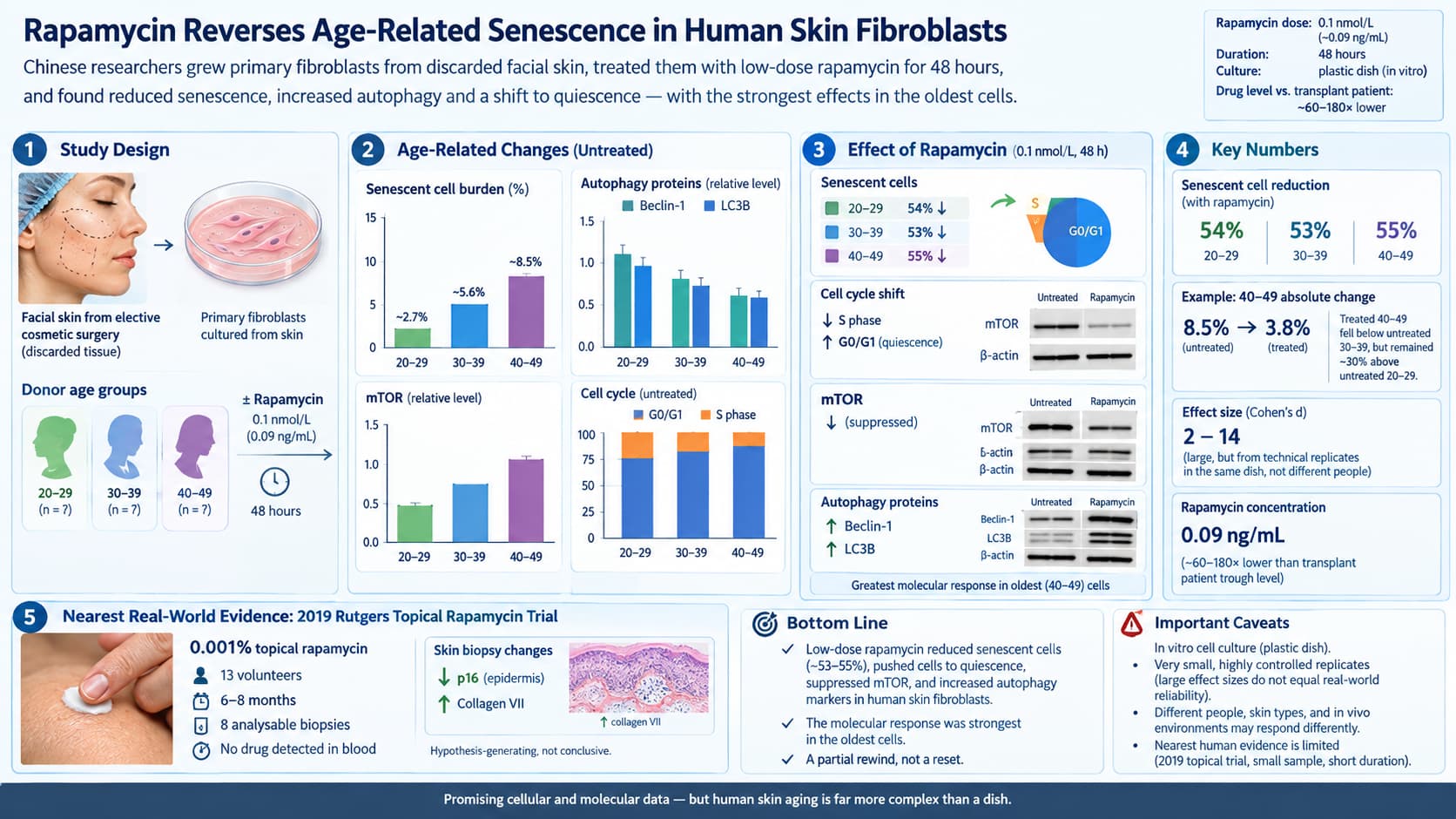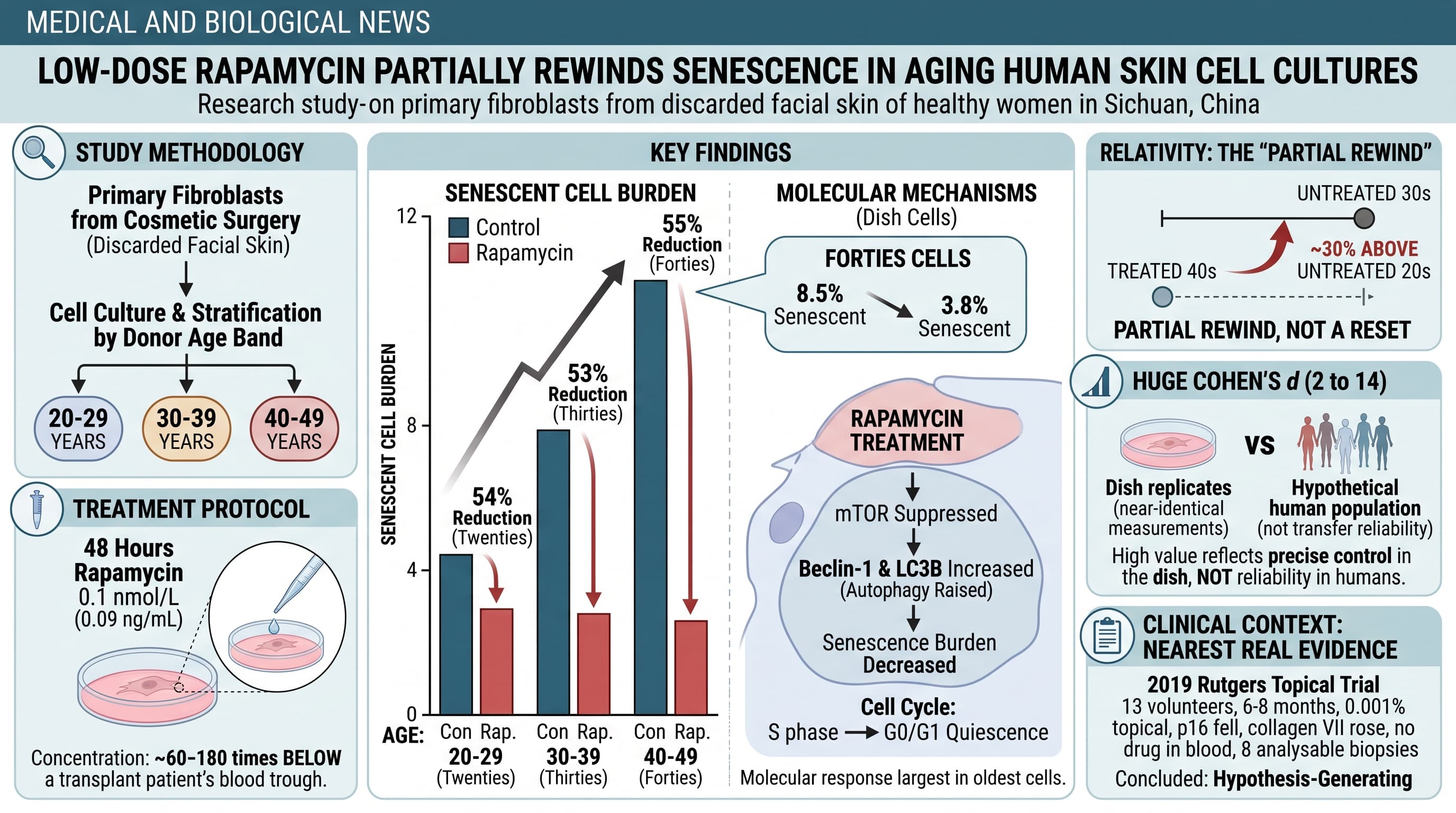
A new preprint study demonstrates that ultra-low concentrations of rapamycin can alleviate cellular senescence in human facial skin fibroblasts cultured in vitro. Researchers in Sichuan, China grew primary fibroblasts from facial skin discarded during elective cosmetic surgery on healthy women, stratified the cell lines into three donor age bands (20 to 29, 30 to 39, 40 to 49), and treated them for 48 hours with rapamycin at 0.1 nmol/L, a concentration roughly 60 to 180 times below a transplant patient’s blood trough. Senescent cell burden rose steeply with donor age while autophagy proteins fell and mTOR rose. Rapamycin cut senescent cells by about half in every age band, and suppressed mTOR. The molecular response was largest in the oldest cells. This is an unreviewed preprint.
Rapamycin has spent two decades as the most reliable life-extending drug in mammals and most of what we know about its effect on human skin cells comes from experiments where scientists first poison the cells with hydrogen peroxide or blast them with ultraviolet light, then show that rapamycin rescues them. That is a model of injury, not a model of getting older.
A group based in Sichuan has taken a different route. They collected facial skin discarded during eyelid surgery and facelifts from healthy women, grew the fibroblasts out of the dermis, and sorted the resulting cell lines by the decade of the donor. No poison, no radiation. Just cells that had aged the ordinary way, inside people.
The picture they found is the one textbooks predict but rarely show in a single experiment. As donor age rose, so did the fraction of cells staining positive for senescence, roughly tripling from the twenties group to the forties group. The recycling machinery ran the other way. Beclin-1 and LC3B, two proteins that build the vesicles cells use to digest their own damaged parts, fell by about 40 percent in the oldest cells. mTOR, the growth-signalling hub that suppresses that recycling, climbed.
Then they added rapamycin, at a dose easy to misread. One tenth of a nanomole per litre works out to roughly 0.09 nanograms per millilitre, somewhere between sixty and one hundred and eighty times lower than the blood concentration a transplant patient carries. At that dose the cells did not die or visibly stall. What changed was their character. Senescent cells dropped by about half in every age group. The cells stopped pushing into DNA replication and settled into a quiet resting state. Autophagy markers climbed.
The finding the authors care most about is that the oldest cells responded most strongly. In fibroblasts from women in their forties, LC3B protein tripled. Beclin-1 protein, which barely moved in the younger cells, rose by two thirds. The authors link this to the approach of perimenopause, when falling oestrogen may shift the same growth-signalling pathway rapamycin targets. They measured no hormones, so that link is a story told about the data rather than a result in it.
What the work supplies is a dose-response argument for the small group of dermatologists already testing rapamycin as a cream. It suggests that if the drug works in skin, it may work at concentrations far below anything with systemic consequences, and that the people most likely to notice are those whose cells have drifted furthest from baseline.
Actionable Insights
The concentration tested was about 0.09 nanograms per millilitre and the experiment ran 48 hours in a plastic dish.
On magnitude: senescent cell burden fell 54 percent in twenties cells, 53 percent in thirties cells, and 55 percent in forties cells. In absolute terms the forties cells went from about 8.5 percent senescent to about 3.8 percent. Treated forties cells ended up below where untreated thirties cells started, though still about 30 percent above untreated twenties cells. A partial rewind, not a reset.
The statistical effect sizes are enormous in a way that should prompt suspicion rather than excitement. A Cohen’s d above 0.8 is conventionally called large. These run from 2 to 14. That happens when you compare three near-identical replicate measurements, not three different people. The number reflects how tightly controlled the dish was, not how reliably this transfers to a human face.
The nearest real evidence remains the 2019 Rutgers trial of 0.001 percent topical rapamycin: 13 volunteers, six to eight months, p16 fell in the epidermis, collagen VII rose, no drug detectable in blood, eight analysable biopsies.
Bottom line. The direction of the findings is consistent with a large prior literature and is probably real. The specific magnitudes, the age-dependence claim, and the mechanism are not established by this dataset.
Context and Source
- Open Access Preprint paper: Rapamycin Alleviates Age-Related Senescence in Human Facial Dermal Fibroblasts by Modulating Autophagy
- Institutions: School of Stomatology, Southwest Medical University (Luzhou, Sichuan); Department of Medical Cosmetology and Department of Oral and Maxillofacial Surgery, Suining Central Hospital (Suining, Sichuan); Bohao Stomatology (Guiyang, Guizhou); School of Stomatology, Zunyi Medical University (Zunyi); University of Electronic Science and Technology of China (Chengdu and Guangdong).
- Country: China.
-
Publication: Research Square preprint server.
Impact evaluation: The impact score of this venue is 0, because Research Square is a preprint server and carries no Journal Impact Factor.
Related Reading:
- DIY Rapamycin skin cream
- Rapamycin May Slow Skin Aging (Drexel U. Study)
- Oral vs Topical Rapamycin for Skin Benefits?
- A New Rapalog for Skin Aging: Rapalogix Health RLX-201
- Rapamycin - Increased Skin Sun Sensitivity and Skin Cancer Risks
- Rapamycin Protects Mouse Skin from Ultraviolet B-Induced Photodamage