FGF21: The Hormone That Predicts Early Death in Humans and Extends Life in Mice
RapAdmin
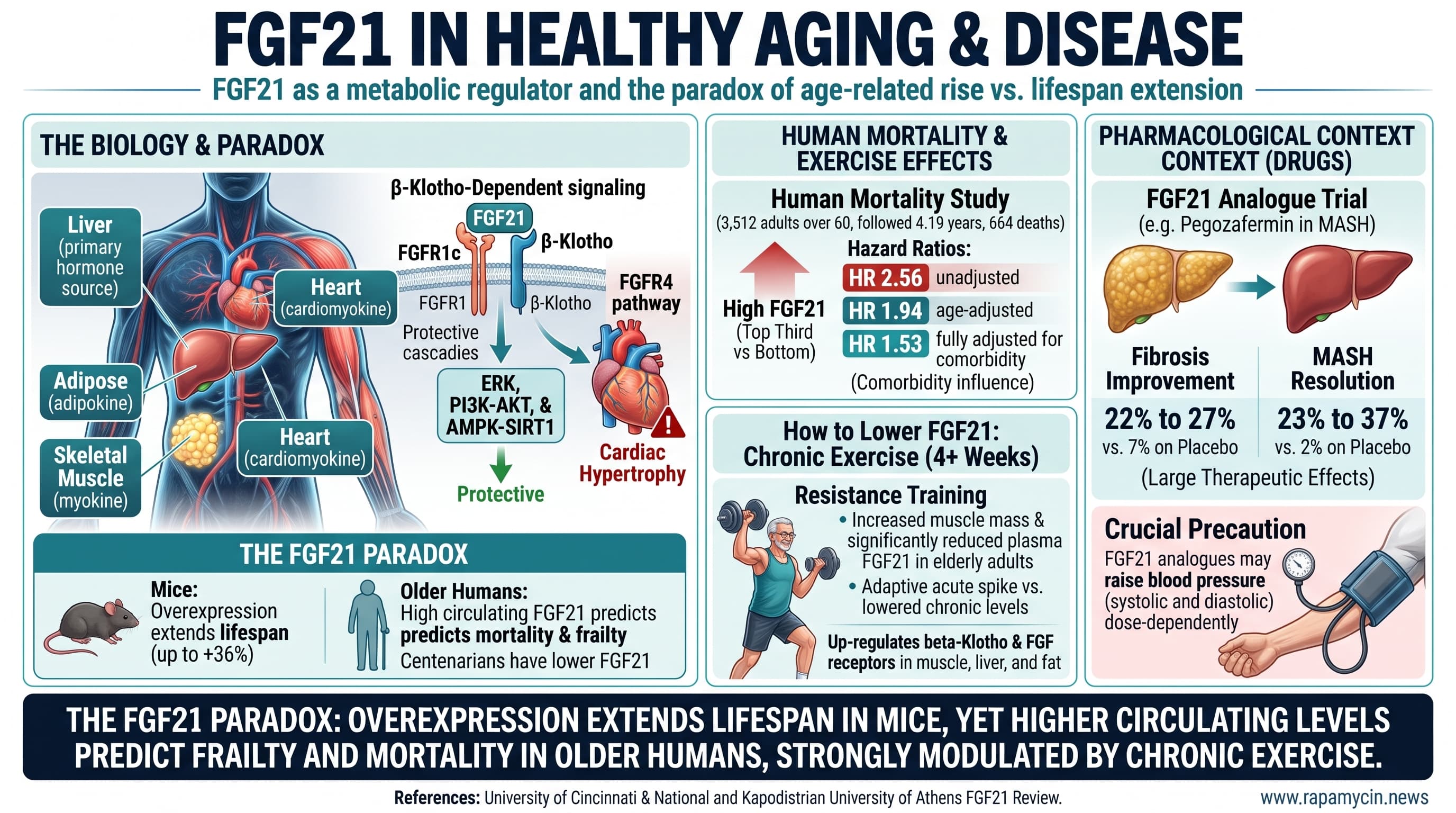
This narrative review from the University of Cincinnati and the National and Kapodistrian University of Athens examines fibroblast growth factor 21 across healthy aging and age-related disease. FGF21 is a liver-derived hormone that also acts as an adipokine, myokine, and cardiomyokine, signaling through FGFR1c paired with the co-receptor beta-Klotho to activate ERK, PI3K-AKT, and AMPK-SIRT1 pathways. The review’s organizing problem is a genuine paradox: higher circulating FGF21 predicts mortality and frailty in older humans and is lower in disease-free centenarians, while FGF21 overexpression extends lifespan in mice. The authors propose that effects depend on duration of exposure, tissue of origin, and which receptor complex forms, with beta-Klotho-dependent signaling protective and FGFR4 signaling driving cardiac hypertrophy.
The same hormone looks protective in mice and lethal in humans, and this review is an attempt to work out why.
FGF21 is a starvation signal. The liver makes it when nutrients are short, and it tells the body to burn fat, improve insulin sensitivity, and shift into a conservation mode. It is also what is called a mitokine, a molecule released when mitochondria are under stress, which puts it in the same family as GDF15. Levels climb steadily in human blood from age 5 to 80 regardless of body composition.
On the human side the picture is bleak. In the Polsenior2 study of 3,512 Polish adults over 60, people in the top third of FGF21 had roughly double the death rate of the bottom third over four years. FGF21 tracks with frailty, with insulin resistance, with cachexia in people over 60, with lower bone mineral density, and with weaker grip strength. Disease-free centenarians have less of it circulating than healthy people in their seventies. Every human association points one direction.
On the mouse side the opposite. Transgenic mice overexpressing FGF21 in the liver live substantially longer. Mice given the gene in fat tissue while eating a high-fat diet live longer than their littermates. A single dose of gene therapy delivered to muscle in old mice extended life expectancy by about a fifth. Protein restriction extends mouse lifespan and stops working if you delete FGF21.
The authors’ resolution has three parts and it is the most useful thing in the paper.
Duration matters. Acute FGF21, the kind you get from a hard workout or a short fast, drives mitochondrial adaptation. Chronic elevation, the kind you get from aging or persistent mitochondrial damage, drives muscle atrophy. In cardiac tissue the authors put a number on it: benefit for about two weeks and not after.
Tissue of origin matters independently of the level in blood. Liver and fat overexpression extends lifespan. Cardiomyocyte-derived FGF21 promotes hypertrophy even when circulating levels are unchanged.
And the receptor matters most. FGF21 needs a co-receptor called beta-Klotho to signal through FGFR1c, and that pairing is the protective route. When beta-Klotho is scarce, FGF21 signals instead through FGFR4, which drives the heart toward thickening. Aging and metabolic stress both reduce beta-Klotho, partly through a protease called ADAM-10 that chews it up. So aging does not stop FGF21 signaling. It reroutes it down the harmful path.
That framework makes a sharp prediction. High endogenous FGF21 in an older person is a stress alarm firing in a body that has lost the receptor needed to respond to it usefully. Giving a drug version is a different act entirely, which is why FGF21 analogues clear liver fibrosis in trials while natural elevation predicts death.
The review reports two mouse lifespan figures incorrectly, and both errors run in the same direction.
Actionable Insights
Read your own FGF21, if you ever measure it, as an alarm rather than a cause. Nothing in this literature supports trying to raise it.
The human mortality numbers. In 3,512 adults over 60 followed 4.19 years with 664 deaths, each standard deviation of higher FGF21 carried a 34 percent higher death rate unadjusted and 24 percent after age adjustment. Comparing the top third to the bottom third, the hazard ratio was 2.56 unadjusted, 1.94 age-adjusted, and 1.53 after full adjustment for comorbidity. The middle third was not significantly different from the bottom after full adjustment, so this looks like a top-end threshold rather than a smooth gradient, and the drop from 2.56 to 1.53 means much of the raw association was comorbidity.
What lowers it, with numbers. Long-term exercise training of four weeks or more reduces circulating FGF21 while increasing FGF receptor and beta-Klotho expression in muscle, liver, and fat. In adults aged 62 to 70, resistance training increased muscle mass and decreased plasma FGF21. In elderly people with and without type 2 diabetes, resistance training significantly reduced FGF21 in both groups. Acute exercise raises it transiently, which is the adaptive signal; training lowers the chronic level. One study found the response depends on metabolic status: 10 weeks of resistance exercise lowered FGF21 in women with metabolic syndrome and raised it in women without.
What the drugs do, for context. Pegozafermin in 222 patients with MASH over 24 weeks produced fibrosis improvement in 22 to 27 percent against 7 percent on placebo, and MASH resolution in 23 to 37 percent against 2 percent. Those are large effects. One FGF21 analogue also raised systolic and diastolic blood pressure dose-dependently in humans.
The practical read: train for strength, which raises FGF21 acutely and lowers it chronically, and treat a high resting level as information about mitochondrial and metabolic stress rather than a target to push.
Context and Source
- Open Access Paper: Fibroblast growth factor 21 (FGF21) in healthy aging and aging-related diseases., published October 26, 2026.
- Institutions: First Department of Cardiology, National and Kapodistrian University of Athens, Greece; Metabolic Biology Laboratory, Cardiovascular Center, Department of Biomedical Sciences, University of Cincinnati College of Medicine.
- Countries: Greece and the United States.
- Journal: Geromedicine, volume 3
- Impact evaluation: this journal has no impact factor. Geromedicine launched in May 2025 under Science Exploration Press, a Singapore-headquartered publisher that is a regular member of the STM Association and lists 14 journals. Two mitigating facts should be weighed against that. The editor-in-chief is Guido Kroemer, with Andrea Maier and Hans Meij as deputy editors, which is a serious geroscience board, and the author list here includes the leadership of LonGenity, BLSA, and the Stanford organ-clock group. This is credible work placed in a venue with no track record.