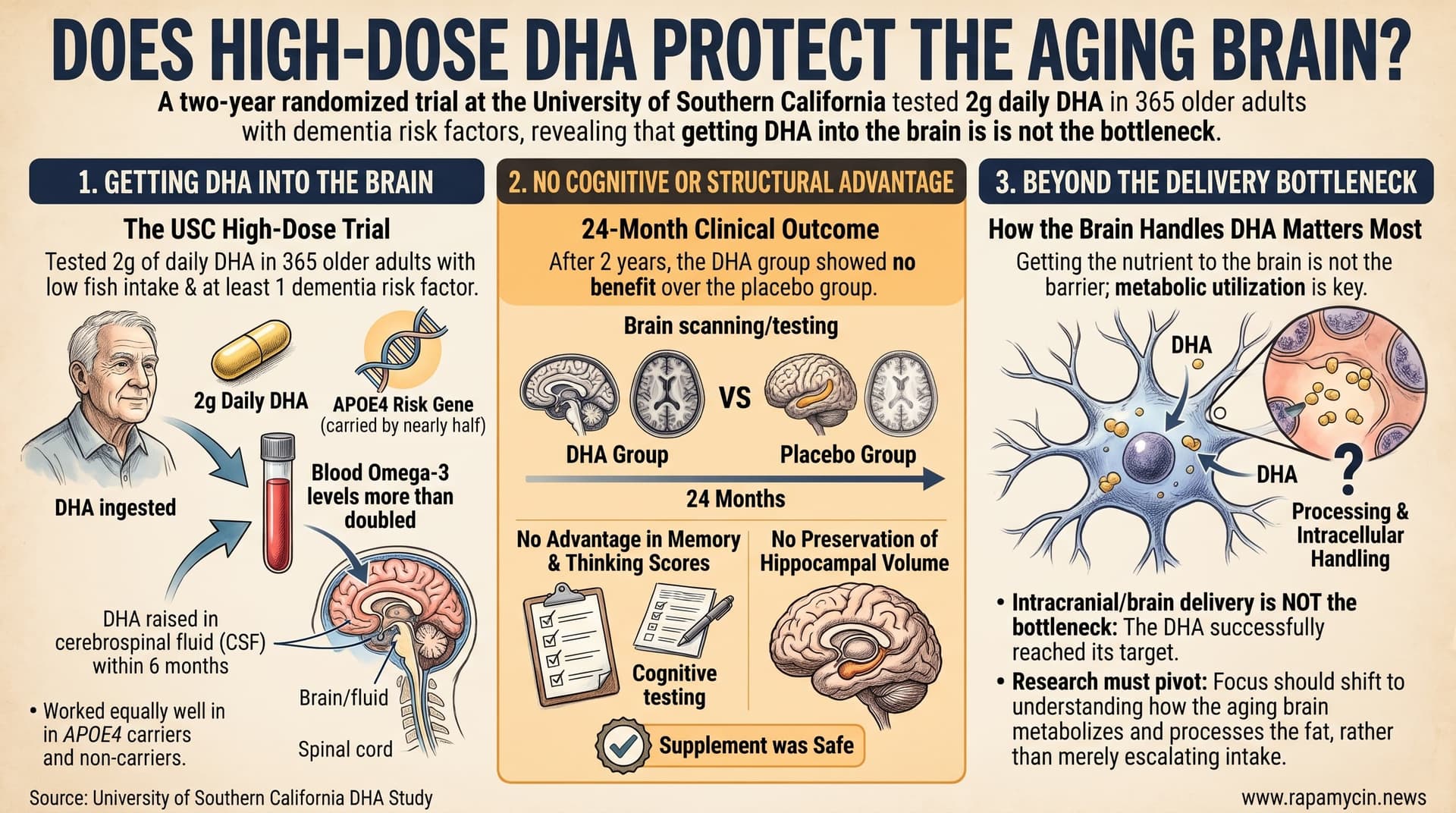
A two-year randomized trial at the University of Southern California tested whether a high daily dose of the omega-3 fat DHA could reach the brain and protect it in 365 older adults who ate little fish and had at least one dementia risk factor. Nearly half carried APOE4, the strongest common genetic risk factor for Alzheimer’s disease. Two grams of DHA per day raised DHA in the fluid surrounding the brain and spinal cord within six months, and it worked as well in APOE4 carriers as in non-carriers. Blood omega-3 levels more than doubled. Yet after 24 months, the DHA group showed no advantage over placebo in memory and thinking scores or in hippocampal volume. The supplement was safe. The authors conclude that getting DHA into the brain is not the bottleneck and that how the brain handles DHA matters more.
For two decades, omega-3 research on the aging brain has run into the same wall. Observational studies keep finding that people with more DHA in their blood hold on to their memories longer. Randomized trials keep coming back empty. One persistent explanation was that capsules simply weren’t getting enough DHA into the brain, especially in people carrying APOE4, a gene variant that speeds DHA breakdown and raises Alzheimer’s risk.
The PreventE4 trial was designed to test that explanation directly. Researchers enrolled 365 adults aged 55 to 80 with normal cognition, very low fish intake (a median under 90 mg of DHA a day, a fraction of what one serving of oily fish provides), and at least one risk factor such as high blood pressure, obesity, high cholesterol or a sedentary lifestyle. Almost half carried APOE4. Volunteers took either 2 grams of DHA daily or a corn and soybean oil placebo for two years. About half agreed to spinal taps, which let the team measure DHA in cerebrospinal fluid, the most practical window into brain chemistry in living people.
On that first question, the answer was clear. After six months, the ratio of DHA to arachidonic acid, a competing omega-6 fat, rose sharply in the spinal fluid of supplemented volunteers and stayed flat on placebo. By any statistical yardstick the shift was very large. APOE4 carriers responded as well as non-carriers, which contradicts the team’s own starting hypothesis and an earlier, smaller study from the same lab. In blood, the omega-3 index climbed from about 5 percent to about 11 percent, well above the 8 percent level often cited as a cardiovascular target.
Then came the outcomes that matter to patients. Over 24 months, the hippocampus, the memory hub that shrinks early in Alzheimer’s disease, lost volume slowly and to the same degree in both groups. Scores on a standard cognitive battery rose a few points in both groups, most likely because people get better at tests they repeat, and the difference between DHA and placebo was essentially zero. The margin of uncertainty was tight enough to rule out anything more than a small benefit on the overall score.
The authors frame this as a redirection, not a dead end. If DHA arrives but nothing changes, the problem may lie downstream. One candidate is an enzyme, calcium-dependent phospholipase A2, that is overactive in APOE4 brains and can strip DHA from membranes before it does useful work. Another possibility is that a group this healthy, with almost no measurable decline, gives any treatment little to rescue in two years.
There are real caveats. More than a third of participants dropped out, and those who left differed from those who stayed. Several planned outcomes, including blood Alzheimer’s markers, are missing from the main paper.
The practical message is plain. DHA supplements reliably raise omega-3 levels in blood and brain fluid, but on their own they are unlikely to protect memory in healthy older adults over the short term.
Actionable Insights
- If you rarely eat fish, 2 g/day of DHA will very likely transform your omega-3 status. The red blood cell omega-3 index rose about 6 percentage points more than placebo, more than doubling it from baseline. In spinal fluid, the DHA-to-omega-6 ratio rose roughly 40 percent. The effect size for that change (Cohen’s d of 1.6, where 0.8 already counts as “large”) means the typical supplemented person ended up higher than about 95 percent of the placebo group.
- Don’t expect DHA alone to sharpen memory or slow brain shrinkage over two years if you are cognitively healthy. The cognitive difference was 0.09 points on a scale where 15 points equals one standard deviation, an effect size near zero. Hippocampal differences were around 0.2 percent of total volume, with uncertainty spanning small harm and small benefit.
- APOE4 carriers absorbed DHA into spinal fluid as well as non-carriers. Genotype is not a reason to skip omega-3s, and also not a reason to expect special benefit.
- Safety at 2 g/day was reassuring, with fewer gut complaints than placebo.
- The authors point toward multimodal approaches (exercise, blood pressure and metabolic control) as the more promising lever.
Context and Source
- Open Access Paper: CNS target engagement of high-dose DHA supplementation in older adults at risk for dementia: a randomised, double-blind, placebo-controlled trial, published18 June 2026
- Institution: Keck School of Medicine and Alfred E. Mann School of Pharmacy, University of Southern California, Los Angeles
- Country: United States
- Journal: eBioMedicine (part of The Lancet Discovery Science, Elsevier),
- Impact evaluation: eBioMedicine’s 2023 Journal Impact Factor was 9.7, with more recent listings placing it between roughly 10 and 11 and a CiteScore of about 15. The impact score of this journal is approximately 10 (JIF), evaluated against a typical high-end range of 0 to 60+ for top general science and medicine, therefore this is a High impact journal.