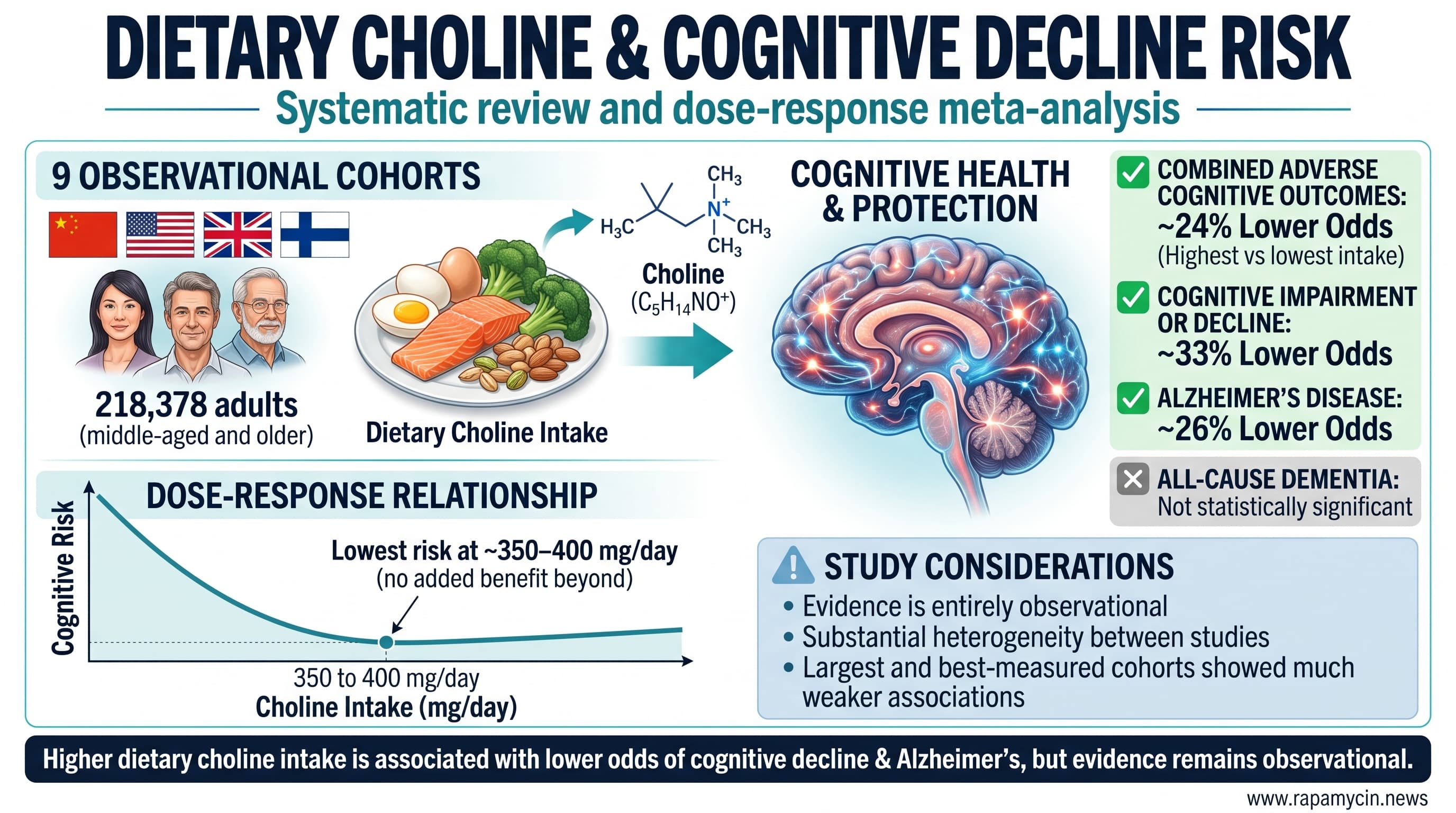
This systematic review and dose-response meta-analysis pooled nine independent observational cohorts covering 218,378 adults, mostly middle-aged and older, from China, the United States, the United Kingdom and Finland. People with the highest dietary choline intake had about 24 percent lower odds of a combined set of adverse cognitive outcomes than those with the lowest intake. Odds were about 33 percent lower for objectively measured cognitive impairment or decline and about 26 percent lower for Alzheimer’s disease. The association with all-cause dementia was not statistically significant. Risk appeared lowest at intakes of roughly 350 to 400 mg per day, close to current dietary guidelines, with no added benefit beyond that. The evidence is entirely observational.
Choline is an underappreciated nutrient. The body uses it to make acetylcholine, a neurotransmitter central to memory and learning, and phosphatidylcholine, a major building block of cell membranes. It also feeds the methylation pathways that regulate gene expression and keep homocysteine in check. The liver can make some choline, but not enough, so diet has to supply the rest. Eggs, meat, fish, liver and soy are the richest sources, and surveys suggest most Americans fall short of the recommended intake.
Because the brain cells that make acetylcholine degenerate early in Alzheimer’s disease, scientists have long wondered whether getting enough choline might help protect cognition. Individual studies have been mixed. This new analysis, led by researchers at Shandong First Medical University, set out to pool the evidence and identify an optimal intake.
The team searched five databases and included 11 articles, eight following people over time and three snapshot studies. After removing overlapping data from the same cohorts, nine independent groups remained. The largest by far were the UK Biobank, with more than 125,000 participants, and two long-running American studies of nurses and health professionals, with about 77,500.
Across all outcomes combined, people in the top choline intake category had 24 percent lower odds of cognitive problems than those in the bottom category. The link was strongest for objectively measured cognitive impairment and decline, and it also reached significance for Alzheimer’s disease. For dementia overall, the pooled estimate pointed in the same direction but could have been due to chance.
The dose-response analysis is the paper’s main selling point. Risk fell as intake rose, reaching its lowest point at around 350 to 400 mg per day, roughly the amount in two and a half large eggs. Beyond that, the curve flattened. That range lines up with European guidance of 400 mg per day and sits slightly below the US recommendations of 425 mg for women and 550 mg for men.
The findings deserve a cautious reading. The biggest and most rigorous cohorts showed weaker associations. In the UK Biobank and a Finnish cohort followed for 22 years, the link with dementia and Alzheimer’s was small and not statistically significant on its own. The strongest effects came from a handful of smaller studies, including one with just 154 participants. When small studies report bigger effects than large ones, that often signals selective publication or other bias.
People who eat more eggs, fish and meat may also differ in income, education, overall diet and health habits, and only four of the studies adjusted for overall diet quality. People in the early stages of cognitive decline may also eat differently, or recall their diets less accurately, which can make choline look protective when it is really a marker of something else.
The big idea is that adequate choline intake, near current guidelines, is associated with somewhat better cognitive aging, and more than that appears to offer no further benefit. This is consistent with choline’s biology. Proving that eating more choline actually prevents cognitive decline will require randomized trials.
Actionable Insights
This analysis cannot establish cause and effect. Its practical value is in pointing toward a reasonable dietary target. [Confidence: Medium]
- Aim to meet, not exceed, recommended choline intake: about 400 to 425 mg per day for women and 400 to 550 mg for men. The lowest observed risk was at 350 to 400 mg.
- Food first. One large egg provides about 147 mg, 100 g of beef liver about 420 mg, and fish, poultry, soy and cruciferous vegetables contribute smaller amounts. People who avoid animal foods are at higher risk of low intake.
- Expect modest effects. Across all outcomes, higher intake was linked to 24 percent lower odds. If 10 percent of a group would develop a cognitive problem over a decade, that would drop to about 7.8 percent, roughly one case avoided per 45 people, if the link were causal. The largest, best-measured cohorts suggest a smaller effect, about 8.7 percent, or one case per 77 people.
- There is no evidence that intakes above about 400 mg add benefit. High-dose supplements raise levels of TMAO, a gut-derived metabolite linked to cardiovascular risk, and the adult upper limit is 3.5 g per day.
Context and Source
- Paywalled Paper: Association of dietary choline intake with cognitive decline and related outcomes: a systematic review and dose-response meta-analysis of observational studies
- Institution: Shandong First Medical University and Shandong Academy of Medical Sciences (lead), with Shandong Medical and Pharmaceutical University, Shandong Second Medical University and the Jiangnan University-Shandong First Medical University Interdisciplinary Center for Food, Nutrition and Health
- Country: China
- Journal: Food and Function (Royal Society of Chemistry)
- Impact evaluation: The impact score of this journal is 6.3 (2025 Journal Impact Factor, per the publisher; CiteScore 7.8), evaluated against a typical high-end range of 0 to 60+ for top general science, therefore this is a Medium impact journal. It sits in the top quartile of food science journals but publishes a high volume of nutrition and bioactive compound papers.