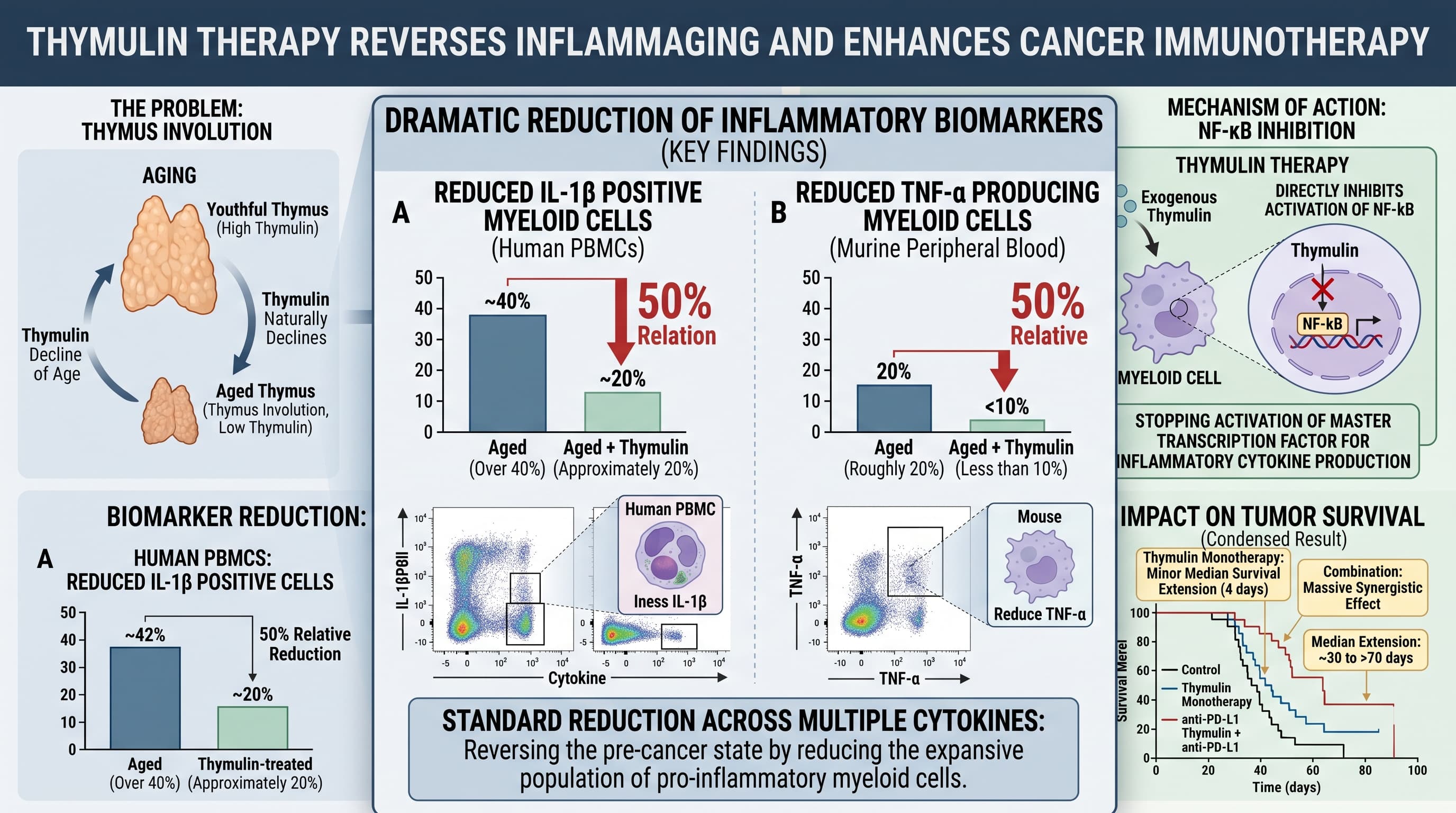
I asked Claude Opus 5 to develop a phase 1 clinical study from the data provided in these two aforementioned papers. Here are some selected items that might inform people about how to potentially implement this therapeutic approach to reversing inflammaging:
1. Trial Overview and Clinical Endpoints
Study Design
Randomized, double-blind, zinc-matched-placebo-controlled cohort in an age- and inflammation-enriched population.
Twelve weeks of dosing, not 28 days. Schedule replicates the historically efficacious regimen: daily for 14 days, then three times weekly for the remainder. Follow-up extends to 6 months from first dose, with platelet counts continuing monthly through that window.
Safety Endpoints and Measurements
Primary: incidence, severity (CTCAE v5), and causality-assessed attribution of TEAEs through day 180.
The monitoring plan is now organised around three named historical hazards rather than a generic panel.
Hazard 1: Immune thrombocytopenia. Elevated to a primary safety endpoint.
- Platelet count at baseline, then twice weekly for the first 4 weeks, weekly to week 12, then monthly to month 6. The historical case was detected by monthly monitoring at a count of 5 x 10⁹/L, meaning the fall had already occurred undetected. Denser sampling is required to catch the trajectory rather than the nadir. [V, C]
- Peripheral smear review at any count below 150 x 10⁹/L.
- Anti-platelet glycoprotein antibody testing (anti-GPIIb/IIIa, anti-GPIb/IX) and, if indicated, bone marrow examination at any count below 100 x 10⁹/L. The historical bone marrow showed numerous megakaryocytes, establishing peripheral destruction rather than marrow suppression [V]. Reproducing that finding would confirm an immune mechanism; absence of it would point elsewhere.
-
Stopping rule: any single count below 100 x 10⁹/L, or a fall of more than 50% from baseline, halts dosing for that subject and suspends cohort escalation pending SRC review. Any count below 50 x 10⁹/L halts the study.
- No concomitant NSAIDs or antiplatelet agents. The historical case was confounded by piroxicam 30 mg/day and aspirin 3 g/day, all stopped simultaneously, which destroyed the dechallenge’s interpretive value [V]. Excluding these drugs is the single cheapest design change that converts an ambiguous historical signal into an answerable question. [Confidence: High]
Hazard 2: Vasculitis.
- Structured neurological examination at each visit, with specific enquiry for paraesthesiae. The historical case presented as isolated leg paraesthesiae with no other findings [V], which a standard AE questionnaire would likely capture as a Grade 1 nuisance symptom.
- Skin examination for purpura, nodules, livedo, digital infarcts.
- Urinalysis with microscopy at each visit, for glomerulonephritis.
- Baseline and week 12: ANCA (PR3, MPO), cryoglobulins, complement C3/C4, immune complexes.
- Nerve conduction studies and biopsy triggered by protocol-defined symptoms.
-
Design advantage worth stating: in a population without rheumatoid arthritis, a vasculitic event cannot be attributed to underlying disease. The 1987 authors used RA as an alternative explanation, defensibly for this event. A healthy or inflammation-enriched but non-rheumatic cohort removes that escape route, so any vasculitis in this trial is an unambiguous drug signal. The historical ambiguity becomes resolvable. [Confidence: High]
Hazard 3: Immediate hypersensitivity.
- First dose of every cohort administered with physician present, resuscitation equipment and epinephrine immediately available, and continuous observation for 2 hours minimum. The historical event produced hypotension and laryngeal oedema within minutes and resolved 30 minutes after IV corticosteroid [V].
- Vital signs at 5, 10, 15, 30, 60, 120 minutes post first dose.
- Serum tryptase at baseline and at any suspected reaction.
- The 1987 authors argued an allergic mechanism was unlikely given the peptide’s small size. That reasoning is weak. Small peptides act as haptens, and the zinc complex adds a metal-protein conjugate that is a plausible immunogen. [S]
Retained from Revision 1, unchanged in rationale: infection surveillance with recall-antigen response and quantitative immunoglobulins, driven by the NF-kB inhibition mechanism [V, Kanemaru]; zinc and copper homeostasis with ceruloplasmin, driven by chronic equimolar zinc administration [V, both papers]; ADA screening with neutralising tier; standard chemistry, cardiac and endocrine panels.
New: injection site reaction grading. Structured ISR assessment at 15 minutes, 1 hour, and 24 hours post dose. Local pain occurred in 9 of 49 Trial 1 patients and in every Trial 2 patient at 10 mg daily, caused one withdrawal in each trial, and was attributed to the zinc salts because it also occurred with zinc-containing placebo [V]. For a chronic subcutaneous therapy this is a compliance-limiting problem, not a tolerability footnote.
Effectiveness Endpoints
Unchanged in substance from Revision 1, with one important caveat added.
Secondary endpoint remains change from baseline in the frequency of CD33⁺CD11b⁺ PBMCs producing IL-1α, IL-1β, IL-6, or TNF-α, by intracellular cytokine staining with Boolean gating. This is the assay Kanemaru et al. performed on human cells ex vivo [V].
The caveat. Amor et al. found that clinical improvement correlated with none of the immunological parameters they measured, including T-cell subsets, sedimentation rate, and rheumatoid factor [V]. They measured T-cell biology, not myeloid cytokine production, so this does not directly contradict the modern endpoint. But it is a documented instance of this compound producing clinical effect without moving the immune biomarkers its investigators expected. The protocol should not assume the PD endpoint will track any clinical signal. [Confidence: Medium]
New exploratory endpoint, derived from 1987. Baseline immune phenotype as a response predictor. Amor et al. found that 7 of 8 responders had normal suppressor T-cell function at entry versus 6 of 24 non-responders, Fisher exact p = 0.0032 [V]. The specific assay is obsolete. The principle is not. Prespecify a baseline monocyte inflammatory phenotype (CD14⁺CD16⁺ fraction, HLA-DR MFI, stimulated cytokine capacity) and test it as a moderator of PD response. This was the most forward-looking finding in the 1987 paper and deserves to be carried forward deliberately rather than rediscovered.
- Target Participant Profile
Option A: Inflammation-enriched but otherwise healthy elderly, dose-capped at 2.5 mg. Stay below the dose at which both serious events occurred. Accepts that the trial may never reach a pharmacologically active exposure and that a null result will be uninterpretable.
Option B: An inflammatory disease population. Return to a patient group where risk is offset by potential benefit. Polymyalgia rheumatica, giant cell arteritis, or steroid-dependent inflammatory disease in older adults would map onto both the 1987 efficacy signal and the modern mechanism. Loses the clean healthspan framing but is the honest risk-benefit position.
Age Bracket: 60 to 80
Unchanged, and now better supported. The 1987 cohort had mean ages of 51 to 59 [V], overlapping the lower end of the proposed bracket, which means the historical safety data are not drawn from a substantially younger population than the one proposed.
Inclusion Criteria
Retained from Revision 1: age 60 to 80, hsCRP 1.0 to 10.0 mg/L, serum zinc within reference range, BMI 18.5 to 35, adequate organ function, documented immunocompetence, clinical stability.
New, driven by the 1987 safety profile:
- Platelet count at or above 150 x 10⁹/L with no history of thrombocytopenia, ITP, or HIT
- No personal or first-degree family history of autoimmune cytopenia
- Normal baseline ANCA, cryoglobulins, and complement
- No NSAID, aspirin, clopidogrel, or other antiplatelet agent within 14 days and throughout the study
- Willingness to accept twice-weekly phlebotomy for the first month
Exclusion Criteria
Retained: active or prior malignancy within 5 years, active or latent infection, immunosuppressive therapy, autoimmune disease requiring treatment, zinc or copper metabolism disorders, live vaccine within 30 days.
New: any history of vasculitis, peripheral neuropathy, or unexplained paraesthesiae; any bleeding disorder; concurrent anticoagulation; any prior exposure to thymic peptide preparations, including unregulated vendor products, which is a realistic exclusion in this population and one that would be easy to omit.
Half-Life and Why It Restructures the Dosing Question
Amor et al. state a plasma half-life of 30 to 60 minutes with T-lymphocyte effects persisting 24 to 48 hours [V]. No source is given for the half-life figure, which is a documentation gap, but the number is consistent with an unmodified nonapeptide cleared by peptidases and glomerular filtration [S].
Three consequences:
-
Exposure is a pulse, not a plateau. Plasma concentration returns to near baseline within a few hours of each injection. Any PK-PD model built on steady-state concentration is modelling something that does not exist.
-
Dosing frequency, not dose size, is the design variable. The historically efficacious regimen was intermittent after loading. Amor et al. themselves speculated that more frequent dosing might improve efficacy [V].
Dose Escalation Scheme (Testing Individual Dosing Levels)
Part A, SAD. Single doses. Immune-mediated events in the historical data emerged at months 2 and 5, so single-dose exposure carries low risk for those specific hazards but is the appropriate setting to characterise PK and immediate hypersensitivity.
| Cohort |
Dose |
Position against human precedent |
| 1 |
0.5 mg |
Below all controlled-trial doses |
| 2 |
1.0 mg |
Lowest controlled-trial dose; zero AE withdrawals historically |
| 3 |
2.5 mg |
Between tested levels |
| 4 |
5.0 mg |
Historically efficacious dose; both serious immune events occurred at this dose on chronic schedule |
Part B. Twelve weeks, replicating the historical schedule of daily for 14 days then three times weekly.
| Cohort |
Dose |
Weekly exposure after loading |
| 1 |
1.0 mg |
3 mg |
| 2 |
2.5 mg |
7.5 mg |
| 3 (conditional) |
5.0 mg |
15 mg |
Cohort 3 proceeds only if cohorts 1 and 2 complete 12 weeks with no platelet signal, no vasculitic symptoms, and no ADA with neutralising activity. Given the historical event rate, the SRC should treat advancement to 5 mg as a substantive decision rather than a default step.
Formulation
New workstream, absent from Revision 1.
The zinc component is both essential and problematic. Thymulin is inert without equimolar zinc [V, both papers], yet zinc is the probable cause of the injection pain that affected every patient at 10 mg daily and one in five across Trial 1 [V]. Reducing zinc is not an option. Available levers are dilution volume, buffering, choice of zinc salt, injection site rotation, and warming before injection [S].
- Translational Targets and Biomarker Strategy
Add anti-platelet antibody as a mechanistic biomarker, not only a safety test. If the historical thrombocytopenia was immune-mediated, as the bone marrow findings suggest [V], then anti-platelet antibody formation is a measurable on-mechanism toxicity of a T-cell modulating agent. Measuring it prospectively in all subjects, not only in those who become thrombocytopenic, converts an adverse event into interpretable data.
Longevity surrogates, unchanged and still weak. hsCRP and IL-6 remain the only endpoints with validated links to clinical outcome, and those links are to cardiovascular risk, not to aging. Epigenetic clocks remain theoretical extrapolation and should not headline any result. Nothing in the 1987 paper changes this.
Highest-value action item for the programme: locate the Choay archive. More than 150 unpublished patient exposures, plus whatever regulatory file exists from the European development programme, plus the reason development stopped. That dataset would be worth more than any single nonclinical study on the list below, and finding out why the programme ended is the cheapest possible way to avoid repeating someone else’s failure. [Confidence: High on the value, Low on whether it is retrievable]
Revised Nonclinical Requirements
Now mandatory rather than optional, driven by the historical AE profile:
-
Platelet-focused toxicology. Serial platelet counts in both tox species, megakaryocyte assessment in bone marrow histopathology, and a specific assessment of drug-dependent anti-platelet antibody formation. The 1987 event is the single most likely cause of programme failure and the nonclinical package must address it directly.
-
Vascular histopathology. Systematic examination of small and medium vessels across multiple organs in the 12-week repeat-dose study, specifically looking for vasculitic lesions and immune complex deposition. A standard tox package would not prioritise this.
-
Immune complex and complement assessment in repeat-dose tox, given that both serious human events are consistent with immune complex pathology.
-
Local tolerance study with formulation comparison, testing at least two zinc formulations for injection site reaction severity.
Bottom Line
The 1987 paper is a mixed inheritance. It de-risks the pharmacology, supplying route, dose range, schedule, half-life, a placebo design, and a responder-biomarker principle that would otherwise cost years to establish. It also documents two serious immune-mediated events at the dose the programme would otherwise target, in 16 patients, over six months, with an event rate whose confidence interval extends to one in three.
The three highest-priority actions, in order: locate the Choay archive and find out why development stopped; generate modern human PK, since the entire dosing paradigm rests on an uncited half-life figure; and decide the indication. On the evidence now available, a healthy-volunteer longevity trial at a pharmacologically active dose is difficult to justify, and the oncology setting is where a first-in-human programme can honestly carry this risk profile.
References
Kanemaru H, Luong S, Yamamoto Y, Mizukami Y, Ito F. Thymulin restrains age-associated myeloid inflammation and enhances cancer immunotherapy. Nature Communications 2026; 17: 6534.
Amor B, Dougados M, Mery C, Dardenne M, Bach JF. Nonathymulin in rheumatoid arthritis: two double blind, placebo controlled trials. Annals of the Rheumatic Diseases 1987; 46: 549-554.
Amor B, Dougados M, de Gery A, Choay J, Dardenne M, Bach JF. Thymulin (FTS) in rheumatoid arthritis. Arthritis and Rheumatism 1984; 27: 117-118. Cited in the 1987 paper as the source of the 150 µg and 1 mg open-trial dosing.