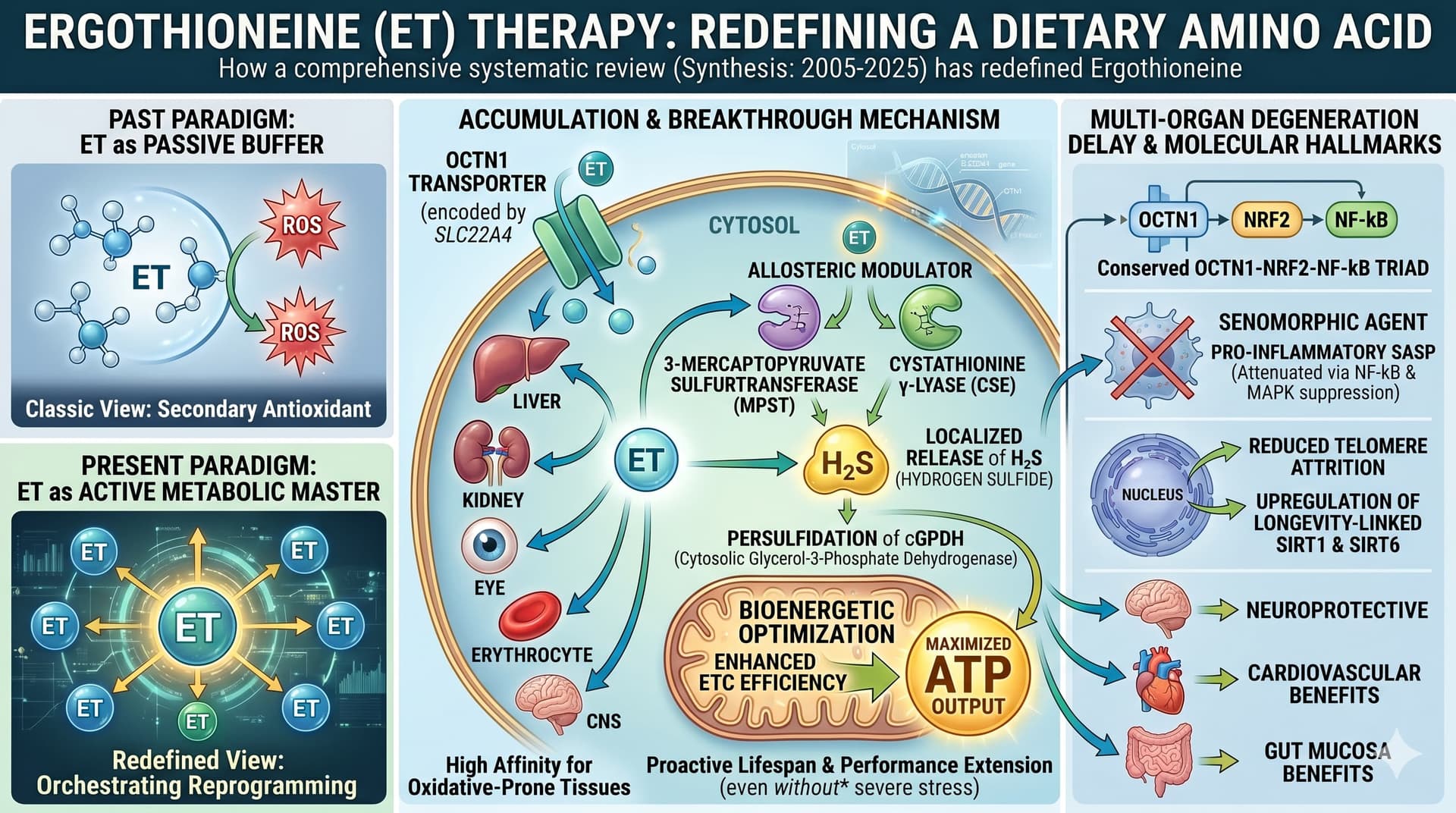
The Mushroom Molecule That May Rewrite Aging: Ergothioneine Emerges as a Multi-Target Geroprotector

Hidden in a plate of shiitake mushrooms is a molecule that may be quietly keeping your cells alive. Ergothioneine (ET) — a sulfur-rich amino acid first isolated from ergot fungus in 1909 — has spent over a century in relative obscurity. That may be about to change.

A sweeping new systematic review published in Ageing Research Reviews synthesizes 20 years of evidence (2005–2025) and makes a forceful case: ET is not merely an antioxidant curiosity but a plausible geroprotector — a compound capable of targeting multiple molecular mechanisms that drive biological aging simultaneously.

The big idea begins with a specialized protein called OCTN1, encoded by the gene SLC22A4. Unlike generic antioxidants that spray-and-pray across tissues, OCTN1 acts as a precision delivery system, ferrying ET specifically into the cells and organs most vulnerable to oxidative damage: the brain, liver, kidneys, eyes, and bone marrow. This selective accumulation is not passive — it is active, energy-dependent, and regulated. Critically, blood levels of ET peak in adolescence at approximately 3.7 mg/100 mL and then decline progressively with age. Lower ET levels have been independently correlated with frailty, mild cognitive impairment, Parkinson’s disease, and all-cause mortality in large cohort studies. This age-related depletion pattern is one reason Nobel laureate biochemist Bruce Ames proposed the “longevity vitamin” hypothesis — the idea that ET is a micronutrient we chronically under-consume, and whose deficit accelerates aging.

The review maps ET’s effects onto the canonical “Hallmarks of Aging” framework. Its actions span telomere preservation (by protecting guanine-rich telomeric DNA from oxidative attack and upregulating SIRT1/SIRT6), mitochondrial quality control (restoring mitophagic flux via PINK1/Parkin pathways), suppression of the pro-inflammatory Senescence-Associated Secretory Phenotype (SASP) via NF-kB inhibition, and modulation of the mTORC1-S6K1 nutrient-sensing axis.

But the most intellectually disruptive finding reviewed here concerns a newly characterized mechanism: ET does not merely neutralize reactive oxygen species — it actively reprograms cellular energy metabolism. Recent data from two independent 2025 studies (Petrovic et al. and Sprenger et al.) demonstrate that intracellular ET binds and activates key sulfur-trafficking enzymes (MPST and CSE), triggering localized hydrogen sulfide (H2S) production. This H2S then persulfidates cytosolic glycerol-3-phosphate dehydrogenase (cGPDH), directly enhancing electron transport chain efficiency and maximizing ATP output. This elevates ET from “defensive scavenger” to “proactive metabolic optimizer” — a mechanistic upgrade with profound implications.

In male mice, ET supplementation at 4–5 mg/kg/day extended median lifespan by 16% and mean lifespan by 21% (Katsube et al., 2024). In Drosophila, lifespan extension was demonstrated across multiple dose ranges.

The honest caveat: human RCT data remains thin. A large cohort study of 3,236 participants over 21 years shows compelling observational links between plasma ET and reduced cardiovascular mortality, but causality is not established. Phase 1 and Phase 2 human trials confirm safety up to 25 mg/day with no adverse signals, but adequately powered, long-term efficacy trials with hard clinical endpoints do not yet exist.

Actionable Insights

The most immediate practical signal from this review is dietary: eat mushrooms. Oyster, shiitake, and king oyster mushrooms contain 1–7 mg ET per gram dry weight, making them by far the richest accessible source. Regular mushroom consumption is the primary way to counter the age-related decline in blood ET levels.

Second, genetic context matters. If you carry the SLC22A4 L503F (C1672T) variant, standard dietary intake may be insufficient to raise tissue ET to protective levels — and counterintuitively, this variant may increase autoimmune risk in inflammatory contexts. Genetic testing for SLC22A4/SLC22A15 polymorphisms could eventually guide individualized ET protocols.

Third, ET operates as an “on-demand” protector: supplementation in healthy, low-stress individuals produces minimal biomarker changes. The benefit signal strengthens under oxidative load — which means individuals with metabolic syndrome, cardiovascular disease, neurodegenerative risk, CKD, or those undergoing hemodialysis (where ET is depleted by 88%) represent the clearest candidates for supplementation trials.

Pulsed Dose: ET exhibits non-linear pharmacokinetics, high systemic accumulation, active renal reabsorption, and an exceptionally long human half-life of approximately 30 days. Continuous daily high-dose supplementation risks saturating the limited capacity of the OCTN1 transporter and may impede the absorption of essential physiological cations or co-administered drugs like metformin. Intermittent pulse dosing is theoretically superior to avoid transport bottlenecks.

Mandate Baseline Genetic and Microbiome Screening: Supplemental ET is highly context-dependent and presents an unexpected biological “Achilles’ heel”. Certain anaerobic gut bacteria express ET hydrolases that cleave ET into trimethylamine (TMA), which the liver converts into trimethylamine-N-oxide (TMAO)—a notorious pro-atherogenic metabolite linked to accelerated vascular aging and cardiovascular disease. Individuals must profile their gut microbiome and verify their SLC22A4 genotype (specifically checking for the L503F variant, which dramatically alters baseline transport efficiency) before initiating heavy, unmonitored supplementation protocols.

The current clinically validated dosage range is 5–25 mg/day, with safety confirmed up to 16 weeks in elderly subjects.

Source:

Related Reading:

1 Like

To practically mitigate the vascular “Achilles’ heel” of Ergothioneine (ET) supplementation—specifically the risk of converting a potential geroprotector into the pro-atherogenic cardiovascular toxin trimethylamine-N-oxide (TMAO)—microbiome screening must evaluate two primary physiological axes: Direct Bacterial Cleavage into Trimethylamine (TMA) and Competitive Hijacking by Pathogens.

1. The TMA/TMAO Metabolic Conversion Profile

Evaluating your system’s propensity for turning amine donors into vascular toxins requires auditing specific bacterial degradation enzymes and overall metabolic capacity.

  • Ergothioneine Hydrolase / Ergothionase Activity: You should prioritize evaluating the presence and transcriptomic abundance of anaerobic gut bacteria harboring functional ET hydrolase (ergothionase) enzymes. Certain anaerobic species actively utilize this enzymatic pathway to cleave the structural imidazole ring of ET, liberating volatile TMA gas directly into portal circulation.
  • Core Amine-Lyase Genetic Machinery (CutC/D and CntA/B): Because direct ergothionase screening is not yet universally isolated on standard commercial functional stool tests, you must look at the surrogate genetic machinery regulating parallel TMA pathways. High expression of these genes signals an internal ecosystem highly efficient at carnitine, choline, and overall amine degradation:
    • CutC (Choline TMA-lyase) & CutD (Glycyl Radical Enzyme Activase): Regulates radical-driven cleavage of quaternary amines.
    • CntA (Rieske-type oxygenase) & CntB (Reductase): Drives the carnitine-to-TMA conversion line.

Clinical Risk Stratification: If metatranscriptomic data reveals high baseline copy numbers of CutC/Dor CntA/B, your microflora is fundamentally primed for rapid amine cleavage. Supplementing with heavy exogenous ET in this state risks accelerating endothelial dysfunction, renal fibrosis, and vascular aging via sudden spikes in downstream hepatic TMAO conversion.

  • Taxonomical Overrepresented Overgrowths: Audit your metagenomic sequencing for heavy colonial overgrowths of specific anaerobic groups notorious for executing high-efficiency amine transformations. This includes members of the Firmicutes phylum (particularly within the Clostridiaceae and Lachnospiraceae families) and select opportunistic Enterobacteriaceae.

2. Opportunistic Pathogen Abundance

A critical knowledge gap in broad-spectrum longevity medicine is the “dark side” of ET accumulation within highly infectious microenvironments. Multiple host-associated microbial pathogens lack the internal biochemical machinery to synthesize low-molecular-weight thiols to serve as their own cellular redox buffers. To survive host immune destruction, they pull host-derived ET out of the mucosal lining to protect themselves.

  • Helicobacter pylori (Gastric Mucosal Hijacking): H. pylori utilizes a highly specialized, high-affinity ATP-binding cassette transporter called EgtUV to aggressively hoard host environment ET. It uses your ingested ET to successfully neutralize the intracellular reactive oxygen species (ROS) deployed by human neutrophils during an immune response.Actionable Strategy: Blindly supplementing with ET when H. pylori is present effectively feeds the pathogen its prime survival shield, extending its virulence window and compounding long-term gastric cancer risks. Ensure zero active colonizations via a fecal antigen, urea breath test, or comprehensive GI-MAP sequencing.
  • Streptococcus pneumoniae and Listeria monocytogenes: Both pathogens utilize homologous EgtU import complexes to actively capture host ET for oxidative stress defense. Heavy baseline pathogen loading in the respiratory or gastrointestinal tract dictates a strict contraindication for high-dose prophylactic ET protocols until resolving structural dysbiosis.

3. Complementary Host Diagnostics & Stratification

Metagenomic stool analytics should always be paired with direct physiological markers to confirm total system clearance and transport capacity:

  • Baseline Circulating Plasma TMAO Test: Quantify baseline fasting plasma TMAO via liquid chromatography-tandem mass spectrometry (LC-MS/MS). If baseline values reside in upper-tier clinical risk zones, ET supplementation must be entirely avoided or strictly substituted with whole-food mushroom consumption, which alters kinetic absorption patterns and limits immediate transporter saturation.
  • Transporter Genotyping (SLC22A4): Map single nucleotide polymorphisms (SNPs) dictating your baseline absorption kinetics. Carriers of the L503F (C1672T) variant possess higher baseline absorption and elevated tissue ET concentrations but show an intricate, bidirectional link to autoimmune susceptibility (e.g., Crohn’s disease and rheumatoid arthritis). In these individuals, high local accumulation under continuous microbial challenge can flip ET from a passive cytoprotectant into a proactive pro-inflammatory driver that triggers Th17 immune skewing.

Current Scholarly Debates & Missing Data

While preclinical data clearly validates that intestinal microbes can cleave ET into pro-atherogenic precursors, a prominent knowledge gap remains regarding the precise diet-microbe-host axis dynamics in long-term human cohorts.

There is an active debate over whether localized tissue accumulation of ET in inflamed environments represents a failed, exhausted compensatory defense mechanism or an active pathogenic driver of local tissue injury. Systematic testing with stable isotope tracing is urgently needed to fully map the net lifestyle outcomes of ET exposure within highly variable human enterotypes. For a detailed systemic analysis of these metabolic frameworks, consult the comprehensive scoping review published in Ageing Research Reviews.

Recommended Plasma TMAO Testing Timeline After Ergothioneine Dosing

Because the specific interaction between ergothioneine (ET) and the human gut microbiome remains an emerging frontier, there is currently no universally standardized, clinically validated diagnostic timeline for an “ET-to-TMAO dynamic challenge test.” However, by synthesizing the known pharmacokinetics of ET alongside established clinical protocols for parallel quaternary amine challenges (such as choline and carnitine loading), a rational testing framework can be engineered.

1. The Post-Challenge Peak Window (Acute Conversion Capacity)

To catch the active microbial cleavage and subsequent hepatic oxidation of a specific dose, plasma should be drawn 6 to 8 hours post-ingestion of your ET supplement.

  • Gastrointestinal Transit and Processing: Ingested ET must escape complete upper small intestine absorption by the high-affinity OCTN1 transporter to interact with anaerobic microbes in the distal gut. Preclinical tracer data demonstrates that oral ET reaches peak concentrations in the small intestine around 4 hours post-dose.
  • TMA to TMAO Kinetics: Once anaerobic bacteria harboring ET hydrolases cleave the molecule into volatile trimethylamine (TMA), the gas is rapidly absorbed via portal circulation. The hepatic flavin-containing monooxygenase 3 (FMO3) enzyme then oxidizes TMA into TMAO. Based on standard oral choline or carnitine loading tests, this total pathway cascade peaks in the blood between 6 and 8 hours before gradual renal clearance begins.

2. The Fasting Steady-State Test (Chronic Accumulation)

To determine whether your long-term supplement regimen is systematically driving up your baseline cardiovascular risk, you should test fasting plasma TMAO (minimum 12-hour fast) at least 2 to 4 weeks into a consistent dosing protocol.

  • Kinetic Rationale: Human single-dose and steady-state kinetics demonstrate that ET concentrations build progressively over time, reaching a stable systemic plateau after approximately 4 weeks of daily intake.
  • Sustained Half-Life Impact: Because ET possesses an exceptionally long systemic half-life of roughly 30 daysdue to aggressive renal reabsorption, testing a standard fasting baseline after a month of exposure provides a highly accurate look at your sustained, chronic exposure to downstream microbiota-generated toxins.

Practical Summary Protocol

  • Step 1 (True Baseline): Establish a true baseline by drawing fasting plasma TMAO before initiating any ET supplementation.
  • Step 2 (The Acute Audit): Ingest your target heavy supplement dose. Draw blood 6 to 8 hours laterto audit whether your specific gut enterotype is aggressively converting the parent compound into TMA.
  • Step 3 (The Steady-State Audit): If you proceed with chronic supplementation, re-verify your fasting plasma TMAO 4 weeks later to ensure you have not pushed your steady-state vascular environment into a pro-atherogenic danger zone.
1 Like