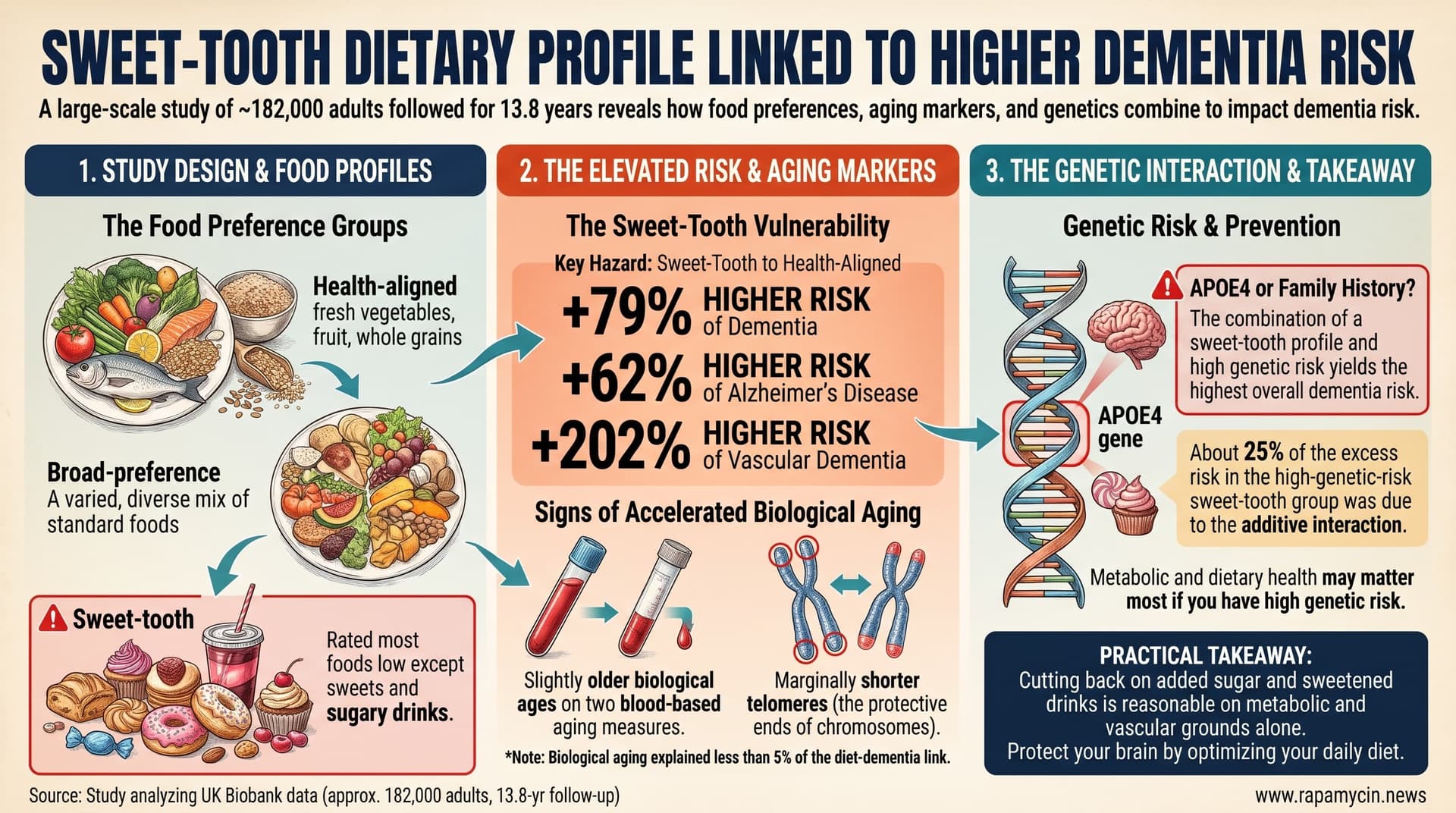
Using UK Biobank data from about 182,000 adults, researchers in China and Hong Kong grouped people by their food preferences into three profiles: health-aligned, broad-preference and sweet-tooth. The sweet-tooth group, who rated most foods low except sweets and sugary drinks, had a 79% higher hazard of dementia than the health-aligned group over a median of 13.8 years. Their hazard of Alzheimer’s disease was 62% higher and of vascular dementia 202% higher. The sweet-tooth group also had slightly older biological ages on two blood-based aging measures and marginally shorter telomeres. People with both a sweet-tooth profile and high genetic risk had the highest dementia risk, more than the two factors would predict separately.
Most diet and dementia research asks what people eat. This study asked something different: what people like to eat. In 2019, UK Biobank invited participants to rate 140 foods and drinks on a scale from strong dislike to strong like. About 182,000 people responded. Using a statistical clustering method, the researchers sorted them into three taste profiles.
The health-aligned group favored vegetables, fruits and lighter foods while showing less enthusiasm for meat, sweets and fatty products. The broad-preference group liked most foods but avoided strongly flavored ones. The sweet-tooth group rated most foods low but gave high marks to sweets and sugary drinks. This group was somewhat younger, more often male, more likely to smoke, heavier, and had lower income and education.
The researchers then linked these profiles to dementia diagnoses from hospital, primary care and death records. After adjusting for age, sex, lifestyle, income, existing disease and a diet quality score, the sweet-tooth group had a 79% higher hazard of any dementia than the health-aligned group. The link was strongest for vascular dementia, which fits the idea that a sugar-heavy diet damages blood vessels. Vascular dementia cases were few, though, so that estimate is imprecise.
Genetics added another layer. People with both a sweet-tooth profile and above-median genetic risk had more than three times the dementia hazard of health-aligned people with lower genetic risk. The combined effect was larger than the sum of the two parts, suggesting that diet may matter most for those already genetically vulnerable.
The study’s central weakness is timing. Food preferences were collected in 2019, but follow-up began when participants joined UK Biobank between 2006 and 2010, and the aging markers came from that earlier visit. That leaves room for reverse causation. Early brain changes, depression and apathy can all reshape appetite and food preferences. Notably, the sweet-tooth group was defined by low enthusiasm for most foods, a pattern that could reflect blunted reward or low engagement with the questionnaire rather than a love of sugar. People who already had significant cognitive problems in 2019 were unlikely to complete an online survey at all, which may explain why the cohort had relatively few dementia cases.
The absolute risks were also small. Only 641 of 181,695 participants developed dementia during follow-up, so even a 79% relative increase translates to a fraction of a percentage point of extra risk.
Reducing added sugar is sound advice on many grounds, and this study fits that picture. But it cannot show that sweet preferences cause dementia, and some of the association may run in the opposite direction.
Actionable Insights
- Cutting back on added sugar and sweetened drinks is reasonable on metabolic and vascular grounds alone, and this study is consistent with that.
- If you have a family history of dementia or carry APOE4, the additive interaction suggests that metabolic and dietary health may matter more for you. About a quarter of the excess risk in the high-genetic-risk sweet-tooth group was attributed to the interaction. Treat this as a hypothesis.
- A sudden shift toward sweets, or a loss of interest in other foods, in later life can itself be an early sign of neurological change and is worth mentioning to a doctor.
Context and Source
- Paywalled Paper: Dietary preference, biological aging, and incident dementia: a prospective cohort study
-
Institutions:
- City University of Hong Kong
- Southeast University, Nanjing
- Shandong Second Medical University
- Institute of Psychology, Chinese Academy of Sciences
- Renmin University of China
- University of Notre Dame
- Countries: China (including Hong Kong SAR), with one US affiliation; data from the UK Biobank
- Journal: GeroScience (Springer), published online 7 October 2026
- Impact evaluation: GeroScience has a 2025 impact factor of 5.4 and is ranked Q1. The impact score of this journal is 5.4, evaluated against a typical high-end range of 0 to 60+ for top general science, therefore this is a Medium impact journal.