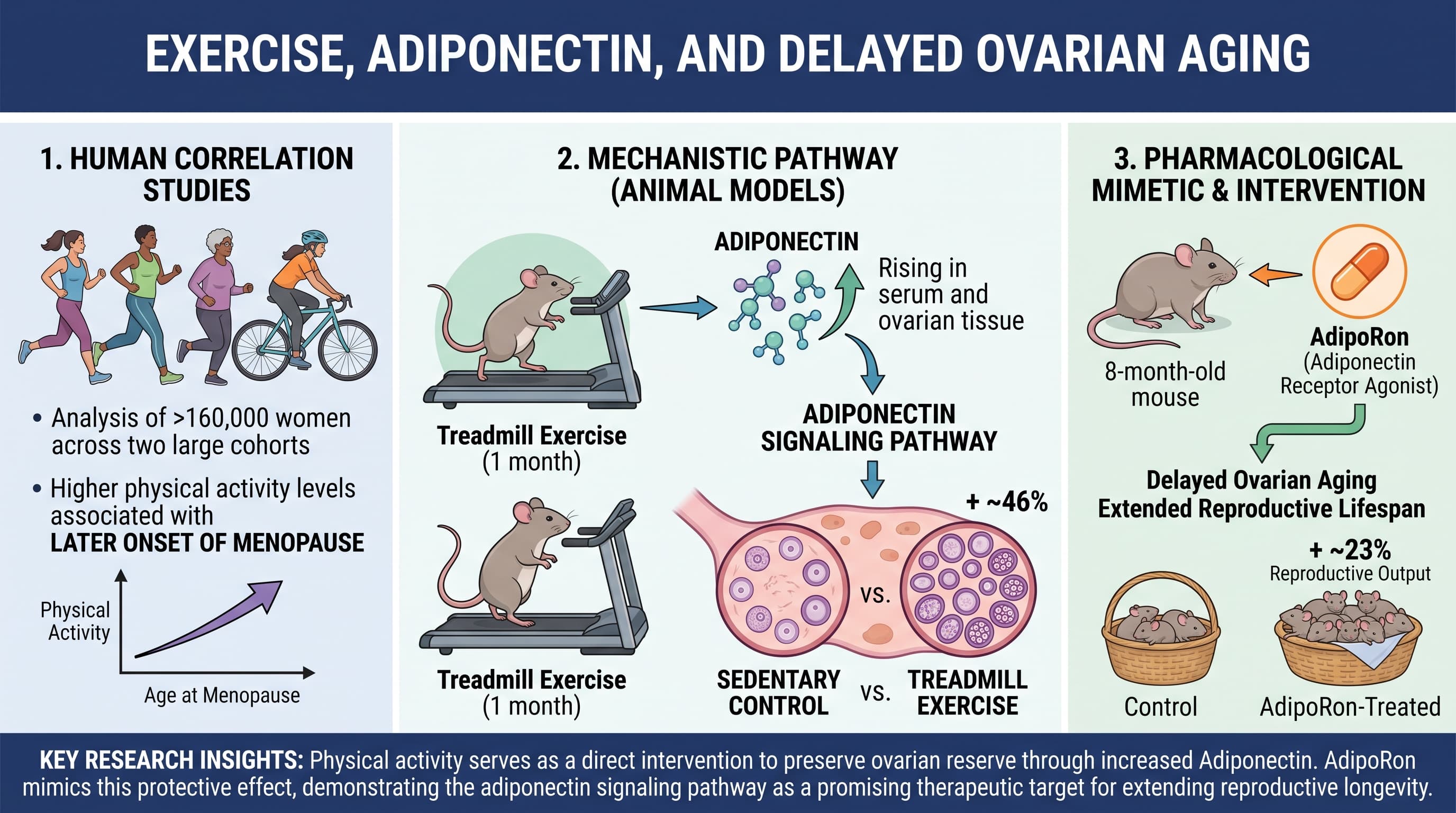
A recent research briefing reveals a strong correlation between physical activity and delayed ovarian aging in humans, supported by mechanistic data in animal models. Analysis of over 160,000 women across two large cohorts indicated that higher physical activity levels are associated with a later onset of menopause. Experimental models utilizing mice demonstrated that treadmill exercise preserved ovarian follicles and that this protective effect is mediated by the adiponectin signaling pathway. Pharmacological activation of this pathway using the agonist AdipoRon successfully delayed ovarian aging and extended reproductive lifespan in the animal models.
Ovarian aging acts as a primary driver of reproductive decline and contributes to secondary systemic issues, including endocrine dysregulation, elevated cardiovascular disease risk, and psychological distress. Despite the growing gap between reproductive lifespan and the societal trend of delayed parenthood, there are currently no approved therapeutics designed to directly slow ovarian aging. Physical activity is widely recognized for modulating systemic aging, but its specific impact on the ovaries and the underlying molecular pathways has remained largely undefined.
Researchers tackled this gap using a dual approach. First, they conducted cross-sectional analyses of 152,435 women from the UK Biobank and 12,418 women from the National Health and Nutrition Examination Survey (NHANES). The population data revealed that premenopausal women engaged in significantly more physical activity than postmenopausal women, and postmenopausal individuals with a history of higher physical activity experienced a later onset of menopause.
To move beyond mere correlation, the research team implemented controlled animal experiments. Mice subjected to a one-month treadmill exercise protocol demonstrated a robust preservation of primordial follicle numbers compared to sedentary controls. The researchers observed that physical activity elevated adiponectin levels in both serum and ovarian tissue. To confirm the molecular mechanism, they tested mice lacking adiponectin and mice with ovary-specific adiponectin deficiencies. In both knockout models, the protective benefits of exercise on the ovarian reserve were significantly diminished.
Finally, the team tested a pharmacological intervention. Administering AdipoRon, an adiponectin receptor agonist, to eight-month-old mice was sufficient to delay ovarian aging and extend their reproductive lifespan, measured by an increase in pup yield. These findings position the adiponectin signaling pathway as a highly promising therapeutic target for extending reproductive longevity and potentially modulating broader systemic aging processes linked to ovarian decline.
Actionable Insights
For individuals interested in longevity and healthspan optimization, this research provides highly practical takeaways regarding exercise and pharmacological mimetics. Routine physical activity serves as a direct behavioral intervention to preserve the ovarian reserve. Based on the provided histological data, the exercise intervention resulted in a roughly 46% absolute increase in primordial follicle counts compared to sedentary controls.
Furthermore, the adiponectin receptor agonist AdipoRon offers a blueprint for pharmacological intervention. In the interventional trial, mice treated with AdipoRon for one month prior to mating demonstrated a 23% absolute increase in total reproductive output (approximately 13 pups per female versus 10.5 in controls) over their remaining lifespan. For longevity practitioners, these data strongly suggest that upregulating adiponectin pathways through consistent aerobic conditioning or targeted small-molecule agonists (which are only being tested in animals currently) could eventually profoundly delay the onset of menopause and its associated systemic biological aging markers.
Context/Source
- Paywalled Paper: Physical activity delays ovarian aging in part through adiponectin-related signaling pathways., 14 August 2026.
- Institution: The Affiliated Brain Hospital, Guangzhou Medical University.
- Country: China.
- Journal Name: Nature Aging.
- Impact Evaluation: The impact score of this journal is 16.6, evaluated against a typical high-end range of 0 to 60+ for top general science, therefore this is a High impact journal.
Related Reading:
- Rapamycin Restores Fertility Potential in Endometriosis by Reversing Ovarian Aging in Mice
- The Body’s Hidden Metronome: Why Ovarian Aging Dictates Whole-Body Female Longevity Long Before Menopause
- Mechanisms of Ovarian Aging: A Target for Geroprotection in Women, Yousin Suh, Columbia U
- Rapamycin for Fertility and Menopause; Clinical Results