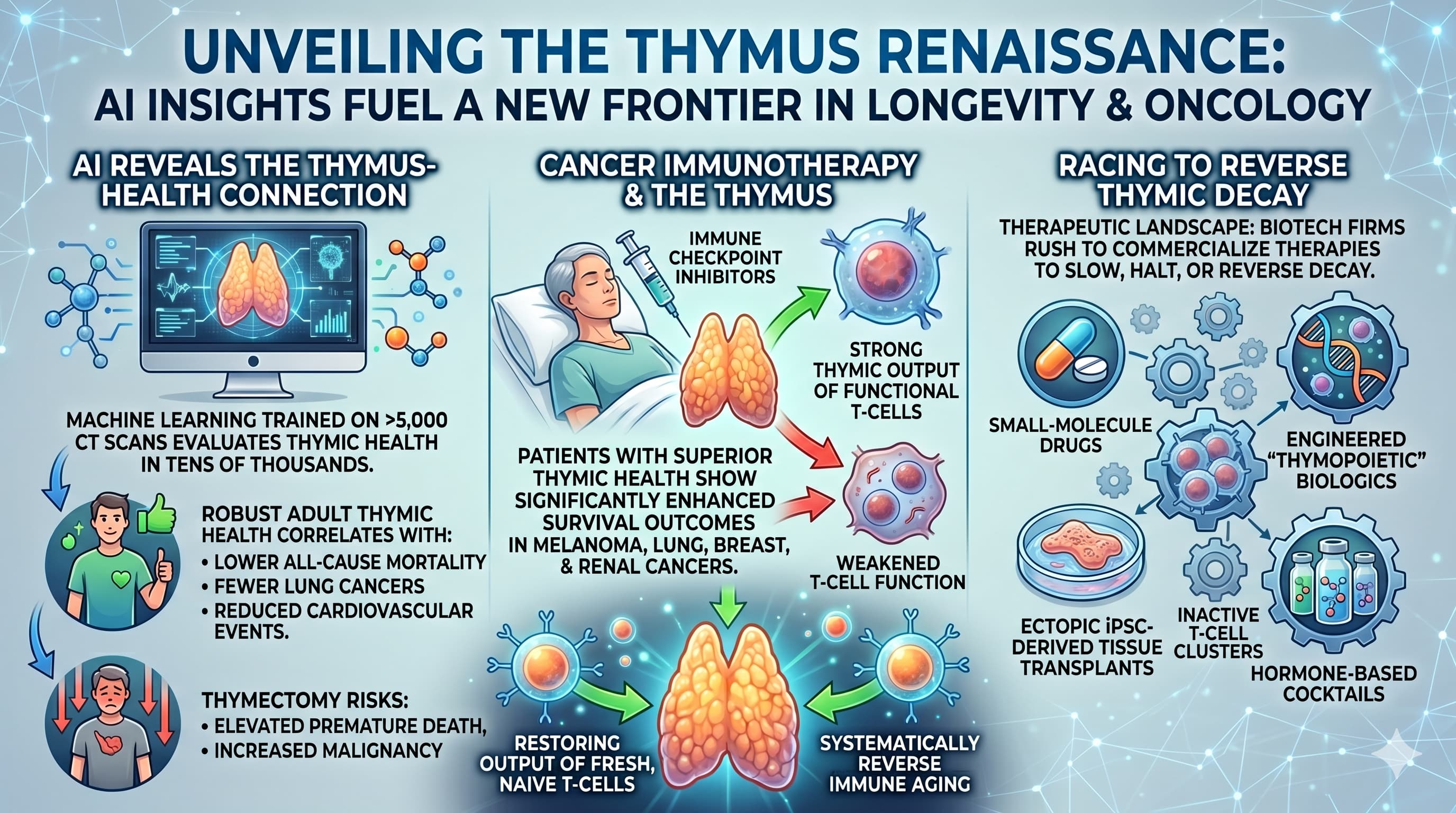
For decades, clinical consensus relegated the adult thymus to a biological graveyard. Safe behind the sternum, this small lymphoid gland works tirelessly during childhood to train T cells to defend the body without attacking its own tissues. Yet by puberty, the organ begins to shrink, gradually replacing its functional architecture with fat in a process known as thymic involution. By adulthood, it was widely deemed a useless, vestigial remnant—frequently excised during routine cardiac surgeries simply to clear a path to the heart.
That paradigm has officially collapsed. A surge of population-scale data and machine-learning insights has catalyzed a “thymus renaissance,” positioning thymic preservation as a critical, unexploited frontier in human longevity and oncology. Researchers utilizing an artificial intelligence tool trained on over 5,000 routine CT scans evaluated the thymic health of tens of thousands of adults. The conclusions were stark: robust adult thymic health strongly correlates with decreased all-cause mortality, a lower incidence of lung cancer, and reduced cardiovascular events. Furthermore, a secondary study revealed that cancer patients maintaining superior thymic health experience significantly enhanced survival outcomes when treated with immune checkpoint inhibitors across melanoma, lung, breast, and renal cancers. Conversely, historical data demonstrates that adults who undergo complete thymectomy suffer an elevated risk of premature death and malignancy.
Driven by these insights, a diverse cohort of biotechnology firms is racing to commercialize therapies capable of slowing, halting, or reversing thymic decay. The therapeutic landscape spans small-molecule oral drugs designed to upregulate master transcriptional nodes, engineered “thymopoietic” biologics, ectopic iPSC-derived tissue transplants, and hormone-based biochemical cocktails. While scaling and regulatory translation remain formidable hurdles, the fundamental objective is clear: by restoring the organ’s capacity to output fresh, naive T cells, science may finally possess the means to systematically reverse immune aging.
Actionable Insights
Despite the early clinical stage of direct rejuvenating therapies, the text highlights immediate, practical entry points for optimizing healthspan:
-
Incorporate Structured Caloric Restriction: Clinical evidence confirms that two years of voluntary caloric restriction in humans significantly preserves adult thymic function and maintains robust naive T-cell output.
-
Avoid Elective Thymectomy: Clinicians and patients should critically question the routine, elective removal of the thymus during adult cardiothoracic surgeries, given the documented long-term elevations in cancer incidence and mortality risk.
-
Leverage the Growth Hormone/Metformin Axis: While the landmark TRIIM protocol (combining recombinant human growth hormone, metformin, and DHEA) remains in localized trials, its dual-action design demonstrates that reversing epigenetic aging and expanding functional thymic mass in humans is biochemically achievable. Metformin serves a vital practical role here by neutralizing the diabetogenic side effects of growth hormone therapy.
-
Target Endogenous Repair Pathways: Future longevity protocols will likely exploit transient upregulation of local pathways, such as thymic-derived fibroblast growth factor 21 (FGF21), which directly protects the organ from age-related fat infiltration.
Context & Impact Evaluation
- Paywalled Paper: Thymus renaissance poised to boost health and longevity
- Institutions: Harvard Medical School (USA) and Maastricht University (Netherlands).
- Journal Name: Nature Biotechnology.
- Impact Evaluation: The impact score of this journal is 45.0, evaluated against a typical high-end range of 0–60+ for top general science, therefore this is an Elite impact journal.