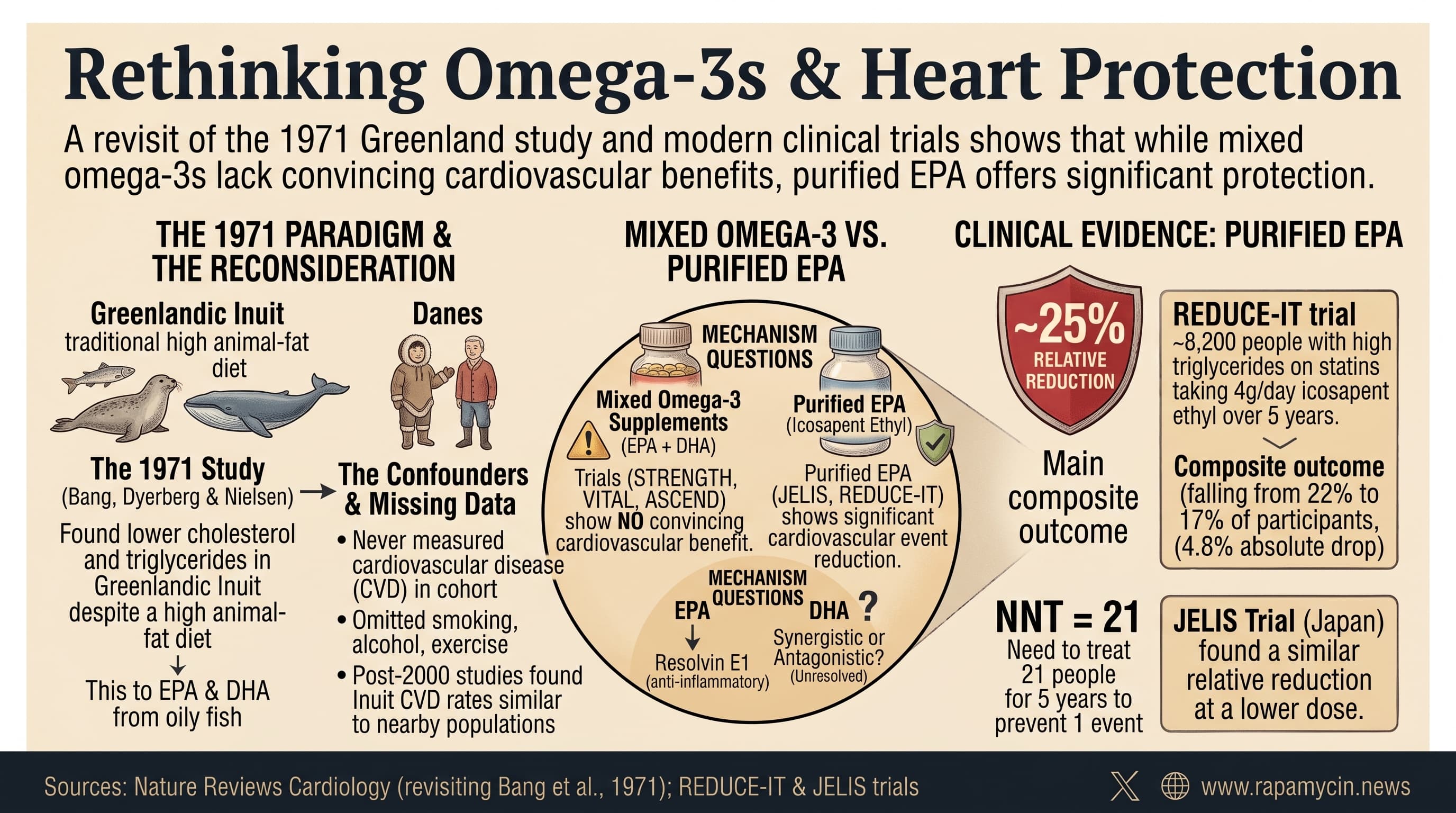
This is a Journal Club piece in Nature Reviews Cardiology, written by a doctoral researcher revisiting the 1971 Bang, Dyerberg and Nielsen paper that launched the omega-3 field. That study found Greenlandic Inuit had lower cholesterol, lipoproteins and triglycerides than Danes despite a high animal-fat diet, and attributed this to eicosapentaenoic acid (EPA) and docosahexaenoic acid (DHA) from oily fish. The author points out that the original work never measured cardiovascular disease in the cohort, omitted confounders including smoking, alcohol and exercise, and that post-2000 studies found Inuit cardiovascular disease prevalence similar to nearby populations. Modern randomized trials of mixed omega-3 supplements (STRENGTH, VITAL, ASCEND) failed to show convincing cardiovascular benefit, while trials of EPA alone or purified icosapent ethyl (JELIS, REDUCE-IT) did show significant event reductions over about five years. The author argues the mechanisms, the role of the EPA metabolite resolvin E1, and whether DHA acts synergistically or antagonistically remain unresolved.
Few nutrition stories have travelled further on weaker evidence than the Greenland fish oil hypothesis.
In 1971, three Danish scientists, Hans Olaf Bang, Jørn Dyerberg and Aase Brøndum Nielsen, published blood work from Inuit on Greenland’s west coast. Despite a diet heavy in seal and fish fat, these men and women had lower cholesterol, lower lipoproteins and lower triglycerides than Danes. Over the next seven years, Bang and Dyerberg traced this to two long-chain omega-3 fats, EPA and DHA, and proposed that EPA also thinned the blood by shifting the balance of clot-promoting signalling molecules.
The idea landed at a receptive moment. Heart disease deaths were climbing across northern Europe and the United States, and the Seven Countries Study had already pointed toward Mediterranean fish eaters as the healthy outliers. Within two decades, the UK’s Eatwell Guide, Australia’s Guide to Healthy Eating and Japan’s Spinning Top all recommended at least one portion of oily fish per week, citing omega-3 content. A global supplement industry followed.
The trouble, as this commentary notes, is what the 1971 study did not do. It never counted heart attacks or strokes in Greenland. It measured blood lipids, a surrogate, and inferred disease rates. It did not account for smoking, alcohol or physical activity, each of which differed substantially between the two populations. Later researchers went back with harder endpoints and found that Inuit communities across the Arctic had cardiovascular disease rates broadly in line with neighbouring non-Inuit populations. The authors of those studies were careful to note that Inuit life had changed enormously in the intervening decades, so the comparison is not clean either.
Then the trials arrived. STRENGTH, VITAL and ASCEND, three large randomized studies of omega-3 supplements, all failed to show convincing cardiovascular benefit. The hypothesis that had reshaped dietary guidelines did not survive its own test.
But the story has an awkward wrinkle. Two trials that used EPA alone rather than a mixture, JELIS in Japan and REDUCE-IT internationally, did report significant reductions in cardiovascular events over about five years, on top of statin therapy. Something in the purified-EPA arm appears to work, even as fish oil blends do not.
Why remains genuinely unsettled. One possibility is that DHA interferes with EPA, perhaps by competing for incorporation into cell membranes. Another is that the mineral oil placebo in REDUCE-IT exaggerated the apparent benefit, a criticism this commentary does not mention. A third focuses on EPA’s downstream metabolites, particularly resolvin E1, a molecule that actively switches off inflammation rather than merely suppressing it. That resolution biology is well studied in immune cells and poorly studied in heart and blood vessel tissue, which is where the author’s own laboratory work sits.
The broader lesson is about evidence. A surrogate marker, a confounded comparison and an untested causal claim became worldwide dietary policy. It took fifty years and tens of thousands of randomized participants to find out.
Actionable Insights
Mixed EPA plus DHA supplements have repeatedly failed to prevent cardiovascular events in large trials. In VITAL (around 25,900 participants, roughly five years, 1 g/day), the main cardiovascular outcome showed a hazard ratio near 0.92, which was not statistically significant. The absolute difference was under half a percentage point. In practical terms, that is a coin flip rather than a benefit. [Confidence: High]
Purified EPA is a different proposition. In REDUCE-IT (around 8,200 people with high triglycerides on statins, 4 g/day icosapent ethyl, about five years), the main composite outcome fell by about 25 percent in relative terms, from roughly 22 percent to 17 percent of participants, a 4.8 percentage point absolute drop. About 21 people needed treating for five years to prevent one event. JELIS in Japan found a similar relative reduction at a lower dose. Two caveats: the REDUCE-IT placebo was mineral oil, which may have raised event rates in the comparison group, and the dose is 4 g/day, roughly four to eight times a typical supplement. [Confidence: Medium]
Eating oily fish is not the same intervention as taking capsules and has not failed in the same way. The dietary guidance to eat fish once or twice a week remains reasonable, though its original justification was shakier than advertised.
Practical takeaway: a standard 1 g fish oil capsule has essentially no demonstrated cardiovascular event benefit. High-dose icosapent ethyl is a prescription drug used for elevated triglycerides on statin therapy, carries a known increase in atrial fibrillation and bleeding, and is a decision to make with a clinician.
Context and Source
- Paywalled Article: Fishing for answers: omega-3 fatty acids and cardiovascular health
- Institution: Comparative Biomedical Sciences, Royal Veterinary College, London
- Country: United Kingdom
-
Journal: Nature Reviews Cardiology, 2026
Impact evaluation: The impact score of this journal is 50.2 (2025 Journal Impact Factor, Clarivate JCR 2026; five-year JIF 60.3), evaluated against a typical high-end range of 0-60+ for top general science, therefore this is an Elite impact journal.