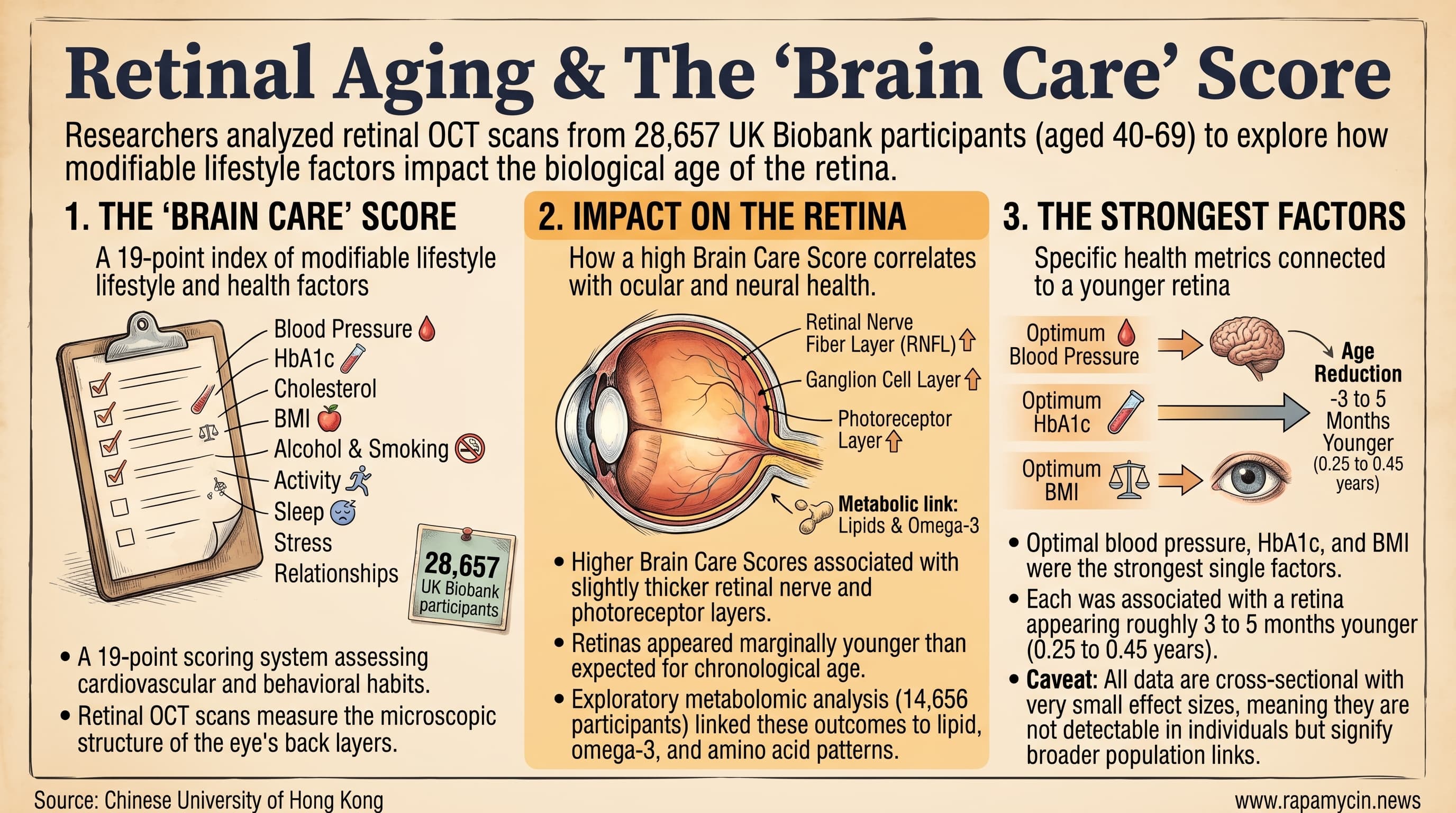
Researchers from the Chinese University of Hong Kong analyzed retinal OCT scans from 28,657 UK Biobank participants aged 40 to 69 and compared them with each person’s Brain Care Score, a 19-point index of modifiable factors including blood pressure, HbA1c, cholesterol, BMI, diet, alcohol, smoking, physical activity, sleep, stress and social relationships. Higher scores were associated with slightly thicker retinal nerve fiber, ganglion cell and photoreceptor layers and with a retina that appeared marginally younger than expected for age. Exploratory blood metabolomic analyses in 14,656 participants suggested lipid, omega-3 and branched-chain amino acid patterns statistically accounted for a small share of these links.
The back of your eye is a piece of brain you can photograph. The retina develops from the same embryonic tissue as the brain, and its nerve layers thin with age, with diabetes and high blood pressure, and in people heading toward dementia. That makes it a cheap, non-invasive window onto how well the nervous system is aging.
A team led by ophthalmologists at the Chinese University of Hong Kong used that window to test the Brain Care Score, a checklist developed at the McCance Center for Brain Health in Boston. The score awards points for healthy blood pressure, blood sugar, cholesterol and body weight; for diet, alcohol, smoking, exercise and sleep; and for low stress and good social relationships. Higher scores have previously been linked to healthier brain scans and lower risk of stroke, dementia and late-life depression.
The researchers analyzed retinal scans from 28,657 UK Biobank volunteers. People with higher scores had slightly thicker retinas in the layers most relevant to neurodegeneration: the nerve fiber and ganglion cell layers, which carry visual signals to the brain, and parts of the photoreceptor layer, which captures light. Every 5-point improvement on the 19-point scale went with about one micron more overall macular thickness.
The team also used a machine learning model to estimate each person’s “retinal age” from 60 scan measurements. A 5-point better score went with a retina that looked about four months younger than expected. Blood pressure, blood sugar and body weight drove most of the link. Not smoking, moderate drinking, exercise and at least seven hours of sleep added smaller contributions. Stress and social relationships showed nothing.
Blood chemistry hinted at why. In participants with metabolic profiling, patterns of circulating fats, including HDL subtypes, large triglyceride-rich particles, omega-3 fatty acids and branched-chain amino acids, statistically accounted for a small slice of the association, typically under 10 percent.
The size of these effects matters. One micron is about one seventieth the width of a human hair, smaller than the variation between repeat scans of the same eye. The authors themselves say the differences cannot be seen in an individual. Four months of retinal age is small next to the model’s average error of almost six years. The retinal age model is also weak: it tracked real age only modestly, and people with diagnosed heart disease, stroke or diabetes had retinas that looked just 0.2 years older than healthy people.
The design limits what can be concluded. Everything was measured at a single point in time, so the study cannot show that improving your score thickens your retina or slows its aging. The metabolite analyses are statistical decompositions of snapshot data, not proof that blood lipids carry the effect. And because cholesterol and blood sugar sit inside both the score and the blood panel, some overlap is built in.
What the study does show is consistency. Across tens of thousands of people, the same vascular and metabolic factors that predict brain health also track with a slightly healthier-looking retina. That supports the idea of the eye as a mirror of the brain, and gives researchers a reason to test retinal scans as a cheap readout in lifestyle and drug trials.
Actionable Insights
This study tested no intervention. It describes which everyday factors line up with retinal structure.
- Prioritize the physical numbers. Optimal blood pressure, HbA1c and BMI each went with a retina appearing roughly 3 to 5 months younger (0.25 to 0.45 years). These were the strongest single factors.
- Lifestyle adds a little. Not smoking, moderate alcohol, regular aerobic exercise and at least 7 hours of sleep each corresponded to about 1 to 2 months younger retinal age (0.08 to 0.15 years).
- Stress and social measures showed no retinal association in this dataset.
- Keep magnitudes in perspective. Moving from the bottom to the top quarter of brain care scores corresponded to about 1.5 microns more macular thickness (about half a percent) and a retina looking 0.39 years younger. In statistical terms that is roughly a tenth of a standard deviation, a very small effect. It matters for populations, not for reading your own scan.
- The omega-3 (DHA) link to photoreceptor thickness is a hypothesis, not a recommendation.
Context and Source
- Open Access Paper: Brain care score and retinal health: structural and metabolic insights from the UK Biobank
- Institutions: Department of Ophthalmology and Visual Sciences, The Chinese University of Hong Kong; Hong Kong Eye Hospital; Prince of Wales Hospital; Sichuan Provincial People’s Hospital and University of Electronic Science and Technology of China (Chengdu)
- Country: China (Hong Kong SAR and Sichuan). Data from the United Kingdom.
- Journal: GeroScience (Springer), official journal of the American Aging Association.
- Impact evaluation: The impact score of this journal is 4.9 (2024 Journal Impact Factor; CiteScore 8.3), evaluated against a typical high-end range of 0-60+ for top general science, therefore this is a Medium impact journal. Within aging-specific journals it sits in the top quartile.