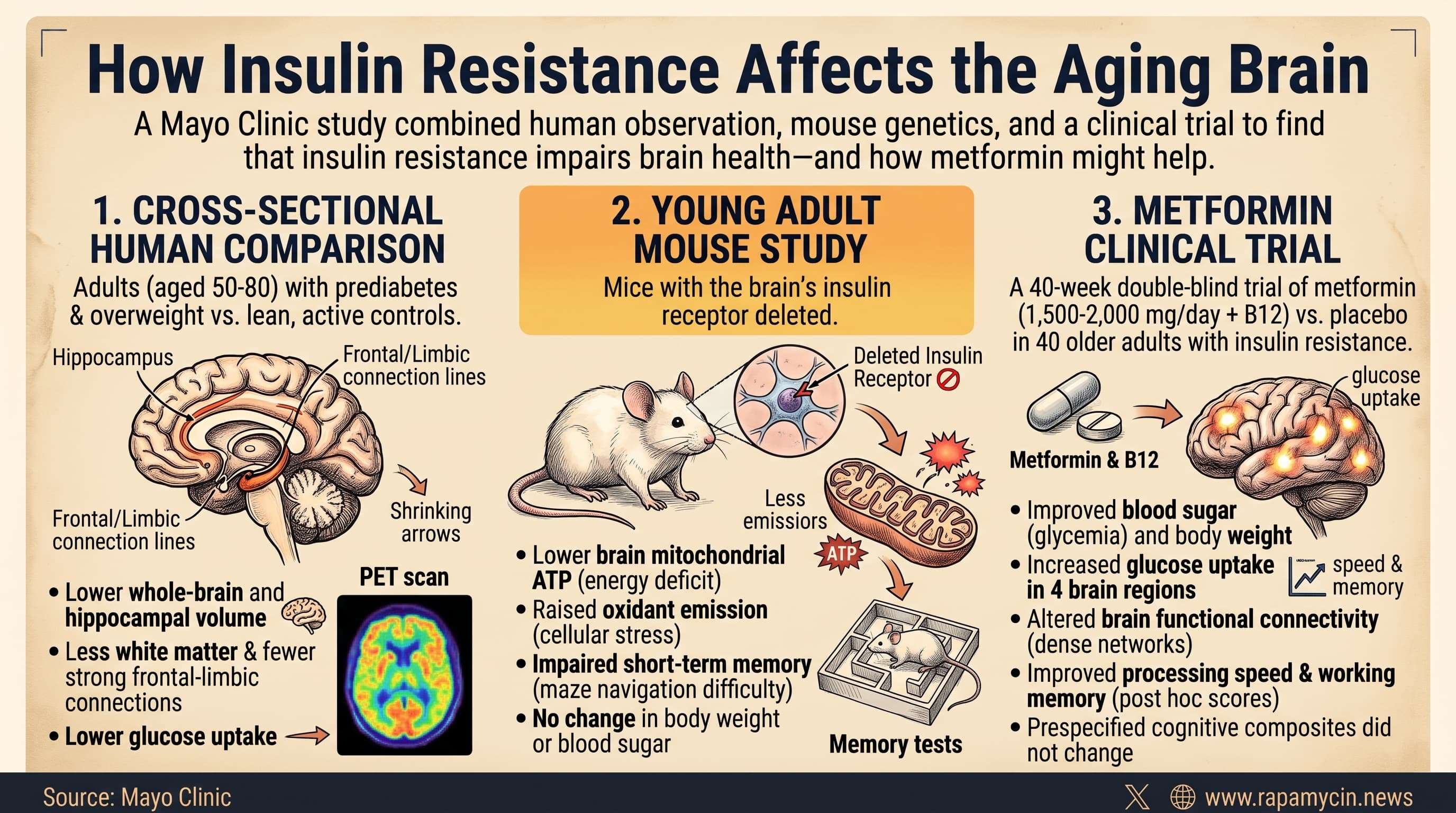
A Mayo Clinic team combined three lines of evidence on how insulin resistance affects the aging brain. In a cross-sectional comparison of 74 adults aged 50 to 80, people with prediabetes-range fasting glucose and overweight had lower whole-brain and hippocampal volume, less white matter, lower glucose uptake on PET, and fewer strong functional connections between frontal and limbic regions than lean, exercising controls. In young adult mice, deleting the insulin receptor in the brain lowered brain mitochondrial ATP production, raised oxidant emission and impaired short-term memory, with no change in body weight or blood sugar. In a double-blind trial, 40 older adults with presumed insulin resistance took metformin (1,500 to 2,000 mg/day, plus vitamin B12) or placebo for 40 weeks. Metformin improved glycemia and weight, increased glucose uptake in four brain regions, changed functional connectivity, and improved a post hoc processing speed and working memory score. Prespecified cognitive composites did not change.
Your brain uses about a fifth of your body’s energy, and it runs mainly on glucose. A Mayo Clinic team led by K. Sreekumaran Nair asked a simple question: what happens to that fuel supply when the body becomes resistant to insulin, as it does in many people in their 60s and 70s? Their answer, published in the Journal of Clinical Investigation, is that the brain seems to run on a slightly emptier tank, and that a cheap diabetes drug may partly refill it.
The researchers first compared 56 older adults with overweight and fasting glucose in the prediabetes range against 18 lean, regularly exercising peers. The metabolically unhealthy group had brains about 4 to 5 percent smaller relative to skull size, with the losses concentrated in white matter, the wiring that links brain regions, and in the hippocampus, a key memory hub. PET scans showed lower glucose uptake in prefrontal, parietal and cingulate areas involved in attention and working memory. Resting-state MRI showed fewer strong links between frontal regions and the brain’s default mode network.
That comparison cannot show cause and effect, especially since the healthy group was also leaner and exercised more. So the team turned to mice. They deleted the insulin receptor in the brains of young adult mice without changing their body weight or blood sugar. Brain mitochondria in these animals produced about a third less ATP, released almost twice as much hydrogen peroxide, and had less antioxidant capacity. The mice also did worse on simple maze tests of short-term spatial memory.
The final step was a randomized trial. Forty adults in their 60s with presumed insulin resistance took metformin or a placebo for 40 weeks. Everyone took vitamin B12, since metformin can deplete it and B12 deficiency harms cognition. Metformin lowered HbA1c, fasting glucose and body fat as expected. Whole-brain glucose uptake trended upward but did not reach significance. Four regions, including parts of the orbitofrontal cortex and the thalamus, showed significantly larger increases on metformin. Average cortical thickness changed by +0.44 percent with metformin versus -0.26 percent with placebo, a difference that was not statistically significant. Two visual-cortex regions did reach significance. Metformin also produced more changes in functional connectivity, centered on the executive control network.
The cognitive result needs careful reading. A combined score for processing speed and working memory improved more with metformin, by a moderate effect size. However, that composite was built after the fact. The three cognitive composites the team specified in advance showed no difference.
The study has real strengths: a placebo control, B12 supplementation that removes an important confounder, and multimodal imaging rarely combined in a single trial. It also has real limits. With only 20 people per arm, a single site, many brain regions tested and few corrections for multiple comparisons, it is best read as a well-designed pilot. The larger MAP trial, which is testing metformin in more than 300 people with mild cognitive impairment, should give a clearer verdict.
Actionable insights
This is a careful, multimodal pilot from an experienced metabolic group, with good design choices (placebo control, B12 supplementation, controlled fasting conditions). Its headline claims (“preserves structure,” cognitive benefit) run ahead of its statistical power and its post hoc cognitive endpoint. The most robust conclusions are that metformin improved glycemia and weight as expected, and that insulin resistance tracks with a less energetic, less connected brain. Whether metformin itself protects the brain remains open.
- Glucose control is the strongest result. In older adults with prediabetes-range blood sugar, 40 weeks of metformin produced large improvements relative to placebo: HbA1c fell by roughly 0.25 percentage points (effect size d about 1.3, large), BMI fell by about 1.2 units, or roughly 3 to 4 kg (d about 1.1), and fasting glucose dropped by about 7 mg/dL (d about 0.9).
- Brain effects were moderate and regional. Glucose uptake rose in four regions (d about 0.7 each), but the whole-brain change was not significant.
- Cognition improved on one measure that was defined after the data came in (d about 0.76). Treat this as a hypothesis, not a benefit.
- If you take metformin, keep vitamin B12 up. The trial supplemented everyone and kept levels above 180 ng/L.
- Exercise was the hidden variable. The healthy comparison group exercised at least three times a week. In a separate trial (MASTERS), 1,700 mg/day of metformin blunted lean mass gains from resistance training in adults over 65. If you lift weights, discuss this tradeoff with your clinician.
Context and source
- Open Access Paper: Metformin Preserves Regional Brain Glucose Uptake, Structure, and Functional Connectivity in Adults with Insulin Resistance, Published October 27, 2026.
- Institution: Mayo Clinic, Rochester, Minnesota, with Hanyang University, Seoul (fMRI analysis)
- Country: United States (with a South Korean collaborator)
-
Journal: The Journal of Clinical Investigation (American Society for Clinical Investigation)
Impact evaluation: The impact score of this journal is 14.3, evaluated against a typical high-end range of 0-60+ for top general science, therefore this is a High impact journal.