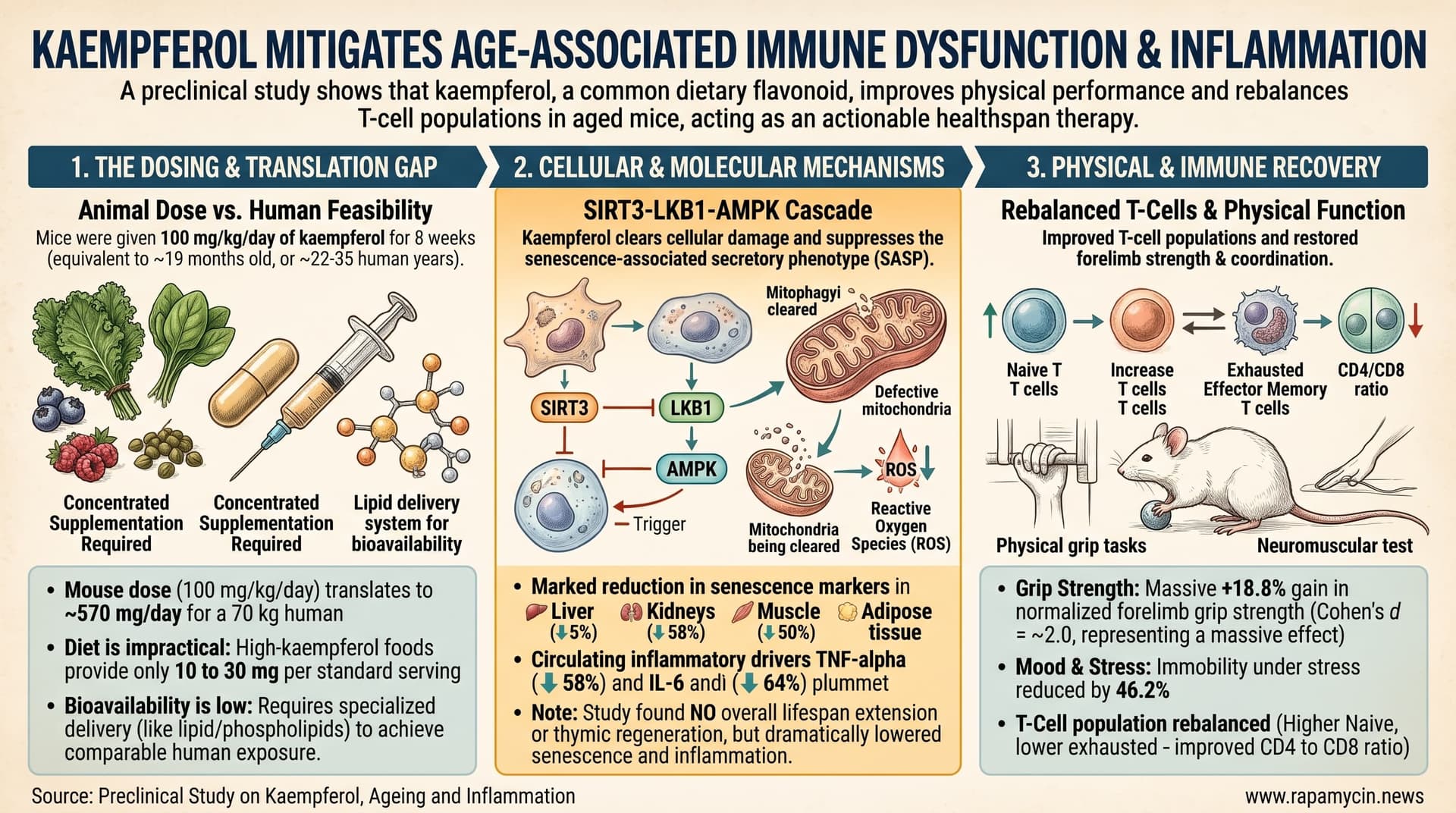
A new preclinical study demonstrates that kaempferol, a common dietary flavonoid found in kale, spinach, and berries,effectively mitigates age-associated immune dysfunction and systemic inflammation in mice. Administering kaempferol to nineteen-month-old mice for eight weeks significantly improved physical performance, restoring grip strength and neuromuscular coordination while reducing depressive behaviors. The compound rebalanced peripheral T-cell populations by increasing naive T cells, lowering exhausted effector memory T cells, and elevating the CD4 to CD8 ratio. At the cellular level, kaempferol eliminated defective mitochondria and lowered toxic reactive oxygen species through the SIRT3-LKB1-AMPK signaling cascade, thereby repressing the senescence-associated secretory phenotype. Although the intervention failed to achieve a statistically significant extension in overall lifespan or regenerate the atrophied thymus, it markedly reduced senescence markers across the liver, kidneys, muscle, and adipose tissue, highlighting its viability as an actionable nutritional therapy to preserve functional healthspan.
As mammalian bodies grow older, the immune system undergoes a double failure. It loses the capacity to mount effective defenses against novel pathogens while simultaneously stoking a persistent, destructive fire known as inflammaging.Central to this breakdown are aging T cells. Instead of protecting the host, these exhausted white blood cells turn into persistent sources of inflammatory poisons, leaking toxic signaling molecules that degrade muscle fibers, damage organs,and accelerate frailty.
A research team at Shandong University has demonstrated that dietary administration of the natural plant flavonoid kaempferol can break this destructive loop by targeting cellular waste disposal inside aged T cells.
The investigators placed nineteen-month-old mice, roughly equivalent to sixty-year-old humans, on chow supplemented with kaempferol for eight weeks. Rather than attempting to revive the thymus, the primary immune organ that generates fresh T cells and typically undergoes near-total atrophy by middle age, the treatment targeted the survival and functional quality of circulating T cells already in the periphery.
The phenotypic improvements were pronounced. Mice receiving the higher dietary dose demonstrated substantial gains in neuromuscular coordination and grip strength alongside marked reductions in depressive-like behavior during stress challenges. Looking deeper into the tissues, the researchers discovered that the compound extinguished inflammatory and senescence markers across vital organs, including the liver, kidneys, skeletal muscle, and visceral fat depots.
The root cause of these systemic benefits traced back to mitochondrial health inside the T cells themselves. Aged lymphocytes typically accumulate swollen, leaky mitochondria that generate damaging reactive oxygen species and trigger chronic inflammatory secretions. Kaempferol reversed this degradation by activating a specialized cellular cleanup pathway known as mitophagy.
Through molecular docking and cellular assays, the researchers proved that kaempferol interacts with SIRT3, a critical mitochondrial enzyme. SIRT3 de-acetylates the regulator LKB1, which subsequently switches on AMPK, the primary metabolic gauge of the cell. This cascade flags worn-out mitochondria for rapid engulfment and degradation in cellular lysosomes. Once these dysfunctional powerhouses were eliminated, overall cellular energy production stabilized, oxidant production plummeted, and the T cells stopped spewing destructive cytokines like interleukin-6, interleukin-17A, and tumor necrosis factor-alpha. Using gene-editing tools to delete SIRT3 completely eliminated these therapeutic effects,demonstrating that this cleanup pathway is strictly mandatory.
Crucially, the compound did not significantly extend the total lifespan of the animals, yielding only a non-significant trend toward longer survival. It also failed to reverse structural thymic shrinkage. What it accomplished instead was functional rejuvenation: restoring the peripheral ratio of helper-to-cytotoxic T cells, increasing the supply of naive T cells, and substantially improving late-life physical vigor. Kaempferol demonstrates that targeting metabolic quality control in circulating immune cells offers a realistic pathway to preserve late-life physical function and shorten the period of age-related infirmity.
Actionable Insights
For individuals focused on healthspan optimization, this research highlights the therapeutic potential of targeting peripheral immune metabolism. The study utilized a high dose of 100 milligrams per kilogram of body weight per day in mice. Applying standard allometric scaling translates this animal dose to roughly 8.1 milligrams per kilogram in humans,equivalent to approximately 570 milligrams daily for a 70-kilogram adult.
Achieving this intake solely through diet is impractical. High-kaempferol foods such as capers, kale, spinach, and watercress provide only 10 to 30 milligrams per standard serving. Concentrated dietary supplementation would be required to approximate these experimental exposures.
The magnitude of physical benefit in the animal model was substantial. Kaempferol produced an 18.8 percent gain in normalized forelimb grip strength (standardized Cohen’s d of approximately 2.0, representing a massive effect) and reduced immobility under stress by 46.2 percent. Circulating levels of key inflammatory drivers such as tumor necrosis factor-alpha and interleukin-6 dropped by 58 to 64 percent. However, because kaempferol has naturally low human oral bioavailability, biohackers should recognize that high oral doses may require lipid-based or phospholipid delivery systems to achieve comparable cellular concentrations.
Context/Source
- Open Access Paper: Kaempferol alleviates T-cell immunosenescence and inflammaging in aged mice via the SIRT3-LKB1-AMPK-mitophagy pathway. Published Feb. 2, 2026.
- Institutions: Institute of Women, Children and Reproductive Health, Cheeloo College of Medicine, Shandong University; Shandong Provincial Hospital, Cheeloo College of Medicine, Shandong University
- Country: China
- Journal Name: Immunity & Ageing
- Journal Impact Evaluation: The impact score of this journal is 7.9, evaluated against a typical high-end range of 0–60+ for top general science, therefore this is a High impact journal.