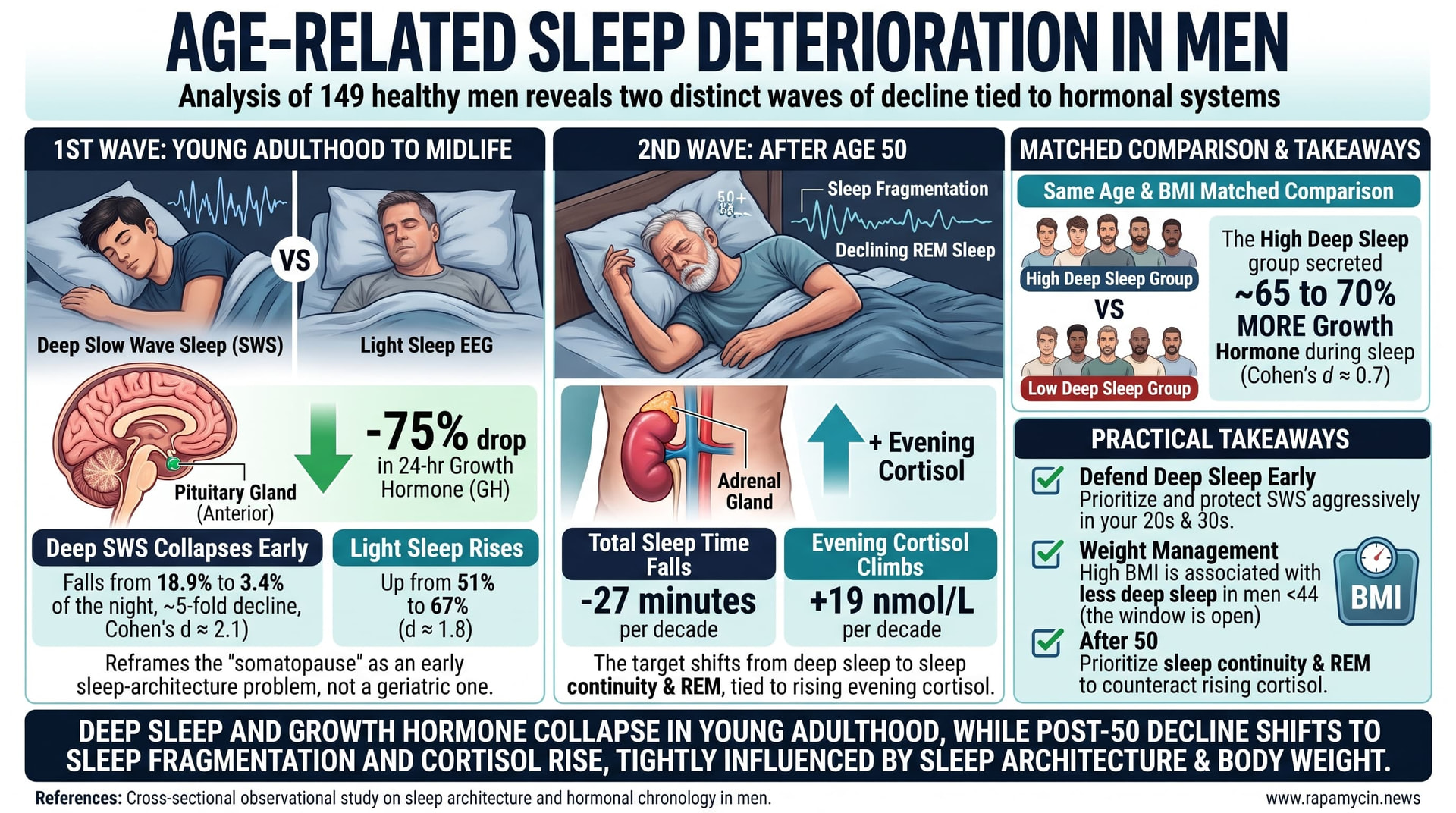
This pooled analysis of 149 healthy men aged 16 to 83 shows that age-related sleep deterioration happens in two distinct waves, each tied to a different hormonal system. Deep slow wave sleep collapses early, falling roughly five-fold between early adulthood and midlife, and this collapse runs in parallel with a near 75 percent drop in 24-hour growth hormone secretion. Critically, when the authors modeled growth hormone against age and slow wave sleep together, slow wave sleep carried the statistical weight and age by itself did not. The second wave arrives after about age 50: sleep becomes fragmented, REM sleep declines, total sleep time falls by roughly 27 minutes per decade, and evening cortisol begins climbing by about 19 nmol/L per decade. The study is cross-sectional, male-only, and observational, so it establishes chronology and association rather than causation. But it reframes the somatopause as a sleep-architecture problem beginning in young adulthood rather than a geriatric one.
For most of the last half century, the decline of growth hormone with age has been filed under geriatrics. Clinics sell recombinant growth hormone and secretagogues to men in their sixties and seventies on the premise that this is when the deficiency bites. This paper, assembled from 149 healthy men studied across four sleep laboratories between 1985 and 1999, says that premise has the timing badly wrong.
The researchers took 24-hour blood sampling at 15 to 30 minute intervals, paired with overnight polysomnography, and sorted the results by age band rather than the usual young-versus-old split. What emerged was not one curve but two, separated by decades.
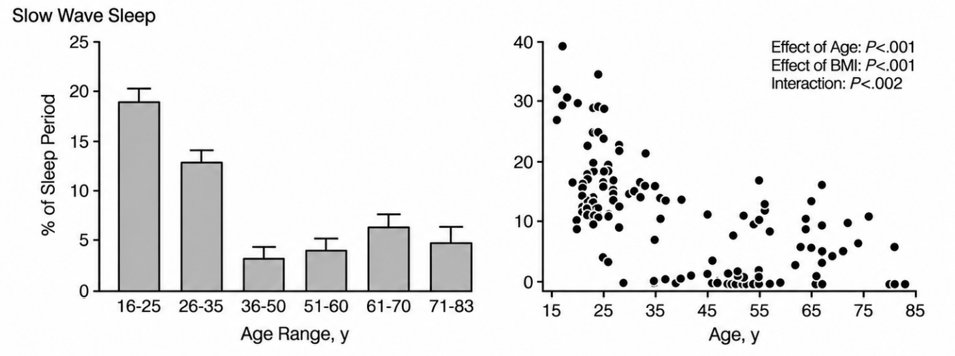
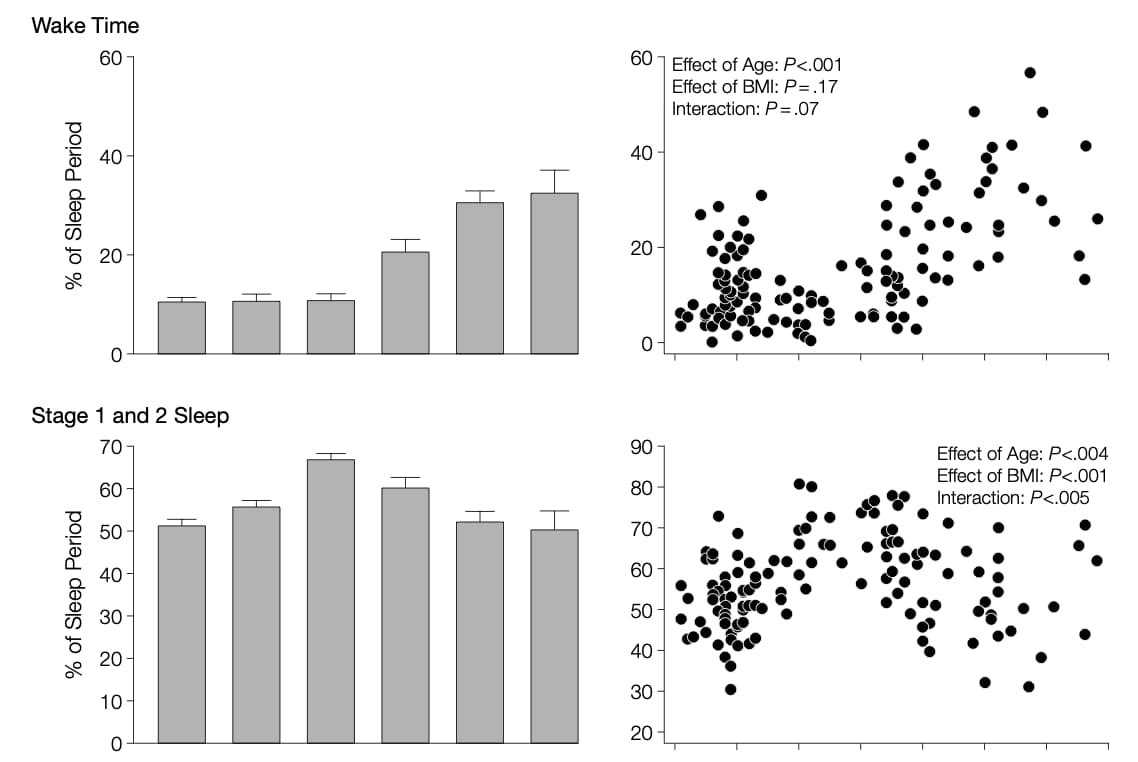
The first wave is the loss of deep sleep. Between the 16 to 25 band and the 36 to 50 band, slow wave sleep fell from about 19 percent of the night to about 3 percent. The lost deep sleep was not replaced by wakefulness. It was replaced by light stage 1 and 2 sleep. Total time asleep barely moved. A man of 45 in this cohort was sleeping about as long as a man of 20, but in a structurally different and far shallower way.
Growth hormone tracked that curve almost exactly, falling close to 75 percent over the same interval. The interesting part is what happened when age and slow wave sleep were entered into the same model. Slow wave sleep explained the variance. Age, on its own, explained essentially nothing. Deep sleep was not a marker of hormonal aging in these men so much as a proxy for the mechanism.
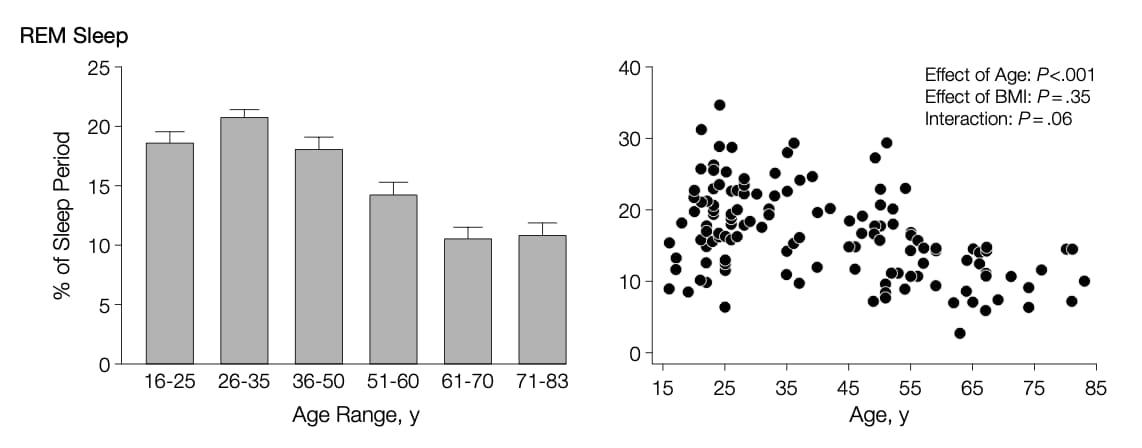
The second wave begins around the fifth decade and has nothing to do with growth hormone. Here sleep starts breaking apart. Time awake in bed rose by roughly 28 minutes per decade, REM sleep by then had fallen by about half compared with young adulthood, and evening cortisol, which had been flat for thirty years, began a steady climb. Morning cortisol peaks did not change. What changed was the body’s ability to switch the stress axis off at night.
That matters because the evening trough is where glucocorticoid excess does its damage, and chronically elevated evening cortisol has been linked to insulin resistance and memory impairment. The authors frame it as accumulating allostatic load: the wear from a stress system that no longer stands down.
The limits are significant. This is cross-sectional data pooled from studies not designed to answer this question, combining two different growth hormone assay methods, in men only, who slept in a laboratory with a catheter in one arm and at least eight hours of enforced darkness. Nothing here was randomized. Nobody’s sleep was manipulated and nobody’s hormones were measured afterward.
What it does deliver is a map with timing on it. If slow wave sleep is the lever on the growth hormone axis, the window to pull it opens in your twenties and is mostly closed by 50. If sleep continuity and REM are the levers on evening cortisol, that window opens later. Two targets, two clocks, and interventions aimed at the wrong decade.
Actionable Insights
Effect size is simply how large a difference is relative to the natural spread in the data. A Cohen’s d of 0.2 is small, 0.5 is moderate, 0.8 is large. Anything above 2.0 means the two groups barely overlap.
The headline difference here is enormous. Slow wave sleep falling from 18.9 percent to 3.4 percent of the night between young adulthood and midlife works out to a Cohen’s d of roughly 2.1. That is not a subtle aging effect. It is the near-total disappearance of a sleep stage. Light sleep rising from 51 to 67 percent gives a d of about 1.8.
The more useful number for anyone deciding what to do is the matched comparison the authors ran. They took men of the same age and same BMI and split them by how much deep sleep they actually got. The high deep sleep group secreted roughly 65 to 70 percent more growth hormone during sleep than the low group, a moderate-to-large effect of around d equals 0.7. Same age, same body composition, different sleep, meaningfully different hormone output.
Practical takeaways: deep sleep is worth defending aggressively starting in your twenties and thirties, but perhaps less so at 60. Higher BMI was associated with less deep sleep in men under 44 but not over, so weight management is a sleep-architecture lever that appears to work only while the window is open. After 50, the target shifts to sleep continuity and REM, which the data tie to evening cortisol.
Context and Source
- Paywalled Paper: Age-Related Changes in Slow Wave Sleep and REM Sleep and Relationship With Growth Hormone and Cortisol Levels in Healthy Men, Published Aug. 16, 2000.
- Institution: Department of Medicine, University of Chicago, Chicago, Illinois. Contributing data sets came from the University of Pittsburgh, the University of California Los Angeles, and Pennsylvania State University at Hershey.
- Country: United States
- Journal: JAMA (The Journal of the American Medical Association), 2000.
- Impact evaluation: The impact score of this journal is 65.4, evaluated against a typical high-end range of 0 to 60+ for top general science and medicine, therefore this is an Elite impact journal.
Related Reading:
- Sleep Quality Beats Duration: Why Staying Asleep is the Hidden Key to Cognitive Longevity
- Five Sleep Habits Linked to a 24% Lower Risk of Thyroid Disease
- Older Brains Still Need Their Sleep. They Have Lost the Machinery to Make It
- The Hidden Architecture of Longevity: Machine Learning Decodes 95,000 Sleep Trackers Across 1,000 Diseases
- The Smartwatch on Your Wrist Is a Measuring Instrument Nobody Calibrated - #3 by Yogo25
- A Heart Pill and a Vibrating Mattress May Clear Alzheimer’s Protein From The Brain
- Hormones and the Body Clock Shape Each Other Across Life, and Both Lose Their Rhythm With Age
- Exercise May Offset the Aging Cost of Sitting and Poor Sleep, a French Study Hints