A Heart Pill and a Vibrating Mattress May Clear Alzheimer’s Protein From The Brain

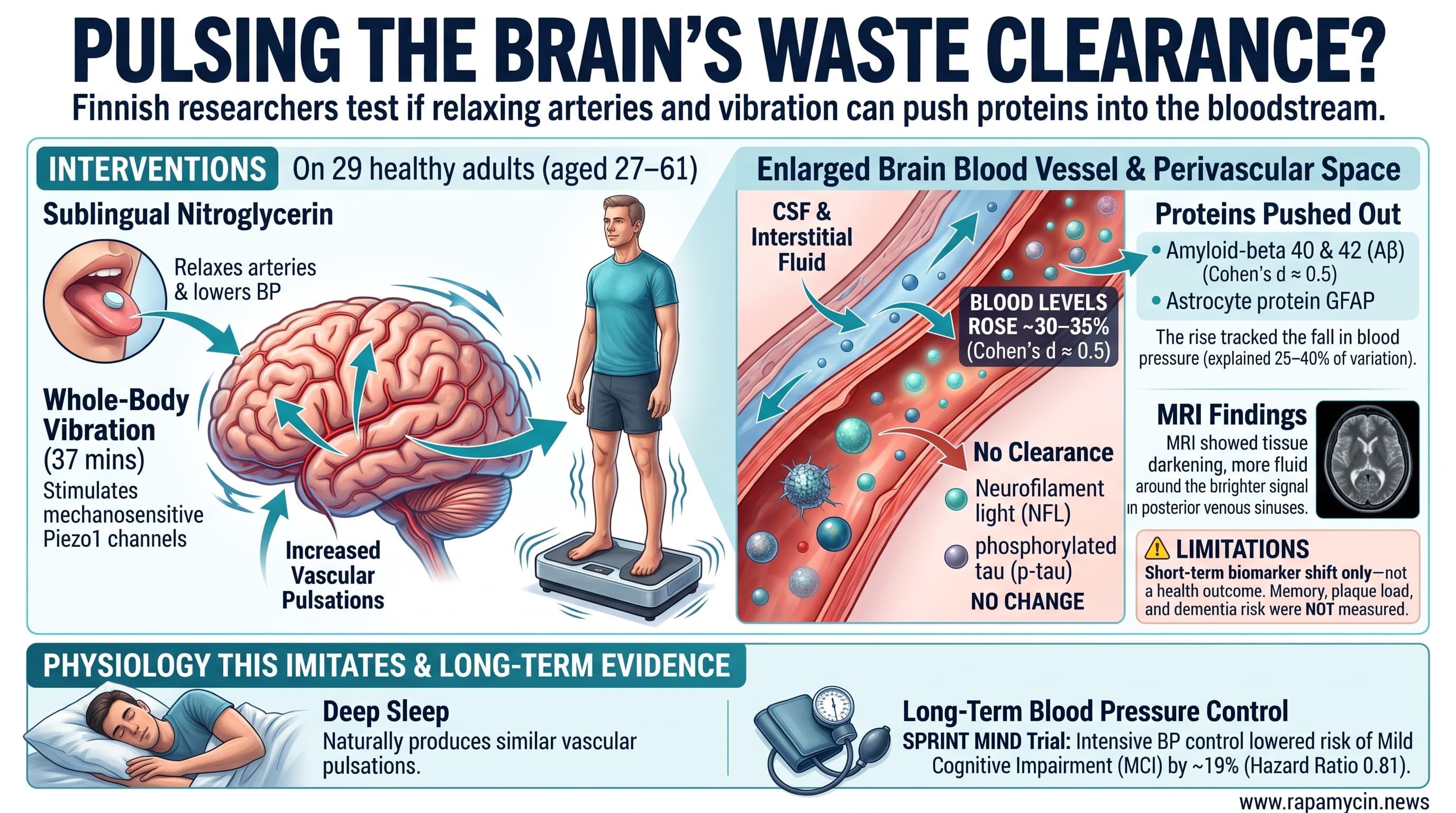
Finnish researchers tested whether manipulating blood vessels could push proteins out of the human brain and into the bloodstream. Twenty-nine healthy adults aged 27 to 61 received sublingual nitroglycerin, a nitric oxide donor that relaxes arteries and lowers blood pressure, combined with 37 minutes of patterned whole-body vibration designed to stimulate the mechanosensitive Piezo1 channel. After the combined session, blood levels of amyloid-beta 40, amyloid-beta 42 and the astrocyte protein GFAP rose by roughly 30 to 35 percent, and the size of the rise tracked how far blood pressure fell. MRI showed brain tissue signal darkening, more fluid around the brain and brighter signal in posterior venous sinuses. Larger proteins, neurofilament light and phosphorylated tau, did not change. The findings hint at a non-invasive way to boost brain clearance, but the study was small and short, and its key blood measurements had no control arm.

Every night while you sleep, your brain rinses itself. Cerebrospinal fluid washes through brain tissue and carries away waste proteins, including the amyloid-beta that clumps into plaques in Alzheimer’s disease. This plumbing, often called the glymphatic system, appears to falter with age, and many researchers suspect the failure begins years before memory does. A team led by Vesa Kiviniemi at the University of Oulu in Finland asked a direct question: can we turn that drainage up in awake humans?

Their approach targeted the blood vessels that drive brain fluid flow. Nitric oxide relaxes arteries, and in mice, lowering blood pressure with nitric oxide donors pushes cerebrospinal fluid tracers out of the skull and into the blood. A second lever is Piezo1, a channel in vessel walls that responds to mechanical force. Gentle mechanical stimulation of Piezo1 in mice restores sluggish lymphatic drainage in the neck. The Finnish group combined both. Volunteers placed a nitroglycerin tablet under the tongue, the same drug used for angina, then lay on a vibrating mattress that cycled between 22 and 50 hertz in a pattern meant to keep Piezo1 responsive rather than numb.

The results were clear in direction, if modest in scale. Blood pressure fell by about 15 percent at its lowest point. Blood levels of two forms of amyloid-beta and of GFAP, a protein made by the brain’s astrocyte support cells, rose by roughly a third after correcting for the blood thinning that nitroglycerin causes. People whose blood pressure dropped the most showed the biggest protein rises. Two larger brain proteins, neurofilament light and phosphorylated tau, did not budge, which the authors read as a size filter on the exit route.

Brain scans told a parallel story. A clinical MRI sequence sensitive to the protein content of water showed the whole brain darkening slightly, the fluid space around the brain expanding by about 6.5 milliliters, and signal brightening in two large veins at the back of the head. Blood amyloid levels correlated, weakly, with that venous signal. Changes were larger in older participants. Nitroglycerin alone reproduced much of the brain darkening, vibration alone did little the scanner could detect, and the combination affected a wider area of brain than either alone.

The authors draw a parallel to sleep. Nitroglycerin amplified slow oscillations in blood vessel diameter near 0.1 hertz and breathing-linked pulsations, rhythms that intensify in deep sleep and are thought to pump fluid through the brain.

The study has important gaps. It enrolled 29 healthy adults and measured blood proteins once, about 90 minutes after treatment. It did not measure blood proteins at all after vibration alone, nitroglycerin alone or a sham session. A rise in blood amyloid could mean more protein leaving the brain, but it could also mean slower removal of amyloid by the liver and kidneys while blood pressure is low, or a temporary loosening of the blood-brain barrier. Nobody yet knows whether repeated treatment would lower brain amyloid or protect memory.

What the paper does establish is that human brain fluid dynamics respond measurably, within a couple of hours, to deliberate vascular manipulation. That moves the brain’s drainage system closer to being a practical therapeutic target rather than a purely theoretical one.

Insights

  1. In this trial, one volunteer taking nitroglycerin vomited and withdrew, and others had headaches or nausea. Combining nitrates with PDE5 inhibitors such as tadalafil or sildenafil can cause dangerous, potentially fatal drops in blood pressure. For repeated or long-term use for this purpose: Safety Data Absent.
  2. The benefit measured is a short-term biomarker shift, not a health outcome. Blood amyloid rose about a third, a moderate effect (Cohen’s d about 0.5, meaning the average person moved about half of the normal person-to-person spread). The size of the blood pressure drop explained roughly 25 to 40 percent of the variation in that rise. Memory, plaque load and dementia risk were not measured.
  3. Deep sleep naturally produces similar vascular pulsations. Long-term blood pressure control has real outcome data: in the SPRINT MIND trial, intensive control lowered the risk of mild cognitive impairment by about 19 percent (hazard ratio 0.81).
  4. Vibration platforms are low risk, but here vibration alone produced only small imaging changes and was never tested on blood biomarkers.
  5. Endothelial nitric oxide production declines with age. Regular aerobic exercise is the best-documented way to maintain it.

Context and Source

  • Open access Paper: Vasomechanic treatment is associated with increased efflux of human brain proteins
  • Institution: Oulu Functional Neuroimaging, University of Oulu and Oulu University Hospital, with collaborators at Lund University, University of Eastern Finland and Kuopio University Hospital, University of Rochester, and University of Copenhagen (Maiken Nedergaard’s group)
  • Country: Finland (lead), with Sweden, USA and Denmark
  • Journal: Nature Communications
  • Impact evaluation: The impact score of this journal is 18.1, evaluated against a typical high-end range of 0-60+ for top general science, therefore this is a High impact journal.

Related Reading:

The Translational Protocol (Rigorous Extrapolation)

Pharmacokinetics and Pharmacodynamics (sublingual nitroglycerin)

Parameter Value
Absolute bioavailability About 40% from sublingual tablets, variable with sublingual hydration and mucosal metabolism
Tmax About 6 to 7 minutes
Cmax (0.6 mg) 2.1 ng/mL
Elimination half-life 2 to 3 minutes, range 1.5 to 7.5 minutes
Clearance 13.6 L/min, greatly exceeding hepatic blood flow; metabolism is the primary route of elimination
Volume of distribution 3.3 L/kg after intravenous administration
Active metabolites 1,2- and 1,3-dinitroglycerin peak at about 15 minutes with elimination half-lives of 36 and 32 minutes, at about 2% and 10% of the parent’s activity
Onset of vasodilation 1 to 3 minutes, maximal by 5 minutes, effects persist at least 25 minutes

Practical implication: the parent drug is gone within minutes. The trial’s post-intervention blood draw was taken roughly 90 minutes after dosing, which is about 30 parent half-lives and 2 to 3 dinitrate half-lives. The biomarker rise was measured in a window when the acute pharmacology had largely dissipated, which argues the signal is a downstream consequence of the earlier hemodynamic event rather than a direct drug artifact. That is a modest point in the paper’s favor and also means the window for capturing peak effect is uncharacterized.

Safety and Toxicity

No-Observed-Adverse-Effect Level (NOAEL):

  • Dog, one year oral gavage: LOAEL 1 mg/kg/day, with mild methemoglobinemia at 1 mg/kg/day and above
  • Reproductive NOAEL: 0.1% in the diet for parents and offspring; at 1% there were reduced litter size, birth weight, and survival, and diaphragmatic hernia and delayed ossification in offspring

Margin check: the trial’s acute 1 mg total dose is about 0.014 mg/kg, roughly 200-fold below the rat chronic NOAEL on a mg/kg basis and about 2,600-fold below after BSA correction. Organ toxicity is not the limiting factor at this dose.

LD50:

  • The estimated lethal oral dose in humans is 200 mg, though people have survived 1,200 mg with no apparent ill effects

Phase I safety profile: not applicable in the conventional sense. Nitroglycerin has over 130 years of clinical use and a full FDA label; there is no modern Phase I to cite. The relevant acute safety data is the trial’s own: four participants reported headache and three reported nausea after NO, one discontinued due to vomiting, all symptoms resolved within 30 minutes, and no serious adverse events occurred. For chronic or repeated use of this protocol specifically: Safety Data Absent.

CYP450 and hepatic/renal signals:

  • The major metabolic pathway is non-CYP. Nitroglycerin is rapidly metabolized in the liver by glutathione-organic nitrate reductase to dinitrates and mononitrates, and there is no clinical or experimental evidence of interactions with CYP metabolism of other drugs.
  • Hepatocyte work shows partial CYP involvement: nitrate formation from GTN by isolated rat hepatocytes was inhibited about 50% when cellular glutathione was depleted and about 40% when cytochrome P-450 was inactivated; depleting glutathione and/or inactivating CYP markedly increased GTN cytotoxicity. Relevant mainly as a theoretical caution for people with depleted glutathione.
  • Hepatic exposure is insignificant; a high and variable plasma clearance of 10 to 50 mL/min points to a high degree of extrahepatic metabolism.
  • Chronic animal signal: in animal studies continuous administration of organic nitrates decreased hepatic P450 content and induced heme oxygenase, and chronic high-dose rat exposure produced bile duct fibrosis and proliferation, renal epithelial pigmentation, liver enlargement and increased methemoglobin, reticulocytes and red cells. These are chronic high-dose findings with no bearing on acute use.
  • Renal: no dosage adjustment is required in renal impairment per the label.
  • Relevant interaction beyond PDE5: coadministration with high-dose aspirin (1000 mg) increases nitroglycerin exposure and may enhance its vasodilatory and hemodynamic effects.
  • Also contraindicated with the soluble guanylate cyclase stimulator riociguat.
  • Other contraindications: early myocardial infarction, severe anemia, increased intracranial pressure, and known hypersensitivity. The increased intracranial pressure contraindication deserves attention: the proposed mechanism of this protocol is that NO raises intracranial pressure. The trial enrolled healthy volunteers with no ICP pathology, and anyone with raised ICP is excluded by label.

Whole-body vibration device safety:

no serious events in this trial. Standard device contraindications include kidney or bladder stones, arrhythmia, pregnancy, epilepsy, seizures, cancer, pacemaker, untreated orthostatic hypotension, recent implants, recent surgery, and acute thrombosis, and severe osteoporosis, unstable cardiovascular disease, and recent retinal surgery or active retinal detachment. For repeated use of the specific 22 to 50 Hz modulated protocol: Safety Data Absent.

Biomarker Verification: what would confirm target engagement

Tiered by what each actually proves.

Tier 1, confirms the drug worked (not that the brain cleared anything):

  • Systolic blood pressure nadir. The trial’s dose-response ran through this variable: the vasodilatory effect peaks by 5 minutes and persists at least 25 minutes. A 15% systolic drop is the intervention’s own proof of pharmacological engagement. Trivially measurable at home.
  • Nitrate headache. The label notes that in patients who get these headaches, the headaches may be a marker of the activity of the drug. A crude but real engagement signal.

Tier 2, replicates the trial’s reported endpoints (requires lab access):

  • Serum or plasma Abeta40, Abeta42 and GFAP on a Simoa HD-X platform, drawn pre and at approximately 90 minutes post. These are the paper’s primary blood endpoints. Expected magnitude: roughly 30% after hemodilution correction.
  • Paired complete blood count pre and post, to calculate your own individual hemodilution factor rather than importing the trial’s 5.2%. Without this, a 30% rise cannot be distinguished from a dilution artifact in reverse.
  • Negative controls that should NOT move: neurofilament light and pTau-181. If these rise too, the molecular size-selectivity argument collapses and something non-specific is happening.

Tier 3, would actually test the clearance hypothesis (research-grade, not individually accessible):

  • CSF Abeta. The decisive missing measurement. If brain-side amyloid falls while blood rises, the efflux claim is supported. If both rise, something else is going on. Requires lumbar puncture; nobody is doing this at home.
  • 3D T2 dark-fluid MRI with the trial’s exact sequence parameters, pre and post, with individual ROI segmentation. Requires a matched Siemens 3T protocol and a radiologist. Interpretation is contested (Part 3, claim 12).
  • Hepatic and renal perfusion markers. Not done in the trial, and the single most useful addition for ruling out the peripheral-clearance confound.

Honest summary: there is no accessible biomarker that verifies brain clearance. Blood pressure verifies the drug worked. Blood amyloid replicates an ambiguous finding. The actual target engagement question is unanswerable outside a research setting.

Feasibility and Return on Investment

Sourcing:

Component Status Notes
Sublingual nitroglycerin Prescription (Rx) Widely available generic. Not a supplement, not a research chemical. Requires a prescribing physician willing to prescribe off-label for a non-angina indication, which is the real barrier.
The vibration device Consumer product Neurosonic Finland, a Finnish company whose technology uses low-frequency vibration (20 to 100 Hz) delivered via mattress, chair or divan. The trial used the Neurosonic Mobile Mattress Basic. Note that the trial was conducted in Oulu, and Neurosonic is based in Oulu, the same city as the research group. The paper declares no competing interests.
The exact 22 to 50 Hz modulation pattern Not specified The paper describes the modulation goal but not a reproducible waveform spec. A consumer unit’s preset programs may not match.

Cost:

Item Cost
Generic nitroglycerin SL, 25 x 0.4 mg $9.00 with a GoodRx coupon, against a retail price of about $37; generic retail averages about $22 to $25 for 25 tablets
Per-session drug cost (2 tablets) About $0.72 to $2.00
Weekly protocol drug cost About $1.50 to $4.00
Monthly drug cost Roughly $6 to $16
Vibration device, consumer options Neurosonic Harmonia is expected to cost just under US$3,000; the Neurosonic Serene chair sells at about 4,490 pounds. Cheaper vibroacoustic mats run $849 to $999, but do not replicate the trial’s modulation.
Physician consultation $150 to $400 initial, variable
Optional Simoa biomarker panel Several hundred dollars per draw, research-use-only in most jurisdictions

Cost versus marginal gain, stated plainly:

The drug is nearly free. The device is $850 to $4,500 with no assurance it reproduces the trial stimulus. The measurable gain is a roughly 30% rise in a blood biomarker lasting an unknown duration, with no cognitive, imaging-outcome or clinical endpoint attached, and with at least two unexcluded non-brain explanations for the biomarker move (Part 3, claim 15).

ROI verdict: negative at any price, for now. Not because the mechanism is implausible, but because there is no demonstrated benefit to divide by the cost. The per-session drug cost being trivial is irrelevant when the numerator is zero. Anyone spending $3,000 on a device is buying a hypothesis. The honest position is that this is a research finding worth tracking for the next trial, not a protocol worth running, yet.