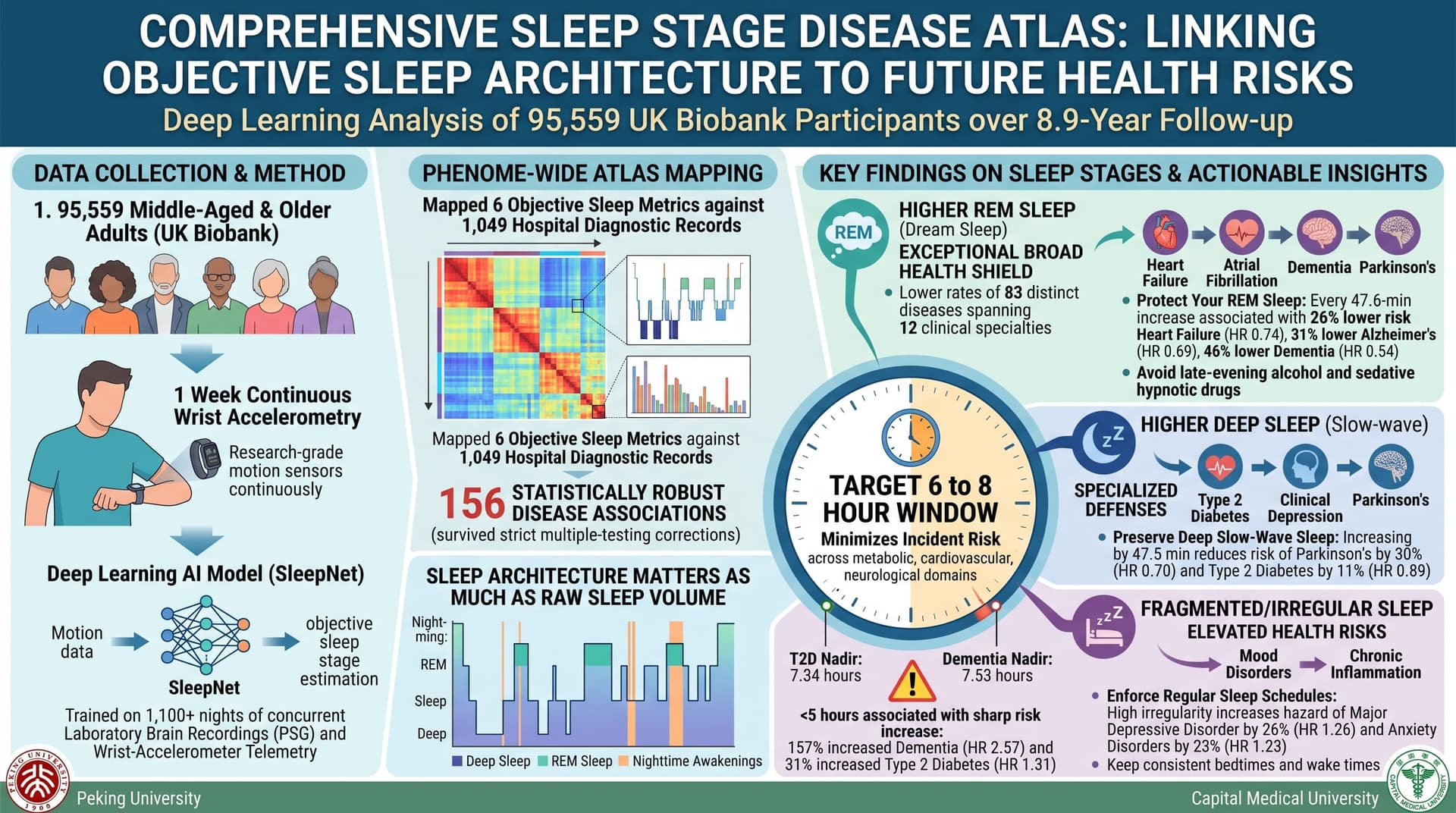
Using deep learning algorithms applied to continuous movement data from 95,559 UK Biobank participants, researchers constructed a comprehensive disease atlas linking objective sleep stages to future health risks over an 8.9-year follow-up. The study revealed that sleep architecture, particularly rapid eye movement (REM) and deep sleep, exerts wide-ranging protective effects across dozens of conditions. The lowest overall risk for 69 distinct diseases concentrated tightly within a daily sleep window of 6 to 8 hours, whereas sleeping less than 5 hours per night triggered sharp increases in long-term cardiometabolic, psychiatric, and neurodegenerative risks.
For decades, public health advice on sleep has relied on a fragile foundation: self-reported questionnaire data. When people guess how long they slept, they routinely overstate or understate reality, obscuring the biological mechanisms that govern repair and regeneration. Polysomnography, the clinical gold standard involving scalp electrodes, provides exact brainwave measurements but remains too cumbersome and expensive to deploy across tens of thousands of people over long periods.
A team led by public health researchers at Peking University and Capital Medical University in Beijing bypassed this bottleneck by training a deep-learning artificial intelligence model called SleepNet on more than 1,100 nights of concurrent laboratory brain recordings and wrist-accelerometer telemetry. The researchers then deployed this model across 95,559 middle-aged and older adults in the UK Biobank who wore research-grade motion sensors continuously for an entire week.
By tracking these individuals for a median of 8.9 years, the team mapped six objective sleep metrics against hospital diagnostic records for 1,049 separate health conditions. The resulting phenome-wide atlas uncovered 156 statistically robust disease associations that survived strict multiple-testing corrections.
The primary discovery is that sleep architecture, the internal composition of dream sleep, deep sleep, and nighttime awakenings, matters just as much as raw sleep volume. Higher amounts of REM sleep emerged as an exceptionally broad health shield, showing statistically significant inverse associations with 83 distinct diseases spanning 12 clinical specialties. Individuals who registered greater REM duration experienced lower rates of heart failure, atrial fibrillation, dementia, and parkinsonian disorders. Deep slow-wave sleep contributed its own specialized defenses, reducing the risk of type 2 diabetes, clinical depression, and Parkinson’s disease. Conversely, fragmented sleep characterized by frequent nighttime waking and erratic, irregular sleep schedules showed elevated risks for mood disorders and chronic inflammation.
When the investigators analyzed total sleep duration, they identified a clear sweet spot. Rather than a simple linear relationship where more sleep is always better, the data demonstrated a non-linear curve for 86 conditions. For 69 of these diseases, the absolute lowest risk point was concentrated between 6 and 8 hours of total daily sleep. Participants sleeping under 5 hours showed severe clinical vulnerabilities, while sleeping longer than 8 hours correlated primarily with elevated risks of major depression. By translating physical sensor telemetry into an epidemiological map, the study establishes that safeguarding specific sleep stages and maintaining a consistent 6 to 8 hour window represents a powerful pillar of preventive medicine.
Actionable Insights For individuals seeking practical longevity interventions, this dataset offers clear, quantifiable targets:
-
Target a 6 to 8 hour window: Sleeping within 6 to 8 hours minimizes incident risk across metabolic, cardiovascular, and neurological domains. The biological risk nadir for type 2 diabetes occurs at 7.34 hours, and for dementia at 7.53 hours. Sleeping less than 5 hours is associated with a 157% increased risk of dementia (hazard ratio 2.57) and a 31% increased risk of type 2 diabetes (hazard ratio 1.31).
-
Protect your REM sleep: Every 47.6-minute increase in REM sleep is associated with a 26% lower risk of heart failure (hazard ratio 0.74), a 31% lower risk of Alzheimer’s disease (hazard ratio 0.69), and a 46% lower risk of general dementia (hazard ratio 0.54). To optimize REM, avoid late-evening alcohol and sedative hypnotic drugs, which suppress REM cycles.
-
Preserve deep slow-wave sleep: Increasing deep sleep by 47.5 minutes reduces the risk of Parkinson’s disease by 30% (hazard ratio 0.70) and type 2 diabetes by 11% (hazard ratio 0.89).
-
Enforce regular sleep schedules: High night-to-night sleep irregularity increases the hazard of major depressive disorder by 26% (hazard ratio 1.26) and anxiety disorders by 23% (hazard ratio 1.23). Keeping consistent bedtimes and wake times stabilizes circadian rhythms.
Context/Source
- Open Access Paper: Accelerometer-derived real-world sleep stages and risk of incident diseases: A UK Biobank cohort study and phenome-wide association analysis, Published: September 17, 2026.
- Institutions: School of Public Health, Peking University; School of Public Health, Capital Medical University; Beijing Key Laboratory of Environment and Aging; Beijing Laboratory of Allergic Diseases
- Country: China
- Journal Name: PLOS Medicine
- Impact Evaluation: The impact score of this journal is 9.9 (with a 5-year impact factor of 11.0), evaluated against a typical high-end range of 0–60+ for top general and medical science, therefore this is a High impact journal.
Related Reading:
- Why Sleep Regularity Beats Sleep Duration as the Ultimate Predictor of Longevity
- How to get a better night's sleep by hacking your brainwaves (NewScientist)
- Sleep supplements: what is most effective, least habit forming, and safest?
- The Metabolic Lullaby: Can Exogenous Ketones Hack Your Sleep Architecture?
- Bursts of ‘pink noise’ during sleep seem to help clear waste from brain