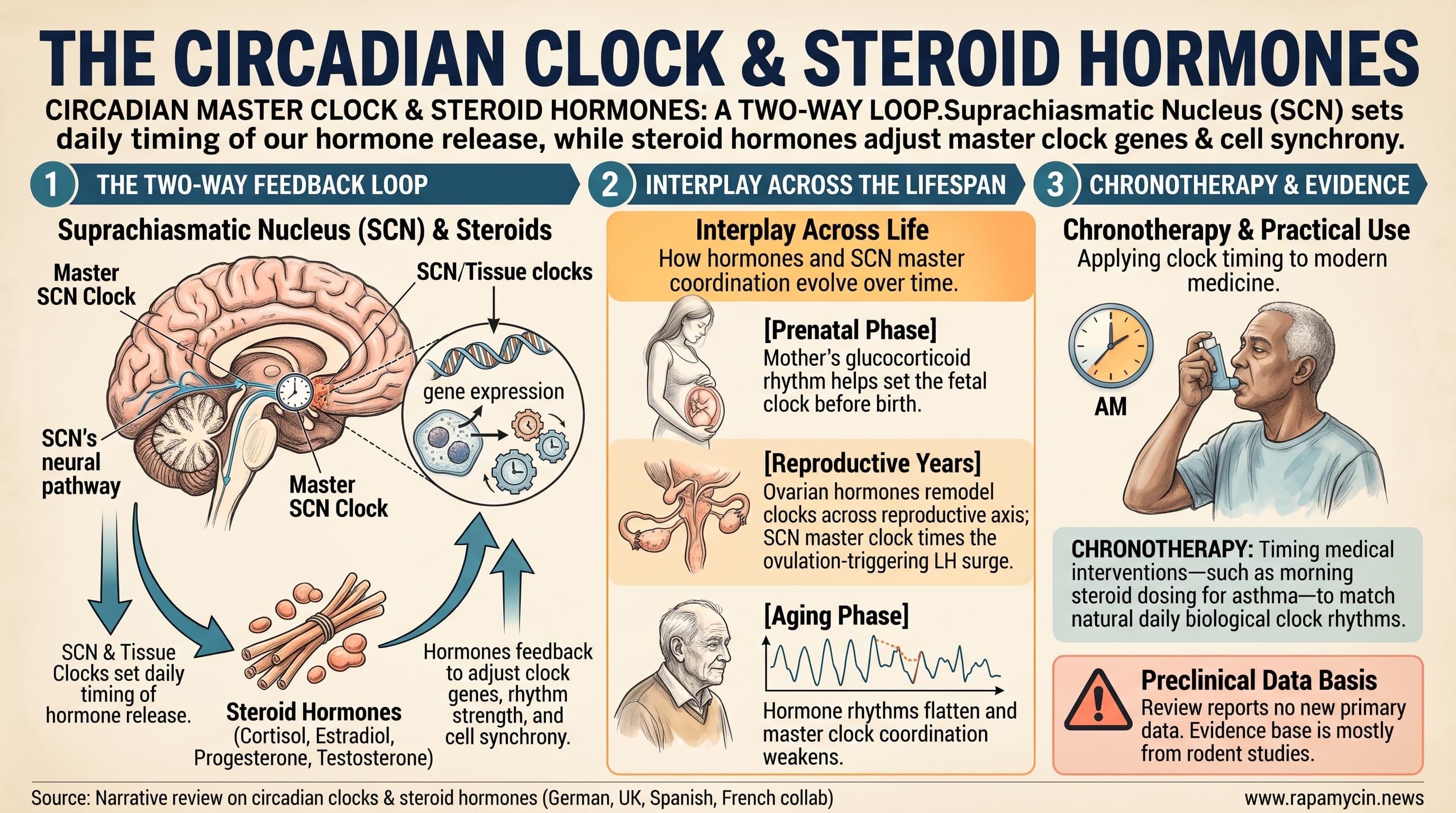
This narrative review by circadian and neuroendocrine researchers in Germany, the UK, Spain and France describes the two-way relationship between the body’s master clock, the suprachiasmatic nucleus (SCN), and steroid hormones: cortisol-type glucocorticoids, estradiol, progesterone and testosterone. The SCN and tissue clocks set the daily timing of hormone release, and those hormones feed back to adjust clock gene expression, rhythm strength and the synchrony of cellular clocks. The authors trace this interplay across life. Before birth, the mother’s glucocorticoid rhythm helps set the fetal clock. In reproductive years, ovarian hormones remodel clocks throughout the reproductive axis, and the clock times the ovulation-triggering LH surge. With aging, hormone rhythms flatten and clock coordination weakens. The review closes with chronotherapy examples, such as morning steroid dosing for asthma.
Hormones and circadian rhythms are usually studied separately, but this review argues they function as a single system. The master clock in the hypothalamus, a cluster of about 20,000 neurons called the suprachiasmatic nucleus, sets the timing of hormone release across the day. Those same hormones then feed back to the clock, tuning its strength and coordination.
The relationship works through several layers. Glucocorticoids, the family that includes cortisol, bind receptors that switch on core clock genes such as Per1 in tissues throughout the body. This is one way the brain’s clock synchronizes the liver, muscle and other organs. The master clock itself resists being reset by glucocorticoids in adulthood, but it still responds to them, partly through its supporting astrocytes. Sex hormones act differently in males and females. Estrogen receptors cluster in the outer shell of the SCN in females, while androgen receptors concentrate in the core in males. That may help explain sex differences in how the clock responds to light.
The review traces this partnership through three life stages.
Before birth, the fetus can’t see light, so the mother’s daily cortisol rhythm acts as one of its main timing signals. Rodent studies suggest that glucocorticoid exposure at the “wrong” time of day has lasting effects on the offspring’s immune, behavioral and metabolic health. That matters clinically, because synthetic steroids are given to most pregnant women at risk of premature delivery without attention to timing.
During reproductive life, clocks run at every level of the reproductive system: the brain, pituitary, ovaries and uterus. Ovulation depends on a well-timed surge of luteinizing hormone. In rodents, this surge occurs only when rising estrogen coincides with a daily signal from the SCN. Removing the SCN abolishes it. In mice, a light schedule mimicking shift work for four weeks eliminated the surge, with effects persisting after normal light returned. Human epidemiology links shift work to menstrual irregularity and adverse pregnancy outcomes.
With aging, both systems lose robustness. Cortisol rhythms flatten, mostly because nighttime cortisol rises. Melatonin rhythms decline. In aging female mice, the four- to five-day activity pattern tied to the estrous cycle fades as ovarian function declines. In older rodents, electrical activity in the SCN is markedly dampened, even though molecular clock gene rhythms seem relatively preserved. Perimenopause in women brings hormone instability that likely contributes to sleep disruption. In a counterintuitive result, restoring testosterone in old castrated male mice reduced activity, whereas in young mice it increased activity.
The final section discusses chronotherapy. The clearest examples involve glucocorticoids. Morning dosing of steroids for asthma improved lung function with less suppression of the stress-hormone system than spread-out dosing. In Cushing’s syndrome, evening dosing of osilodrostat improved cortisol rhythms and sleep. Evidence for timing sex hormones or breast cancer endocrine therapy is preliminary or mixed.
The review is clearly written and well referenced, but it is a narrative synthesis, much of it drawn from rodent work. It does not grade evidence or provide numbers on how much rhythm changes affect health. Its value is conceptual: it reframes hormone health partly as a question of timing.
Actionable Insights
- Keep a regular daily schedule. Consistent light exposure, sleep and meal timing support clock-hormone coordination. In mice, four weeks of shift-work-like light schedules abolished the ovulation-triggering hormone surge.
- If you take oral glucocorticoids such as prednisone, morning dosing usually mirrors the natural cortisol rhythm. Older asthma studies found morning dosing improved bronchial function with less HPA suppression than dosing spread across the day. Discuss timing with your doctor.
- Measure testosterone in the morning. Levels peak early in the day, especially in younger men.
- During perimenopause, sleep disruption may partly reflect hormone-clock instability. Lower estradiol and higher FSH were associated with more nighttime awakenings. Hormone therapy remains the most effective treatment for hot flashes.
- A flattened cortisol rhythm (high at night) is a marker of circadian aging. Salivary cortisol at waking and bedtime is an inexpensive way to check it.
- No effect sizes are provided for any of these benefits. Most evidence is from animals.
Context and Source
- Open Access Paper: Clocks and steroids interaction across the life span
-
Institutions:
- University of Lübeck (Germany)
- University of Bristol (UK)
- Achucarro Basque Center for Neuroscience and Ikerbasque (Spain)
- CNRS Institute of Cellular and Integrative Neurosciences, University of Strasbourg (France)
- Countries: Germany, United Kingdom, Spain, France
- Journal: Journal of Neuroendocrinology (Wiley), 1 October 2026.
- Impact evaluation: The impact score of this journal is approximately 5.35, evaluated against a typical high-end range of 0 to 60+ for top general science, therefore this is a Medium impact journal.