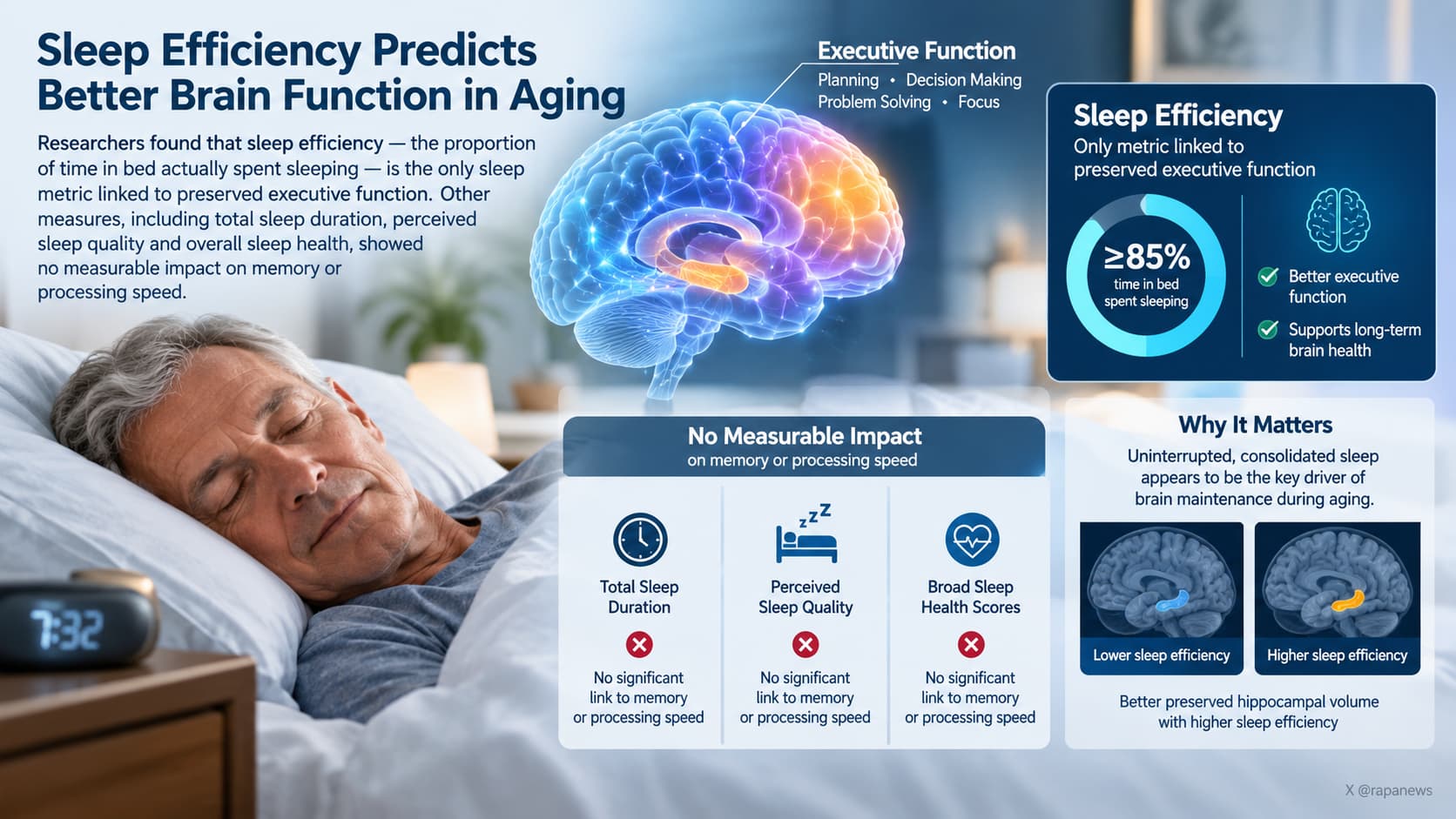
A two-year longitudinal study tracking adults over age 55 reveals that simply spending more time in bed does not protect cognitive function. Researchers discovered that sleep efficiency, defined as the proportion of time in bed actually spent sleeping, is the only sleep metric significantly linked to preserved executive function. Total sleep duration, perceived sleep quality, and broad sleep health scores showed no measurable impact on memory or processing speed, suggesting that uninterrupted, consolidated sleep is the primary driver of brain maintenance during aging.
The quest to preserve brain function during aging often focuses on getting eight hours of sleep. However, new research from an international team shifts the focus from how long you sleep to how well you stay asleep. The study tracked a cohort of community-dwelling adults aged 55 and older over two years to determine which aspects of sleep actually protect the aging brain.
Current guidelines heavily emphasize total sleep duration. This observational study challenges that paradigm by simultaneously measuring both device-tracked sleep and self-reported sleep quality against rigorous cognitive tests. The researchers assessed short-term memory, long-term memory, processing speed, and executive function. The results were highly specific. Total sleep duration offered no detectable cognitive benefit. Subjective sleep quality, which is how rested participants felt, also failed to predict cognitive performance.
The single variable that correlated with cognitive protection was sleep efficiency. This metric represents the percentage of time spent actively sleeping while in bed. For example, lying awake in bed for two hours of an eight-hour rest period constitutes poor sleep efficiency, even if the total sleep time seems adequate. The data showed that individuals with higher sleep efficiency maintained superior executive function. Executive function encompasses the higher-order mental skills required for planning, focusing attention, and juggling multiple tasks. The finding remained stable across multiple observations over the two-year period, suggesting a persistent baseline relationship rather than a fleeting correlation.
This specificity is highly relevant. The lack of association between total sleep time and cognitive preservation implies that merely allocating more time for rest is a flawed strategy for cognitive longevity. Fragmented sleep disrupts the biological processes required for neural maintenance. When the researchers tested alternative markers of sleep disruption, such as wakefulness after sleep onset, the results closely mirrored the sleep efficiency findings. Frequent awakenings actively penalize executive function.
The findings reflect an understanding in neuroscience that sleep architecture matters far more than gross duration for structural brain health. While the study did not measure deep physiological sleep stages, high sleep efficiency serves as a reliable macroscopic proxy for continuous progression through vital sleep cycles. Consolidating sleep into an uninterrupted block allows the brain to complete the biological housekeeping required to clear metabolic waste and repair cellular damage. For those looking to protect their cognitive span, the goal is not to stay in bed longer, but to ensure the time spent in bed is strictly uninterrupted.
Actionable Insights
The primary takeaway for improving cognitive longevity is to prioritize sleep consolidation over total time in bed. If you struggle with waking up in the middle of the night, artificially extending your time in bed will not protect your executive function and will likely worsen your overall sleep efficiency.
The practical intervention is applying strict sleep hygiene to compress the sleep window, perfectly matching time in bed to actual time asleep. By the numbers, the study reports a beta coefficient of 1.27 for the relationship between sleep efficiency and executive function z-scores. Sleep efficiency is measured as a proportion from 0 to 1. A 10 percent improvement in sleep efficiency translates to a 0.127 standard deviation improvement in executive function. This represents a small effect size, roughly equivalent to a Cohen’s d of 0.13, or a marginal gain of 2 points on a standard IQ scale. While modest, this incremental preservation of executive capacity compounds over decades. Optimizing room temperature, reducing late-night fluid intake, and minimizing ambient light are direct steps to maximize this specific efficiency metric.
Context/Source
- Paywalled Paper: Associations between multidimensional sleep measures and domain-specific cognitive function across repeated observations in adults aged 55 years and older.
- Institution: KU Leuven, Ghent University, The University of Newcastle, University of Utah.
- Country: Belgium, Australia, USA.
- Journal Name: GeroScience.
- Impact Evaluation: The impact score of this journal is 5.3, evaluated against a typical high-end range of 0-60+ for top general science, therefore this is a Medium impact journal.