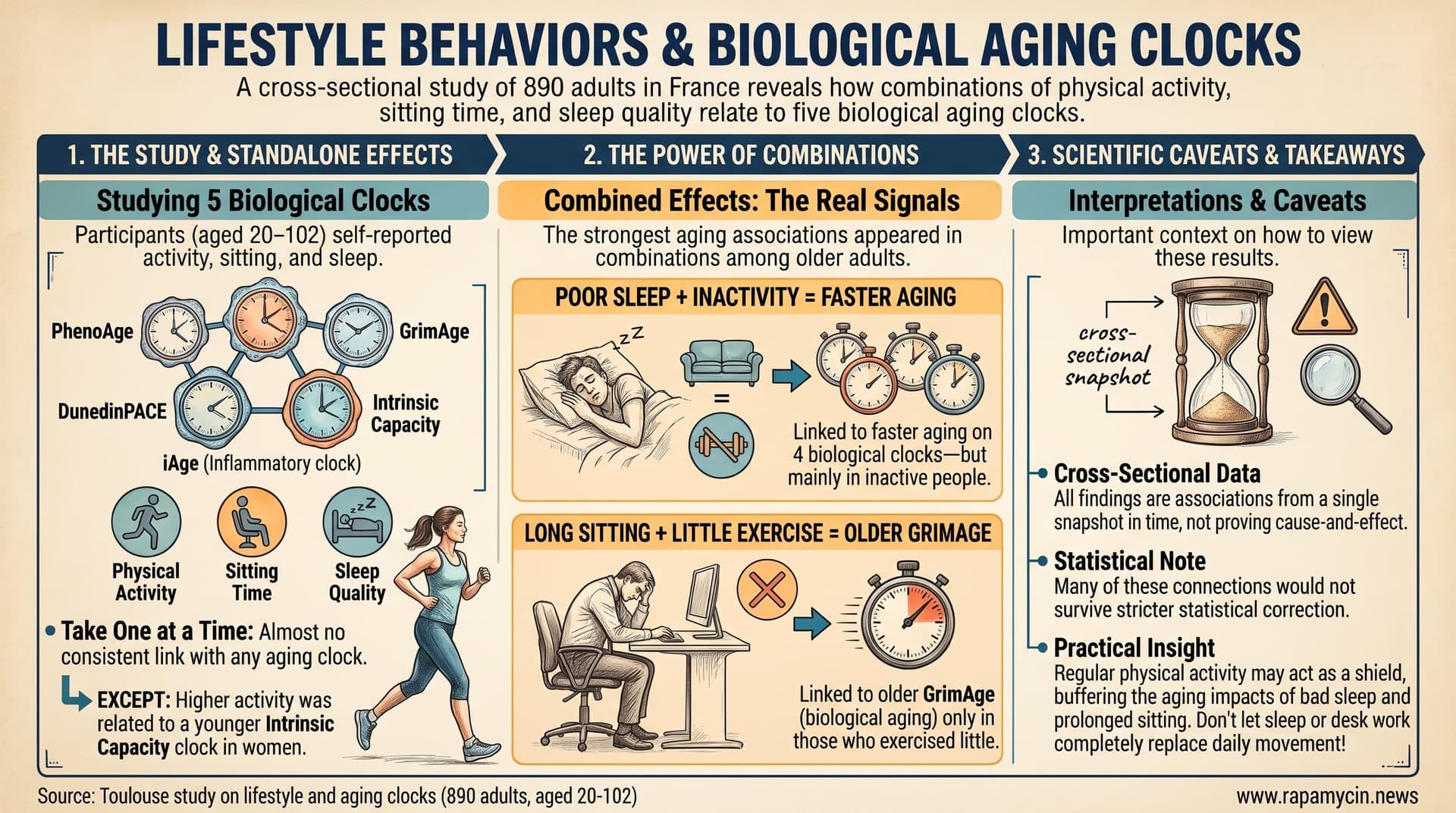
Researchers in Toulouse, France, examined how physical activity, sitting time and sleep quality relate, alone and in combination, to five biological aging clocks in 890 adults aged 20 to 102. The clocks were PhenoAge, GrimAge, DunedinPACE, the inflammatory clock iAge, and an intrinsic capacity clock. Activity, sitting and sleep were self-reported by questionnaire. Taken one at a time, the three behaviors showed almost no consistent link with any clock, apart from higher activity relating to a younger intrinsic capacity clock in women. The interesting signals appeared in combinations. Among older adults, poor sleep was linked to faster aging on four clocks, but mainly in people who were inactive. Long sitting was linked to an older GrimAge only in people who exercised little.
Most people sense that exercise, sitting and sleep interact. A good night’s rest makes a workout easier, and a long day at a desk feels less harmful after a morning run. This study from the INSPIRE cohort in Toulouse tries to measure those interactions against the newest generation of biological aging clocks.
The team analyzed blood samples from 890 adults spanning eight decades of age. From DNA methylation patterns, they calculated four epigenetic measures: PhenoAge and GrimAge, which estimate biological age; DunedinPACE, which estimates how fast someone is aging right now; and a newer clock built to track intrinsic capacity, the World Health Organization’s composite of mobility, cognition, vitality, mood and sensory function. They also measured iAge, an inflammation-based score built from five blood cytokines. Participants reported their weekly physical activity, daily sitting time and how often they slept poorly.
The first surprise was how little the behaviors predicted on their own. Once the researchers accounted for age, sex, education and illness, activity, sitting and sleep showed essentially no independent association with most clocks. The exception was the intrinsic capacity clock in women, where more activity tracked with younger readings.
The picture changed when the behaviors were examined together. In adults 65 and older, worse sleep was associated with faster aging on GrimAge, DunedinPACE, iAge and the intrinsic capacity clock, but that link largely disappeared in people who logged substantial exercise, roughly five to ten hours a week of moderate to vigorous activity. Similarly, across the whole group, longer sitting went with an older GrimAge in people who exercised little, while in highly active people the association flattened or even reversed.
That pattern echoes a large 2016 analysis of more than a million adults, which found that about an hour a day of moderate activity appeared to eliminate the higher death risk linked to long sitting. The new study suggests the same buffering may show up in molecular aging markers.
Some results were harder to explain. For GrimAge, the youngest readings appeared in good sleepers who either exercised a lot and sat more than ten hours a day, or exercised very little and sat less than four hours. The authors interpret this as a sign that the balance between activity and rest matters. It could also be statistical noise, given the number of comparisons tested.
The limitations are substantial. Everything was measured at one point in time, so the study cannot show that exercise slows aging rather than healthier people simply exercising more. Activity, sitting and sleep were self-reported, and the questionnaire used is known to overestimate activity. The analyses did not account for smoking or body weight, both of which strongly influence GrimAge. Three quarters of participants held university degrees.
The bottom line is cautious but consistent with broader evidence. Sitting and poor sleep may matter less for biological aging if you stay very active, and the amount of activity linked to those benefits here exceeded the minimum guideline of 150 minutes a week.
Actionable Insights
- The activity level linked to buffering in this study was high: about 312 to 589 minutes a week of moderate to vigorous activity, or roughly 45 to 85 minutes a day. That is above the 150 to 300 minutes in current guidelines. Because the questionnaire tends to overestimate activity, the true threshold may be lower.
- If you sit a lot, staying highly active appears to matter. In people who exercised little, each extra hour of daily sitting tracked with an older GrimAge. In highly active people, the slope was about 0.37 years lower per hour. Over the typical range of 4.5 to 8 hours of sitting, that is a difference of roughly 1.3 years of GrimAge acceleration, or about 0.4 standard deviations. Earlier work links each year of GrimAge acceleration to roughly a 10% higher mortality hazard. [Confidence: Low to Medium]
- Very high activity went with an iAge about 2.4 years younger, about 0.3 standard deviations. That is a small to moderate difference, and it was not significant after correction.
- Protect sleep, especially if you can’t exercise much. Poor sleep was linked to faster aging mainly in inactive older adults.
- Treat all of this as supportive, not proof. The direction matches decades of mortality data, but this study cannot establish cause and effect.
Context and Source
- Paywalled Paper: Physical activity, sedentary behavior, sleep quality and the biological aging clocks
- Institutions: IHU HealthAge and Gérontopôle, CHU Toulouse; CERPOP Inserm UMR 1295, University of Toulouse
- Country: France
- Journal: GeroScience (Springer), published online 17 October 2026
- Impact evaluation: GeroScience has a 2025 impact factor of 5.4 and is ranked Q1. The impact score of this journal is 5.4, evaluated against a typical high-end range of 0 to 60+ for top general science, therefore this is a Medium impact journal.