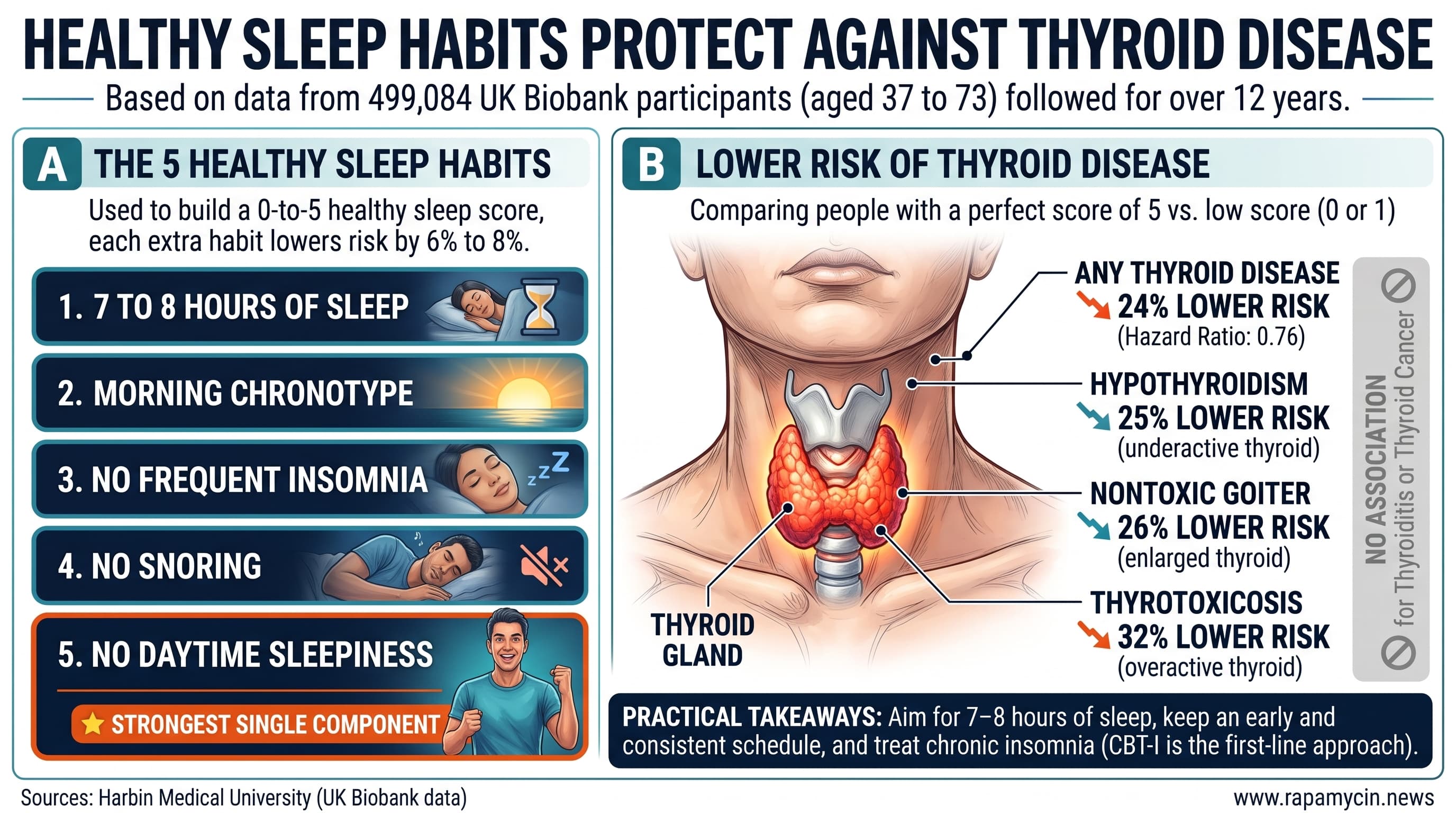
Using data from 499,084 UK Biobank participants aged 37 to 73, researchers at Harbin Medical University built a 0-to-5 healthy sleep score from five self-reported habits: 7 to 8 hours of sleep, morning chronotype, no frequent insomnia, no snoring and no frequent daytime sleepiness. Over roughly 12 years of follow-up, about 15,000 people were diagnosed with thyroid disease. Compared with those scoring 0 or 1, people with a perfect score of 5 had about 24% lower adjusted risk of any thyroid disease, 25% lower risk of hypothyroidism, 26% lower risk of nontoxic goiter and 32% lower risk of thyrotoxicosis. No association was seen for thyroiditis or thyroid cancer. Not feeling excessively sleepy during the day was the strongest single component.
Poor sleep has been linked to almost every chronic disease researchers have gone looking for. Now a team from Harbin Medical University in China has added the thyroid to the list. Using health records from about half a million middle-aged and older adults in the UK Biobank, they report that people with the healthiest sleep habits were roughly a quarter less likely to be diagnosed with thyroid disease over the following decade or so.
At enrollment between 2006 and 2010, the researchers scored each participant from 0 to 5, awarding a point for each of five habits: sleeping 7 to 8 hours, being a morning person, rarely having insomnia, not snoring, and not often dozing off during the day. They then followed medical records until early 2022. About 15,000 people developed a thyroid condition, most commonly an underactive thyroid.
After accounting for age, sex, body size, income, education, smoking, drinking, exercise and diabetes, each extra healthy habit was linked to a stepwise drop in risk. People with a perfect 5 had 24% lower risk of any thyroid disease than those scoring 0 or 1, 25% lower risk of an underactive thyroid, 26% lower risk of goiter and 32% lower risk of an overactive thyroid. There was no link with thyroid cancer or thyroiditis.
In absolute terms the difference is modest. Among the poorest sleepers, about 4 in 100 were diagnosed with thyroid disease during follow-up, compared with about 2.6 in 100 among the best sleepers. After adjustment, the gap shrinks to roughly 1 in 100.
The single habit that mattered most was not feeling excessively sleepy during the day. People who only rarely or sometimes dozed off had about 20% lower risk of thyroid disease overall and nearly 40% lower risk of an overactive thyroid. Snoring made no difference.
That standout finding is also the study’s biggest weakness. Daytime sleepiness is less a habit than a symptom, and fatigue and sleepiness are classic early signs of an underactive thyroid. Thyroid disease often smolders for years before diagnosis. Some participants who reported poor sleep may therefore already have had a faltering thyroid, which would make sleep look like a cause when it is actually an early consequence. The authors excluded people diagnosed in the first year of follow-up, but that does little for a condition that can develop silently over many years. No baseline thyroid blood tests were available to rule it out.
There are plausible biological reasons sleep could matter. Thyroid-stimulating hormone follows a daily rhythm that peaks at night, and sleep loss disturbs that rhythm. Animal studies show sleep deprivation also pushes the immune system toward inflammation and autoimmunity, which is the main driver of both underactive and overactive thyroid disease in iodine-sufficient countries.
Still, people who sleep well also tend to be leaner, wealthier, more active and less likely to smoke, and statistical adjustment rarely erases such differences completely. The study cannot establish cause and effect.
It does add the thyroid to a long list of reasons to protect sleep. And it carries a practical message that may be more useful than the headline: persistent daytime sleepiness deserves a medical look, and a simple thyroid blood test belongs in that workup.
Actionable insights
The habits in the score are worth pursuing for many reasons: aim for 7 to 8 hours, keep a consistent schedule that leans earlier, and treat chronic insomnia (cognitive behavioral therapy for insomnia is the first-line approach).
How big is the effect? Results are reported as hazard ratios (HR), which compare the rate of new diagnoses between groups; an HR of 0.76 means a 24% lower rate. Scoring 5 versus 0 or 1 was linked to an HR of 0.76 for any thyroid disease. Each additional healthy habit tracked with roughly 6 to 8% lower risk.
In absolute terms, that is about 1 fewer diagnosis per 100 people over about 12 years. Put another way, roughly 100 people would need to move from the worst to the best sleep pattern to prevent one thyroid diagnosis, and only if the link is causal. For overactive thyroid alone, the figure is closer to 400.
The most actionable message may run in the opposite direction. If you have persistent, unexplained daytime sleepiness or fatigue, ask for a TSH and free T4 test. If sleepiness comes with loud snoring or witnessed pauses in breathing, ask about sleep apnea testing too.
The associations appeared slightly stronger in women and in overweight adults, but the subgroup differences were small.
Context and source
- Open Access Paper: Healthy sleep pattern is associated with reduced risk of incident thyroid disease: a prospective cohort study from the UK Biobank
- Institutions: Department of Endocrinology and Metabolism, Second Affiliated Hospital of Harbin Medical University; School of Public Health, Harbin Medical University; Key Laboratory of Precision Nutrition and Health, Ministry of Education
- Country: China (analysis of UK data)
- Journal: Frontiers in Endocrinology, published 2 October 2026.
- Impact evaluation: The impact score of this journal is 4.6 (most recent listed Journal Impact Factor; 5-year JIF 5.2; JCR Q1, ranked about 43rd of 191 in Endocrinology and Metabolism), evaluated against a typical high-end range of 0 to 40+ for endocrinology and metabolism, therefore this is a Medium impact journal.