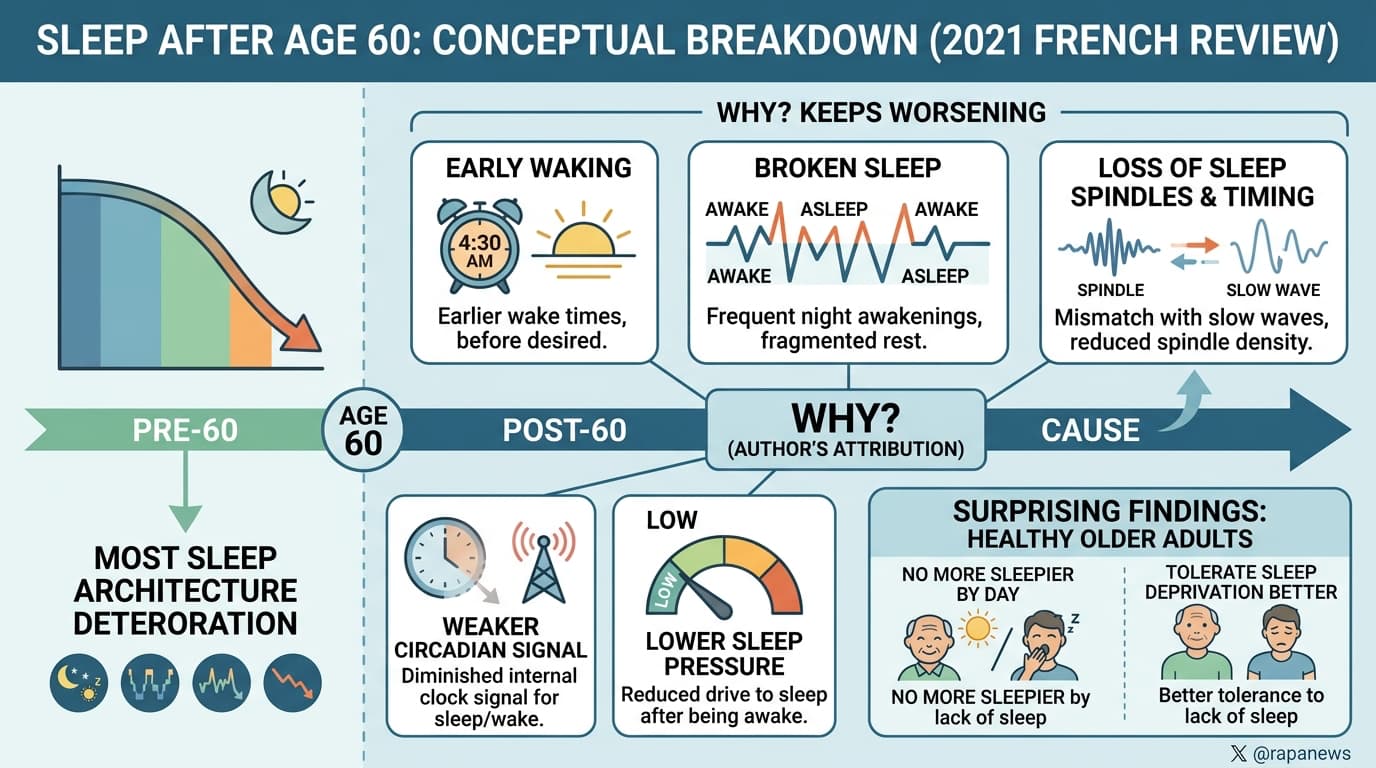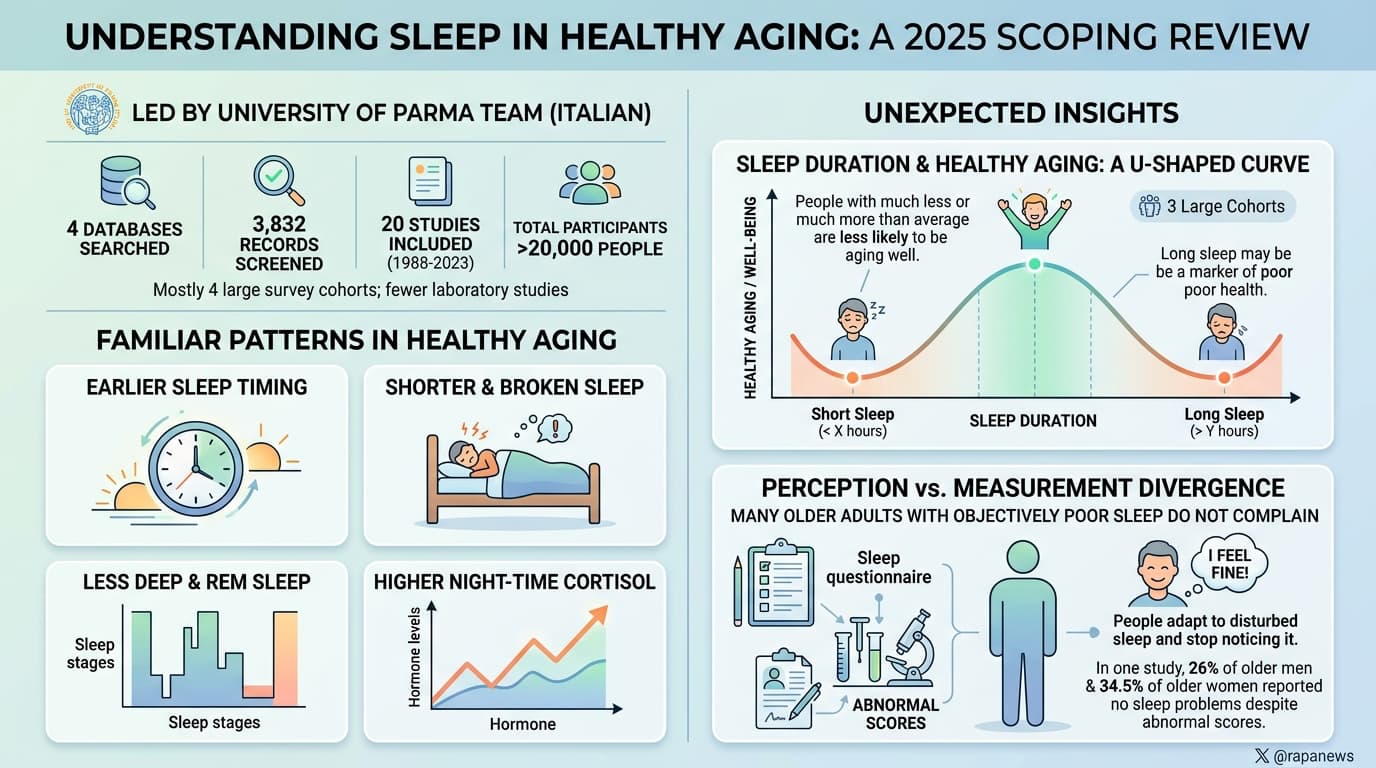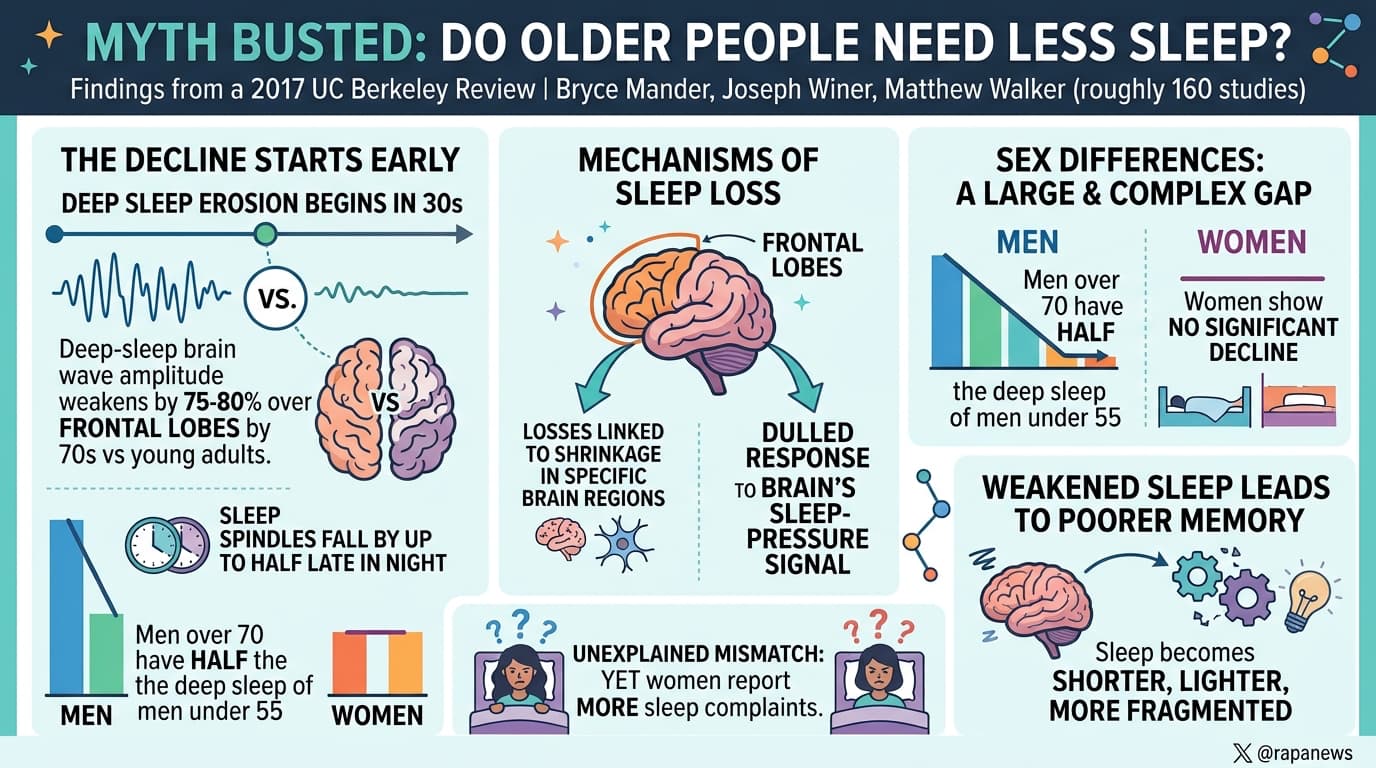
This 2017 review from UC Berkeley argues that the lighter, shorter, more broken sleep of later life is not a sign that older people need less sleep. Deep-sleep brain waves weaken by 75 to 80 percent over the frontal lobes, the decline starts in the 30s, and it is far steeper in men. The authors link these losses to shrinkage in specific brain regions and to a dulled response to the brain’s own sleep-pressure signal, and they tie the weakened sleep to poorer memory. The evidence is mostly correlational, and no reliable way to restore deep sleep has been shown.
It is one of the most familiar assumptions about ageing: grandparents rise at dawn and doze after lunch because older people need less sleep. A review from the University of California, Berkeley, argues that this has the story backwards.
Bryce Mander, Joseph Winer and Matthew Walker draw together roughly 160 studies. The decline they describe begins earlier than most people expect. Deep sleep starts to erode in the 30s. By the 70s, the slow electrical waves that define deep sleep are 75 to 80 percent weaker over the front of the brain than in young adults. Sleep spindles, the brief bursts of activity linked to learning, fall by up to half late in the night. Sleep becomes shorter, lighter and more fragmented.
The sex difference is large. In a cohort of more than 2,500 adults, men over 70 had half the deep sleep of men under 55, while women showed no significant decline. Yet women report more sleep complaints, a mismatch nobody has explained.
The review traces these changes to wear in particular brain structures. Sleep-promoting neurons in the hypothalamus dwindle. The orexin cells that keep sleep and wake states stable thin out. The body clock’s signal flattens. And the medial prefrontal cortex, where slow waves are generated, loses grey matter. The more that region has shrunk, the weaker a person’s slow waves.
The most interesting argument concerns adenosine, the chemical that builds up during waking hours and creates the pressure to sleep. If older people needed less sleep, they should accumulate less of it. Rodent studies show the opposite: older brains carry more. What declines is the number of receptors that detect it. On this reading, the signal is still being sent but is poorly received.
The consequences show up in memory. Older adults with the weakest slow waves forget more overnight, and those with the fewest spindles learn less the next day. Statistically, the sleep deficit accounts for these memory gaps better than age does. In one experiment, disturbing deep sleep with sounds impaired older adults’ learning the next day even though total sleep time was unchanged.
Fixing the problem is harder. Conventional sleeping pills can increase time in deep sleep, but they generally fail to deliver the memory benefit and sometimes impair recall. Gentle electrical or sound stimulation timed to slow waves has improved memory in some small studies and failed in others.
The case has real weaknesses. This is a narrative review, not a systematic one, and several of its central claims rest on small studies from the authors’ own laboratory. Most of the evidence compares young and old people at a single point in time, which cannot show that poor sleep causes memory decline. The authors themselves say there is no consensus. The paper is also nine years old, and the science of sleep drugs and dementia has moved since.
Still, the central message is that feeling less sleepy with age is not good evidence of needing less sleep.
Insights
What this review offers is a better way to think about sleep in midlife and beyond.
- Do not treat low sleepiness as proof of enough sleep. Older adults feel less sleepy even when memory measures suggest a shortfall.
- Hours slept and tracker stage totals miss the main change. Deep-sleep wave strength falls 75 to 80 percent over the frontal lobes even when stage durations look similar.
- Men should start early. Slow wave activity is already about 50 percent lower in men in their 30s than in their 20s (25 percent in women). By the 70s, men’s deep sleep falls from roughly 13 percent of the night to about 5 percent, or approximately 65 minutes down to 25 in an eight-hour night.
- Address fixable disruptors: sleep apnea, pain, nighttime urination, alcohol, and medications such as some blood pressure drugs that disturb deep sleep. Ask a clinician before changing any prescription.
- Be wary of sedative sleeping pills for cognitive purposes. They add deep-sleep time without the memory benefit and can impair recall.
- Treat stimulation devices as experimental. One young-adult study nearly doubled overnight retention, but three trials in the review found nothing.
Context and Source
- Open Access Paper: Sleep and Human Aging
- Institution: Sleep and Neuroimaging Laboratory, Department of Psychology, and Helen Wills Neuroscience Institute, University of California, Berkeley
- Country: USA
-
Journal: Neuron, 2017
Impact evaluation: The impact score of this journal is 16.9, evaluated against a typical high-end range of 0 to 30 for specialist neuroscience journals (0 to 60+ for top general science), therefore this is an Elite impact journal within its field.
Related Reading:
- Frenz headband to measure/increase deep SWS sleep?
- Why Sleep Regularity Beats Sleep Duration as the Ultimate Predictor of Longevity
- Exercise Deployed as a "Shield" Against the Mortality Risks of Bad Sleep
- The Orexin Neuropeptide System; Why Your Wakefulness & Activity Neurons Fade With Age—and How to Turn Them Back On
- Breaking the Nap Habit: How Kicking the Afternoon Snooze Safeguards the Aging Brain
- Bursts of ‘pink noise’ during sleep seem to help clear waste from brain
- Sleep supplements: what is most effective, least habit forming, and safest?