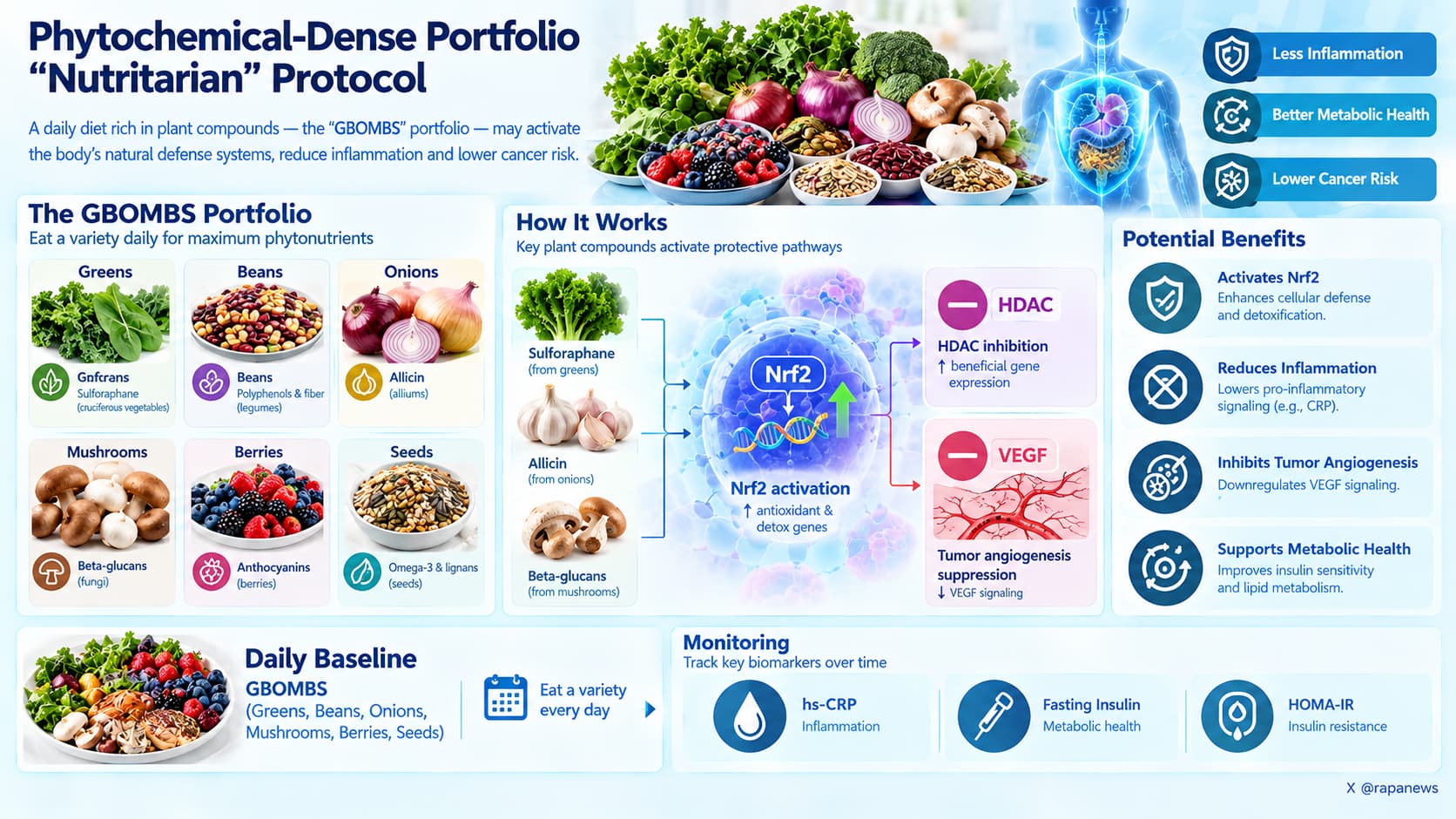
In a retrospective cohort of 97 women aged 40 to 75, researchers compared 48 who had followed a nutrient-dense plant-rich diet, marketed as the Nutritarian diet, for at least five years against 49 who ate a standard American diet. Of seven epigenetic aging algorithms tested, only DunedinPACE differed, with the plant-rich group at 0.81 versus 0.91. The plant-rich group also showed lower dietary inflammatory scores, higher methylation-predicted memory T and B cells, and lower methylation-based proxies for C-reactive protein, LDL cholesterol, glucose, and several insulin-like growth factor binding proteins. The authors report in their own results section that the DunedinPACE difference did not survive adjustment for body mass index and array type. The abstract does not mention this. The study was funded and authored by the owner of the diet brand and by employees of the company selling the test.
Epigenetic aging clocks have become the field’s favorite surrogate endpoint. Among them, DunedinPACE is the one built differently. Rather than estimating how old you look biologically, it estimates how fast you are currently moving, calibrated so that 1.0 means one biological year accrued per calendar year. It was built from twenty years of repeated measurements on a thousand New Zealanders born in the same year, tracking nineteen organ-system biomarkers. A value of 0.85 means you are aging about fifteen percent slower than average. A value of 1.15 means the opposite.
The open question is what moves it. Whole-diet interventions, caloric restriction, Mediterranean patterns, and vegan diets have all shown reductions. Isolated supplements have not, and one year-long nutraceutical trial actually pushed it in the wrong direction. So a team drawn from the Nutritional Research Foundation, Northern Arizona University, and the testing company TruDiagnostic asked whether specific plant compounds, rather than whole patterns, were doing the work.
They recruited women who had eaten one of two ways for at least five years. Forty-two followed a nutrient-dense plant-rich pattern emphasizing cruciferous vegetables, beans, onions, mushrooms, berries, nuts and seeds. Forty-four ate a standard American diet. Food frequency questionnaires estimated intakes of flavonoid subclasses, carotenoids, and folate. Blood spots provided DNA methylation.
The plant-rich group ate dramatically more of everything measured. More than twice the anthocyanidins from berries. Nearly three times the flavonols from onions, kale and apples. Two and a half times the alpha-carotene and the lutein. Double the folate from food rather than pills. These gaps are large, and they confirm that the two groups really were eating differently.
Then the result turned sideways. Higher intake of those compounds was associated with a faster DunedinPACE, not a slower one. The authors describe this direction as unexpected, which is fair. Their resolution is that diet group modifies the relationship. Plotted separately, the standard-diet group shows a steep upward slope while the plant-rich group’s lines run flat or slightly down. The interaction terms are statistically significant. At any given level of berry flavonoids, the standard-diet women had a higher predicted pace of aging than the plant-rich women.
Read generously, this is an argument that nutrients do not act in isolation, and that a bowl of blueberries does not do the same work inside a diet of refined carbohydrates and processed meat as it does inside a diet of greens and legumes. That is biologically plausible and worth testing properly.
Read skeptically, there is another explanation sitting in plain view. The two groups were recruited with different body mass index criteria, the plant-rich group averaging 20.5 and the standard group 25.6. DunedinPACE was trained partly on body mass index and waist-to-hip ratio. The same team’s earlier paper on this cohort reported that the group difference in DunedinPACE vanished once body mass index was controlled. Two groups separated by five units of body mass index will produce separated regression lines regardless of what is on their forks.
Actionable Insights
The honest take-home is narrow. This study does not show that eating more flavonoids, carotenoids, or food folate slows your biological aging. Within the data, higher intakes tracked with a faster pace of aging, and the favorable picture only appears after splitting the sample by diet group.
What the numbers mean. The group differences in nutrient intake were large, with standardized effect sizes of 0.5 to 1.3, meaning the two groups barely overlap on what they eat. But the link between any single nutrient and the aging measure was tiny. The regression coefficients translate to roughly 0.04 to 0.07 pace-of-aging units across the entire intake gap between groups. In plain terms, that is aging about four to seven percent slower, or banking something like two to three weeks of biological youth per calendar year. Over twenty years, perhaps one biological year. That is not nothing, but it is nowhere near the headline impression.
The one variable with a defensible claim on the outcome is body weight. Lower body mass index was the strongest systematic difference between groups, and the authors’ own earlier analysis found the aging difference disappeared when they adjusted for it.
Practical version: eat the whole plant-rich pattern, which has independent evidence behind it, and treat staying lean as the lever most likely doing the work.
Context and Source
- Open Access Paper: Slower Pace of Epigenetic Aging and Lower Inflammatory Indicators in Females Following a Nutrient-Dense, Plant-Rich Diet Than Those in Females Following the Standard American Diet
- Institutions: Nutritional Research Foundation, Flemington, New Jersey; Department of Health Sciences and the PRANDIAL Lab, Northern Arizona University, Flagstaff, Arizona; TruDiagnostic, Lexington, Kentucky.
- Country: United States
- Journal: Current Developments in Nutrition, published online October 28, 2024.
- Impact Evaluation: The impact score of this journal is 4.2 evaluated against a typical high-end range of 0 to 60+ for top general science, therefore this is a Medium impact journal.