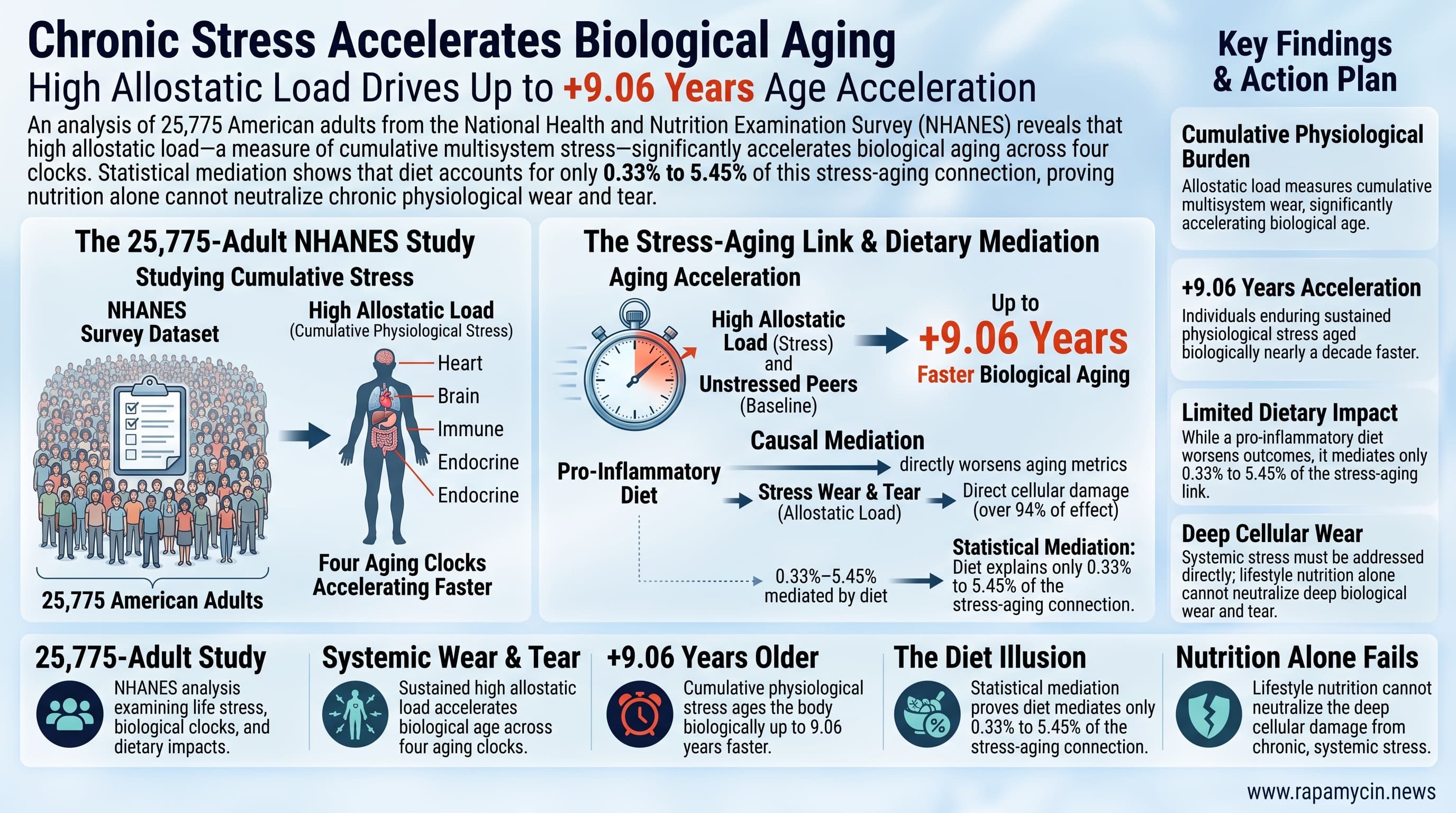
An analysis of 25,775 American adults from the National Health and Nutrition Examination Survey reveals that high allostatic load, a clinical measure of cumulative multisystem physiological stress, significantly accelerates biological aging across four independent aging clocks. Individuals enduring sustained physiological stress demonstrated an average biological age acceleration of up to 9.06 years compared to their unstressed peers. While a pro-inflammatory diet directly worsens biological aging across all metrics, statistical mediation demonstrates that diet accounts for only 0.33 percent to 5.45 percent of the stress-aging connection. This demonstrates that lifestyle nutrition alone cannot neutralize the deep cellular damage inflicted by chronic systemic wear and tear.
Aging is rarely a uniform passage of calendar years. Instead, it reflects an internal ledger of cellular damage, chronic endocrine activation, and metabolic inefficiency. A study examining a nationally representative cohort of 25,775 adults across the United States has mapped the tangible toll that systemic physiological stress takes on biological decay. The investigation measured allostatic load, which reflects the cumulative wear and tear on the body caused by repeated cycles of stress response activation across cardiovascular, metabolic, and immune domains.
To capture the diverse manifestations of biological aging, the investigators evaluated four distinct aging indices: Phenotypic Age, Biological Age based on epigenetic patterns, and two mortality risk algorithms known as GOLD BioAge and Light BioAge. The results confirm a stark divergence between chronological passage and tissue health. Nearly 22 percent of the population met the criteria for high allostatic load, showing high blood pressure, elevated resting pulse, elevated glycated hemoglobin, dyslipidemia, systemic inflammation, and lower serum albumin.
Even after adjusting for socioeconomic disparities, chronic diseases like diabetes and hypertension, and body mass index, individuals carrying high physiological stress exhibited an advanced biological age. Their Phenotypic Age was accelerated by more than two years, while their epigenetic Biological Age was accelerated by an average of 9.06 years. Furthermore, their odds of showing elevated mortality-linked biological markers jumped between 60 percent and 116 percent.
Intriguingly, the vulnerability to stress-induced biological aging was most pronounced not in elderly demographics, but in young and middle-aged adults between 20 and 59 years of age. In the 20 to 39 age bracket, high allostatic load was linked to a four-year acceleration in Phenotypic Age. Because younger bodies generally possess higher functional reserves, chronic physiological disruptions drive a much sharper deviation from their baseline developmental trajectory. Similarly, normal-weight individuals with a body mass index under 25 experienced an average biological age acceleration of 12.12 years under high allostatic load, dispelling the myth that metabolic stress only threatens individuals with excess adiposity.
The investigators also evaluated whether an inflammatory diet mediates this association using the Dietary Inflammatory Index. Diets rich in refined carbohydrates, saturated fats, and ultra-processed foods independently accelerated aging markers, adding up to 3.43 years to Phenotypic Age for those in the highest inflammatory intake quartile. Yet, mediation models proved that dietary inflammation accounts for only a minor fraction, between 0.33 percent and 5.45 percent, of the link between allostatic load and biological age acceleration. Chronic physiological stress damages the human organism through direct endocrine, autonomic, and systemic pathways that diet alone cannot completely mitigate.
Actionable Insights
Sustained physiological dysregulation imposes a heavy biological penalty, but the underlying biomarkers are modifiable through targeted clinical actions. The primary goal is reducing allostatic load below the clinical threshold of four points across eight standard biomarkers: systolic blood pressure, diastolic blood pressure, resting pulse, body mass index, glycated hemoglobin, high-density lipoprotein cholesterol, total cholesterol, and serum albumin.
In real-world terms, moving from high allostatic load to normal biological equilibrium correlates with preventing up to 9.06 years of epigenetic aging and 2.08 years of phenotypic functional decay. In younger cohorts aged 20 to 39, normalizing these parameters prevents an estimated 4.01-year leap in phenotypic aging. To achieve this, maintain resting blood pressure below 120/80 mmHg, target fasting pulse below 70 beats per minute, keep glycated hemoglobin below 5.4 percent, and optimize serum albumin above 4.5 grams per deciliter.
Concurrently, shifting dietary patterns from the most pro-inflammatory quartile to the least inflammatory quartile offers an independent biological age reduction of 3.43 years. This requires eliminating refined seed oils, deep-fried foods, and high-glycemic sugars, while consuming polyphenol-rich foods, leafy greens, wild fatty fish, and soluble fibers. However, because diet mediates only 5.45 percent of stress-induced aging at most, targeted interventions must directly downregulate sympathetic nervous system activity through restorative sleep routines, zone-2 cardiovascular training, and regular stress de-escalation protocols.
Context and Source
- Open Access Paper: Stress, diet, and aging: a comprehensive analysis of allostatic load in biological aging, Published: 24 July 2026.
- Institutions: The Orthopedic Hospital, Department of Sports Medicine, The First Affiliated Hospital, Jiangxi Medical College, Nanchang University; The Key Laboratory of Spine and Spinal Cord Diseases of Jiangxi Province, Nanchang, China
- Country: China
- Journal: Clinical Epigenetics
- Impact Evaluation: The impact score of this journal is 5.4 (Journal Impact Factor) and 9.4 (CiteScore), evaluated against a typical high-end range of 0 to 60+ for top general science, therefore this is a High impact journal.
Related Reading:
- Early Life Stress Pushes Biological Age Up 38 Percent Before Any Sign of Illness
- The Long Shadow of Midlife Stress: How Psychological Distress Accelerates Biological Aging and Frailty Three Decades Later
- The Resilience Prescription: Rewiring the Aging Brain Against Chronic Stress
- Toxic Workplaces Are Accelerating Your Biological Clock: First Data from the Semmelweis Occupational Cohort
- The 30-Year Cliff: How Chronic Psychological Stress Silently Accelerates Biological Aging and Depletes Brain Resilience in Young Women