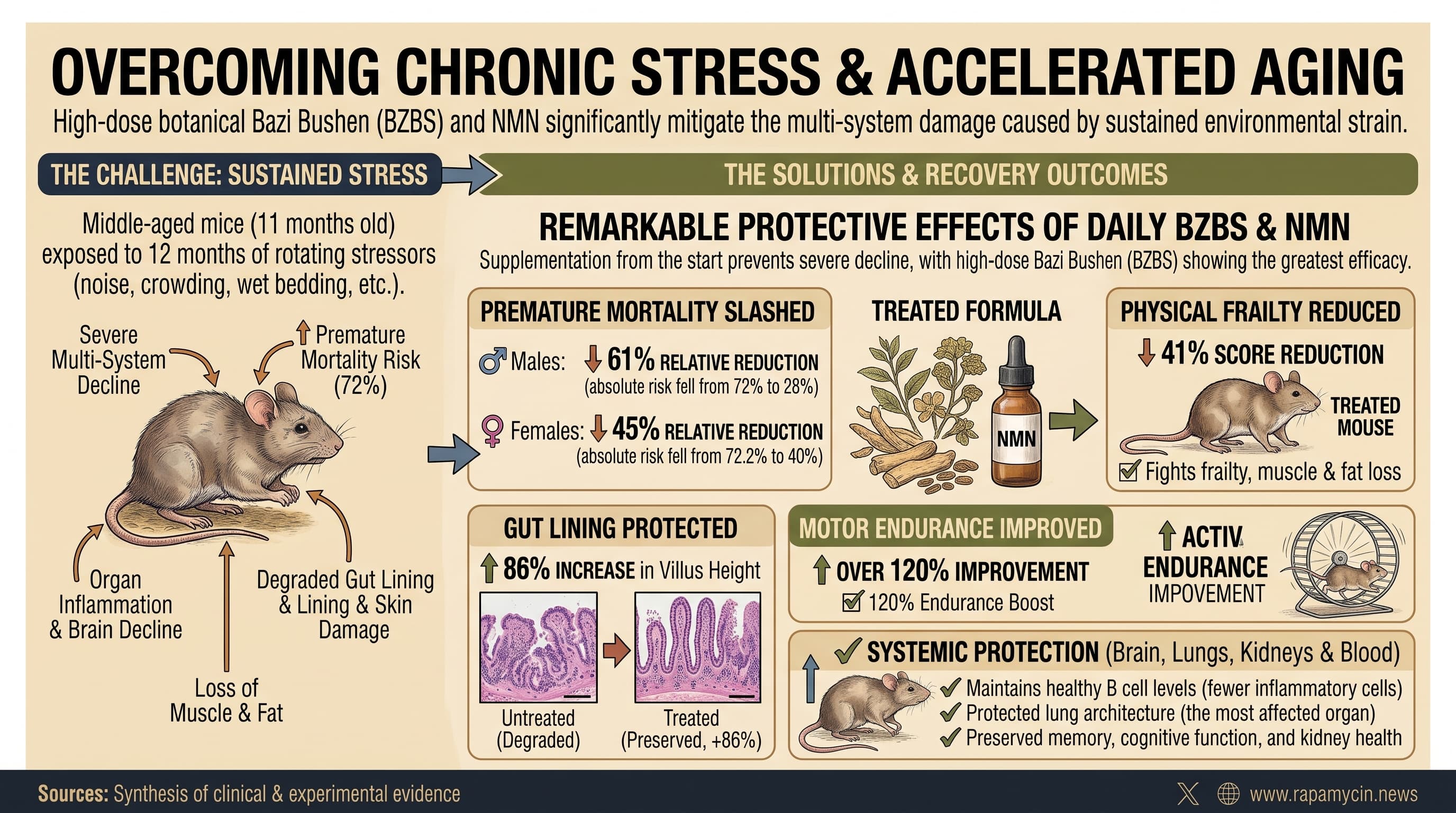
Researchers in China exposed middle-aged mice (11 months old) to a year of rotating mild stressors, including noise, cage tilting, crowding, isolation, wet bedding, light disruption and water deprivation. Stressed mice showed higher frailty scores, poorer memory and strength, loss of muscle and fat, gut and skin damage, and higher mortality. Single-cell sequencing of brain, gut, kidney, lung and blood showed a common pattern of fewer lymphocytes (especially B cells) and more inflammatory myeloid cells, with the lung most affected. Mice given NMN or the commercial herbal formula Bazi Bushen (BZBS) from the start of the stress period fared better, with high-dose BZBS performing best. Lab experiments attributed part of the effect to compounds from Schisandra and Cnidium that bind and activate AMPK and sirtuins and protect mitochondria in stressed cells.
Stress has long been suspected of aging people faster. Studies in humans link years of chronic strain to faster-ticking epigenetic clocks and immune profiles that look older than their owners. What has been harder to show is cause, and which organs pay the price.
This study attempted both in mice. Starting at 11 months, roughly equivalent to a person in their early 40s, mice endured a year of unpredictable daily hassles: tilted cages, damp bedding, crowding, isolation, white noise, scrambled light cycles and periods without water. The stressors rotated so the animals could not adapt.
The results were stark. Stressed mice scored worse on frailty checklists, lost interest in new companions, got lost more often in a memory maze and fell off a rotating rod sooner. Their calf muscles shrank to about half normal weight, belly fat nearly vanished, intestinal villi shortened and the skin thickened. Females under stress died at six times the rate of unstressed females over the study period.
To see what was happening inside, the team sequenced nearly 300,000 individual cells from the brain, small intestine, kidney, lung and blood. A common thread emerged: stress depleted lymphocytes, particularly B cells and naive T cells, while inflammatory macrophages and neutrophils expanded. The lung showed the largest changes, leading the authors to suggest it may act as a hub where stress-driven immune aging spreads.
Two interventions, given from the start of the stress period, were tested. One was NMN, the popular NAD+ precursor. The other was Bazi Bushen, a patented Chinese formula of eight medicinal seeds and herbs, including Schisandra, Cnidium, goji, ginseng and Cistanche. Both helped. High-dose BZBS performed best, cutting the female death rate from 72 percent in stressed animals to 28 percent, and restoring much of the lost muscle, fat and gut structure.
To find out how, the researchers identified which herbal compounds reach the blood and brain of rats. They then tested those compounds in stressed brain support cells and immune cells. Compounds from Schisandra and Cnidium (schisandrin B, schisantherin A and osthole) reduced mitochondrial free radicals, preserved mitochondrial membrane potential and, in the case of osthole, improved cellular respiration. They appeared to bind AMPK, the cell’s energy sensor, and several sirtuins, and blocking AMPK erased much of their benefit. In the lungs of treated mice, AMPK activation and levels of the mitochondrial master regulator PGC-1 alpha were higher.
The story is tidy, but several details deserve caution. The unstressed male mice in this study died far earlier than healthy laboratory mice usually do. The experiment ended when the mice were 21 to 23 months old, before most would die naturally, so it measured early deaths rather than lifespan. The treatment began alongside the stress, so the study tested prevention rather than the “reversal” promised in the title. And the herbal concentrations that worked in cell dishes were far higher than blood levels normally achieved by eating the plants.
The broader message holds up better than the product claim. Sustained, unpredictable stress produced broad, measurable aging-like damage in mice, and interventions that support mitochondrial function blunted it. Whether this specific formula does anything comparable in stressed humans is entirely untested.
Actionable Insights
Sustained physiological strain acts as a major driver of biological aging, accelerating physical frailty and chronic inflammation. This research reveals that the primary systemic damage occurs via an overactive innate immune response coupled with depleted cellular energy reserves.
For educated individuals seeking healthspan optimization, the take-home message is clear: mitigating biological stress requires both lifestyle moderation and targeted cellular energy support. The study highlights that activating the AMPK-Sirtuin-PGC-1a signaling axis is vital for cellular survival under duress.
The real-world magnitude of this intervention is substantial. In stressed animal models, high-dose botanical supplementation reduced the absolute risk of premature mortality by 44 percent in males (dropping from 72 percent to 28 percent) and by 32.2 percent in females (dropping from 72.2 percent to 40 percent). This equates to a relative reduction in mortality risk of 61 percent for males and 45 percent for females under sustained strain. Physical frailty scores dropped by 41 percent, gut lining architecture was preserved by an 86 percent increase in villus height, and motor endurance improved by over 120 percent compared to untreated stressed subjects. People experiencing unavoidable occupational or psychological strain should prioritize habits and compounds that activate AMPK and maintain NAD-dependent sirtuin activity.
Do not buy Bazi Bushen on the strength of this study. The research is still early. All evidence is from mice and cell culture, run by groups tied to the product’s ecosystem. The mouse dose scales to roughly 11 g of formula per day for a 70 kg adult by standard body-surface conversion.
NMN at a mouse dose equivalent to roughly 1.1 g/day in a 70 kg human also reduced deaths (female mortality 72% down to 36%), but this was a single-dose, single-study result in an unusual model.
If you take rapamycin or other drugs cleared by the liver enzyme CYP3A4, be cautious with Schisandra-containing products. Schisandra lignans are well documented to raise blood levels of tacrolimus, which shares that metabolic route with rapamycin.
The reliable takeaways are generic: stable sleep and light cycles, adequate hydration, social contact and stress reduction. These are the variables the stress model manipulated.
Context and Source
- Open Access Paper: Reversal of Chronic Stress-Induced Inflammaging by Bazi Bushen Formula Through AMPK-Sirtuins Axis Activation and Myeloid Reset
- Institutions: State Key Laboratory For Innovation and Transformation of Luobing Theory, Hebei Medical University, Shijiazhuang, China; with collaborating authors from Sheba Longevity Center, Sheba Medical Center,Tel Aviv University, Israel, and Renji Hospital, Shanghai Jiao Tong University School of Medicine, China
- Country: China and Israel
- Journal Name: Exploration (published by Henan University and John Wiley & Sons Australia, Ltd.)
- Impact Evaluation: The impact score of this journal is 30.4 (Scopus CiteScore 27.8), evaluated against a typical high-end range of 0–60+ for top general science, therefore this is an Elite impact journal.