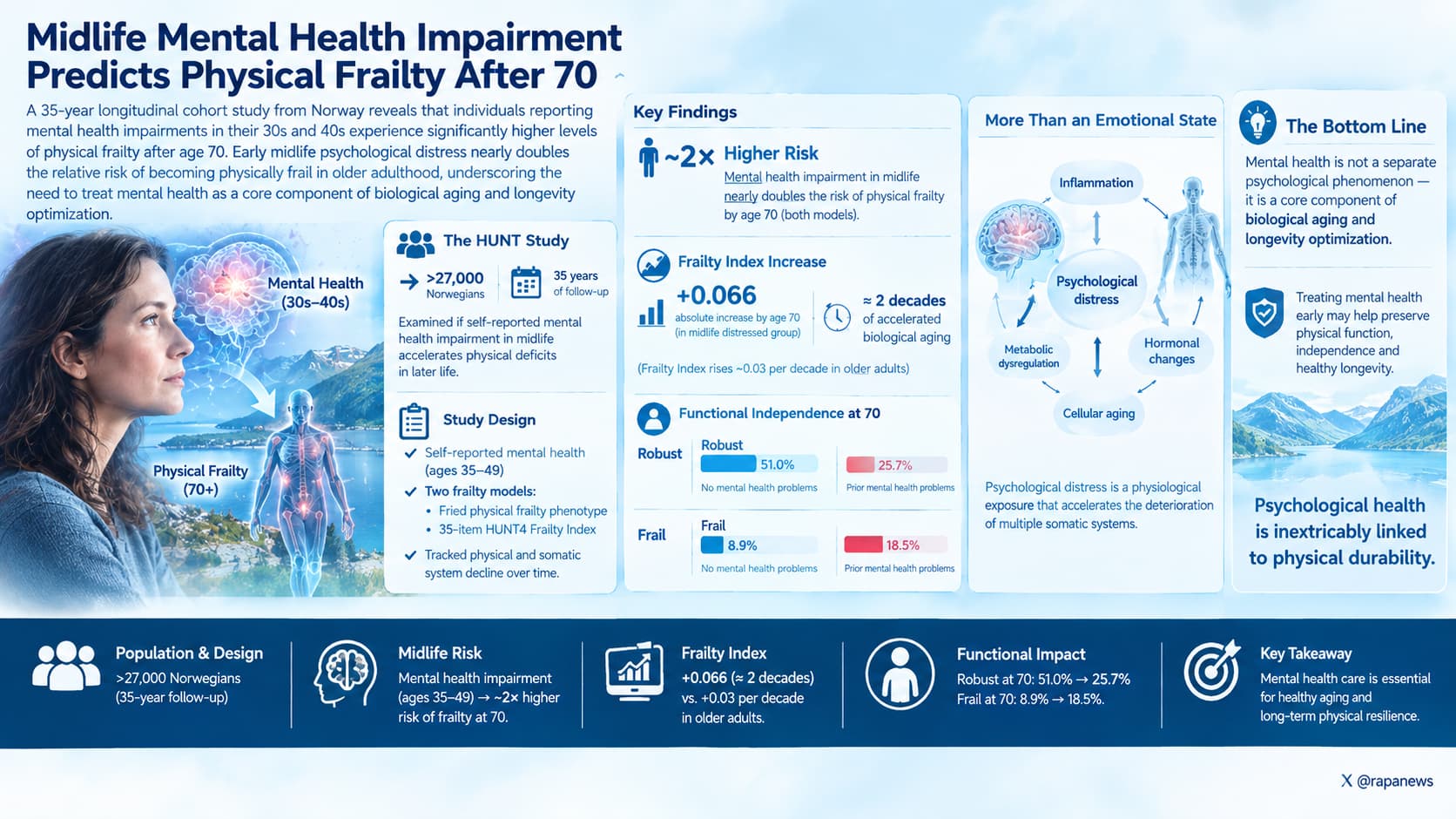
A 35-year longitudinal cohort study from Norway reveals that individuals reporting mental health impairments in their 30s and 40s experience significantly higher levels of physical frailty after age 70. Using two distinct frailty models, researchers found that early midlife psychological distress nearly doubles the relative risk of becoming physically frail in older adulthood. These findings underscore the necessity of treating mental health as a core component of biological aging and longevity optimization, rather than a separate psychological phenomenon.
Psychological health is inextricably linked to physical durability. The HUNT study tracked over 27,000 Norwegians for more than three decades to determine if self-reported mental health impairment in midlife accelerates the accumulation of physical deficits in later life. The data reveals that psychological distress is not merely a transient emotional state but a physiological exposure that accelerates the deterioration of multiple somatic systems. By evaluating individuals through both the Fried physical frailty phenotype and the 35-item HUNT4 Frailty Index, the researchers demonstrate a persistent structural decline in physical capacity.
The biological toll observed in this study likely represents an underestimation (i.e. things are even worse than they are presented). The data exhibits a massive survivor bias. Mortality prior to the follow-up assessment at age 70 was 55.5 percent for individuals who reported early midlife mental health problems, compared to only 36.6 percent for those who did not. This indicates that the participants with a history of mental health challenges who survived to be tested at age 70 represent only the most robust fraction of that initial cohort. Even within this resilient subset, the differences in physical deterioration were profound.
Mental health impairment in early midlife drives a systemic erosion of physical reserves that is detectable over 35 years later. The associations remained robust even after adjusting for traditional lifestyle confounders like physical activity, obesity, smoking, and alcohol consumption. This strongly suggests that psychological distress exerts direct pathogenic effects on physical aging independent of behavioral coping mechanisms. Clinicians and researchers focused on lifespan extension must integrate proactive psychological monitoring and interventions into standard physiological health protocols. Treating depression, chronic stress, and anxiety is a structural necessity for maintaining late-life musculoskeletal and functional independence.
Actionable Insights
Midlife mental health impairment exerts a biological cost equivalent to decades of accelerated aging. For adults aged 35 to 49, reporting psychological distress resulted in an absolute increase of 0.066 on the Frailty Index by age 70. Because the Frailty Index typically increases by approximately 0.03 per decade in older adults, this 0.066 penalty is roughly equivalent to two additional decades of biological deficit accumulation.
The practical outcome is a severe loss of functional independence. At age 70, the prevalence of being categorized as physically “robust” dropped from 51 percent in the unexposed group to only 25.7 percent in the group with prior mental health problems. The prevalence of overt frailty doubled from 8.9 percent to 18.5 percent.
To optimize longevity, psychological stress and mental health disorders must be treated with the same aggressive intervention strategies used for hyperlipidemia or insulin resistance. Relying solely on physical exercise and diet is insufficient if the central nervous system remains in a state of chronic distress. Implementing cognitive behavioral therapy, prioritizing stress management protocols, and seeking psychiatric care are mandatory steps to prevent accelerated sarcopenia and loss of mobility in later life.
Context/Source
- Open Access Paper: Midlife mental health and frailty up to 35 years later: Insights from the HUNT study
- Institution: The Norwegian National Centre for Ageing and Health, Vestfold Hospital Trust, University of Oslo
- Country: Norway
- Journal: Archives of Gerontology and Geriatrics
- Impact Evaluation: The impact score of this journal is 4.0, evaluated against a typical high-end range of 0 to 60+ for top general science, therefore this is a Medium impact journal.
Related Reading:
- Stress and Aging - Dose / Response and Permanence?
- Toxic Workplaces Are Accelerating Your Biological Clock: First Data from the Semmelweis Occupational Cohort
- The 30-Year Cliff: How Chronic Psychological Stress Silently Accelerates Biological Aging and Depletes Brain Resilience in Young Women
- Early Life Stress Pushes Biological Age Up 38 Percent Before Any Sign of Illness
- The Resilience Prescription: Rewiring the Aging Brain Against Chronic Stress
- Social Status Overrides Genetic Destiny in Dementia Risk