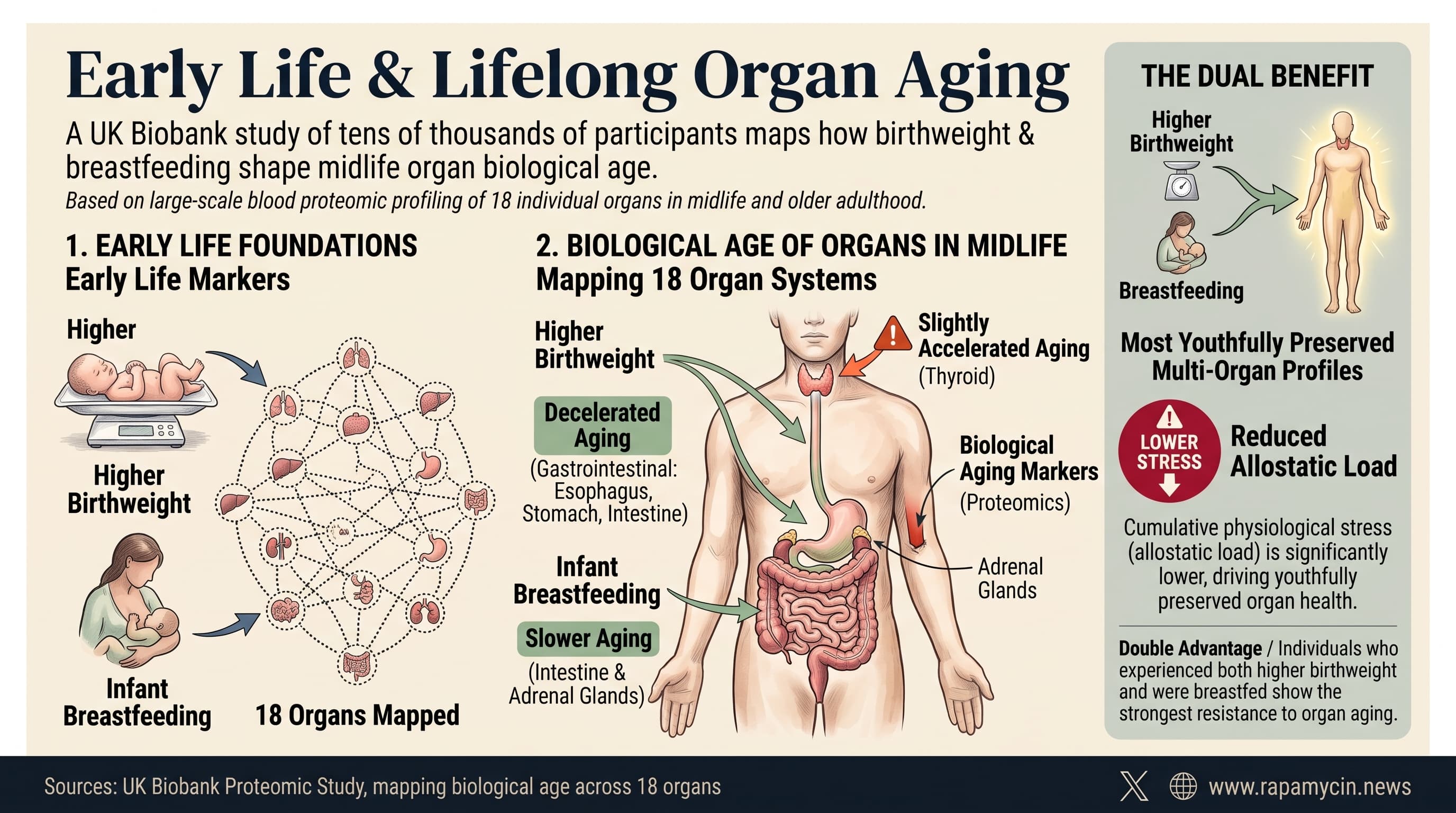
Using large-scale blood proteomic profiling from tens of thousands of UK Biobank participants, researchers mapped how birthweight and infant breastfeeding influence the biological age of eighteen individual organs in midlife and older adulthood. The investigation demonstrated that higher birthweight is associated with slower biological aging across eleven distinct physiological systems, with the most pronounced decelerations occurring in the gastrointestinal tract,including the intestine, esophagus, and stomach. Breastfeeding independently predicted slower aging in the intestine and adrenal glands, though it correlated with slightly accelerated thyroid aging. Individuals who experienced both higher birthweight and breastfeeding exhibited the most youthfully preserved multi-organ profiles, an advantage driven partly by reduced cumulative physiological stress, measured as allostatic load.
For decades, the field of developmental biology has operated on the premise that fetal and early infant environments program future vulnerability to chronic illness. Traditionally, studies examined distinct clinical endpoints such as late-onset type 2 diabetes, stroke, or ischemic heart disease. A major study published in Aging Cell shifts this paradigm by examining biological aging across distinct physiological systems long before clinical disease manifests.
By analyzing plasma proteomics from more than 20,000 adults enrolled in the UK Biobank, the investigators deployed organ-specific proteomic clocks. These algorithms evaluate thousands of circulating proteins to measure how rapidly individual organs are aging relative to a person’s calendar years. The biological data were cross-referenced with two foundational early-life metrics: birthweight, which reflects the quality of intrauterine growth, and breastfeeding status,which captures early postnatal nutrition and immune transfer.
The findings reveal that the earliest nutritional inputs leave systemic, measurable imprints on adult organ biology decades later. Higher birthweight was linked to slower biological aging across eleven separate organ systems. The digestive architecture showed the greatest sensitivity. The intestine, esophagus, and stomach exhibited the most substantial reductions in biological aging gaps, alongside notable benefits in the kidneys, liver, immune system, and skeletal muscle.
Breastfeeding offered targeted, tissue-specific protection. Adults who received breast milk as infants maintained significantly younger biological profiles in their intestines and adrenal glands. However, the data also revealed an unexpected trade-off: breastfed individuals displayed slightly accelerated biological aging in the thyroid gland, an observation that hints at complex metabolic adaptations during early development.
When both early advantages coincided, the effect was amplified. Individuals who had higher birthweight and were breastfed displayed the slowest biological aging across the gut, kidneys, liver, adrenal glands, and lungs. To understand why, the authors tested the role of adult allostatic load (stress), a clinical composite score of ten biomarkers capturing wear and tear across metabolic, cardiovascular, and immune axes. Allostatic load mediated up to 35.3 percent of the link between birthweight and slower organ aging, particularly in stress-sensitive tissues such as the skin and adrenal glands.Conversely, single inflammatory markers such as C-reactive protein accounted for very little of this relationship,demonstrating that early nutrition shapes systemic resilience to chronic stress rather than isolated inflammation alone.
Actionable Insights
While an adult cannot alter their birthweight or whether they were breastfed, this research provides concrete strategies for optimizing longevity and guiding parental decisions. For prospective and new parents, the mandate is clear: maintaining healthy fetal growth through sound prenatal nutrition and choosing breastfeeding when feasible directly builds organ-level structural reserve in offspring.
For adults who were born with low birthweight or bottle-fed, the findings highlight where biological vulnerability concentrates: the digestive tract, kidneys, and adrenal stress pathways. The data indicate that adult lifestyle can actively buffer these early liabilities. Because allostatic load mediated up to 35 percent of the organ aging penalty, mitigating cumulative daily stress is an effective countermeasure. Prioritizing blood pressure control, insulin sensitivity, waist-to-hip ratio management, and regular sleep can dismantle the primary pathway through which poor early growth accelerates adult aging.
Regarding real-world magnitude, the combined effect of higher birthweight and breastfeeding reduced intestinal biological age by 0.13 standard deviations. In practical terms, this equates to a modest deceleration of approximately six to twelve months of biological aging across a midlife adult population. While statistically robust, this small effect confirms that early-life programming creates a baseline susceptibility rather than an unchangeable fate.
Context/Source
- Open Access Paper: Birthweight and Breastfeeding Shape Patterns of Biological Aging Across Adult Organs
- Institution: NHC Key Laboratory of Environment and Endemic Diseases, School of Public Health, Health Science Center, Xi’an Jiaotong University; and Precision Medicine Center, The First Affiliated Hospital of Xi’an Jiaotong University
- Country: China
- Journal Name: Aging Cell
- Impact Evaluation: The impact score of this journal is 7.7, evaluated against a typical high-end range of 0–60+ for top general science, therefore this is a High impact journal.