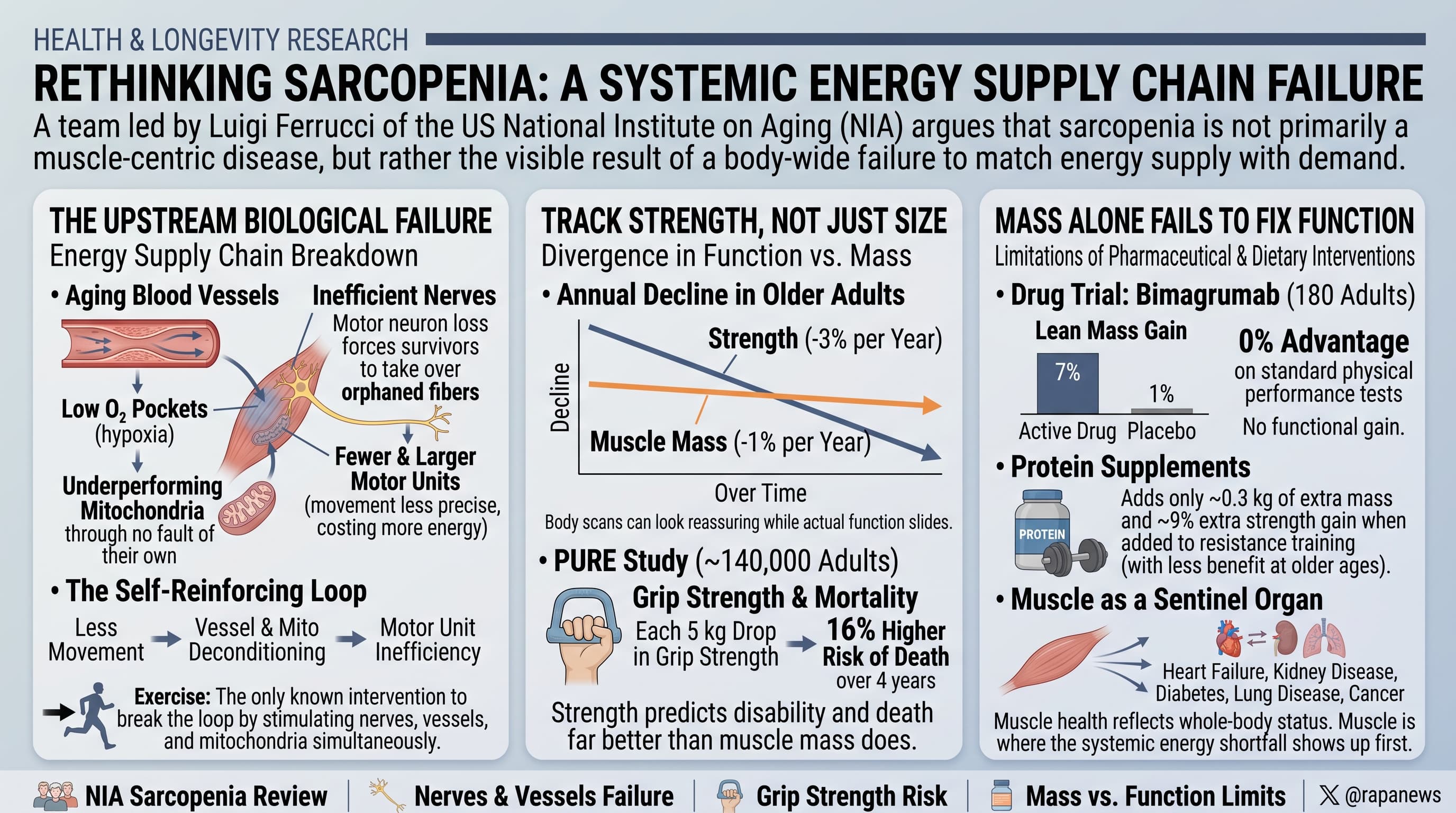
A five-author group including the National Institute on Aging’s Luigi Ferrucci argues that sarcopenia has been conceptually mislabeled for thirty years. The clinical definition already moved from low muscle mass to low strength and poor physical performance, but the underlying disease model stayed muscle-centric, and that mismatch explains why drug after drug has added lean tissue without adding function. The authors propose reframing sarcopenia as a disease of the entire ageing motor system, spanning motor cortex, spinal cord, motoneurons, peripheral nerves, neuromuscular junctions, proprioceptive afferents, and muscle. They offer a two-stage clinical pathway (a pragmatic motor-system-aware screen for everyone, mechanistic phenotyping only in specialist and trial settings) and a five-item research agenda.
For decades, the story of ageing muscle has been told as a story about muscle. Lose flesh, lose strength, lose independence. The trouble is that the arithmetic never worked.
Follow older adults for five years and their strength collapses two to five times faster than their muscle shrinks. In the Health ABC cohort, men aged 70 to 79 lost roughly 16 percent of knee extensor torque while losing only about 5 percent of thigh muscle area. More damaging still, people who gained muscle over those five years lost strength at essentially the same rate as everyone else. When researchers ask how much of the person-to-person variation in strength loss is explained by muscle loss, the answer is 6 to 8 percent. Ninety-plus percent of the phenomenon is coming from somewhere else.
That somewhere else, the authors argue, is the nervous system. Motoneurons degenerate, preferentially the large fast ones. Motor units remodel through repeated cycles of denervation and reinnervation. Persistent inward currents, the amplifiers that let a motoneuron sustain firing, weaken. Serotonin, noradrenaline, and dopamine projections thin out. Neuromuscular junctions fragment. Muscle spindles atrophy, so position sense degrades and movement becomes slow and cautious. Motor cortex excitability drops while inhibitory GABAergic tone rises. Weaker older adults show roughly a 20 percent deficit in voluntary activation compared with stronger peers of the same age, meaning they cannot fully recruit the muscle they already own.
This reframing has teeth because it predicts the field’s failures. If weakness is distributed across a chain, then loading one link, which is what anabolic drugs and protein supplements do, produces exactly what has been observed: mass goes up, function barely moves. It also explains why exercise keeps winning. Resistance and power training load muscle, drive neural adaptation, and improve mitochondrial function simultaneously.
The proposal is not that muscle stops mattering. It is that muscle is the effector, not the explanation. The authors go so far as to ask whether the word sarcopenia, literally poverty of flesh, should survive. Their practical demand is more modest: consensus bodies should redefine the disease, and the field should build cheap point-of-care tests that reveal which link in the chain is failing. Whether such tests beat a stopwatch and a grip dynamometer is, by the authors’ own admission, an open empirical question. [Confidence: High that the muscle-centric model underperforms; Medium that motor-system phenotyping will prove clinically actionable]
Actionable Insights
- Stop using muscle mass as your primary strength metric. Change in mass explains only 6 to 8 percent of the variation in strength loss (a weak correlation, roughly r = 0.25). Track strength, power, and gait speed instead.
- Adding mass does not rescue function. In a 1,678-person five-year cohort, people who gained weight and muscle area still lost knee extensor torque at 2.9 percent per year (men) and 1.9 percent per year (women), the same as everyone else.
- Train velocity, not just load. Power training beats conventional strength training for physical function with a standardized effect size of 0.30 (95 percent CI 0.05 to 0.54, 13 trials, 383 people). Translation: the average power-trained person outperforms about 62 percent of the strength-trained group, worth roughly 0.6 seconds on a timed up-and-go and half an extra chair stand. Real but small, and low certainty.
- Gait speed is the highest-yield number you can measure. Each 0.1 metre per second faster is associated with 12 percent lower mortality risk (hazard ratio 0.88, 95 percent CI 0.87 to 0.90, 34,485 adults). Five-year survival for men aged 75 to 84 ran from 57 percent (slowest) to 93 percent (fastest). Association, not proven causation.
Also worth auditing: sedative and anticholinergic medication burden, flagged as a reversible suppressor of motor drive.
Context and Source
- Open Access Paper: Reframing sarcopenia as a disease of the ageing motor system
- Authors: Lucas B R Orssatto, W David Arnold, Luigi Ferrucci, Marco V Narici, Brian C Clark
- Article type: Personal View (expert opinion, not primary research)
- Journal: The Lancet Healthy Longevity, 2026.
- Institutions and countries: The University of Queensland, Brisbane, Australia; University of Missouri, Columbia, USA; National Institute on Aging, NIH, Baltimore, USA; University of Padova, Italy; Science and Research Centre Koper, Slovenia; Ohio University, Athens, USA.
- Impact evaluation: The impact score of this journal is 20.5 (Journal Impact Factor; 5-year JIF 20.7; SJR 5.433, Q1; 97.2nd percentile in Geriatrics and Gerontology), evaluated against a typical high-end range of 0 to 60+ for top general science, therefore this is a High impact journal.
Related Reading:
- Human skeletal muscle-specific atrophy with aging: a comprehensive review
- Why Old Muscle Still Hears the Growth Signal but Goes Deaf to the Repair Signal
- Genetic Jackpot: Rare Myostatin Mutations Unlock Increased Muscle and Reduced Adiposity in Humans
- Muscle as Mind-Vitamin: How Atrophy Signals Brain Decay and Exercise Builds Cognitive Armor
- The Calcium Leak: Why Your Muscles Age Even If You Train (and how to stop it)
- Increasing Muscle Mass in the Elderly
- Why There Is No Single Fix for Ageing Muscle: A Computer Model Says Sarcopenia Is a Conspiracy of Many Failures
- Dr. William Evans – Why Muscle Mass is a Marker of Longevity
- Imeglimin: An Approved Diabetes Pill Just Made Old Mice Stronger
- HIV Drug (Maraviroc) Reverses Muscle Aging by purging “Zombie Cell” Signals
- Motor Units as determinants of Aging