Researchers at the Chinese University of Hong Kong built a senescence atlas of human hamstring muscle. They used single-nucleus RNA and chromatin profiling on about 53,000 nuclei from five young men and five older men. Senescent cells increased with age in all four major non-immune cell types, most sharply in fibro-adipogenic progenitors (3.3 to 26.9 percent) and smooth muscle cells (4.7 to 40.3 percent). Aged muscle stem cells released inflammatory chemokines CCL3, CCL4 and CCL5 and had more of their receptor, CCR5. Old mice (18 months) were treated with maraviroc, an approved CCR5-blocking HIV drug, for three months. The treated mice gained muscle mass, fiber size, grip strength and treadmill endurance, and showed fewer senescent cells. Young mice showed no benefit.
Muscle loss with age, called sarcopenia, is one of the strongest predictors of falls, frailty and death in older adults. Resistance training and protein remain the only reliable tools. No drug is approved to slow or reverse the condition. This study suggests a new target, and the candidate drug has already been taken by HIV patients for years.
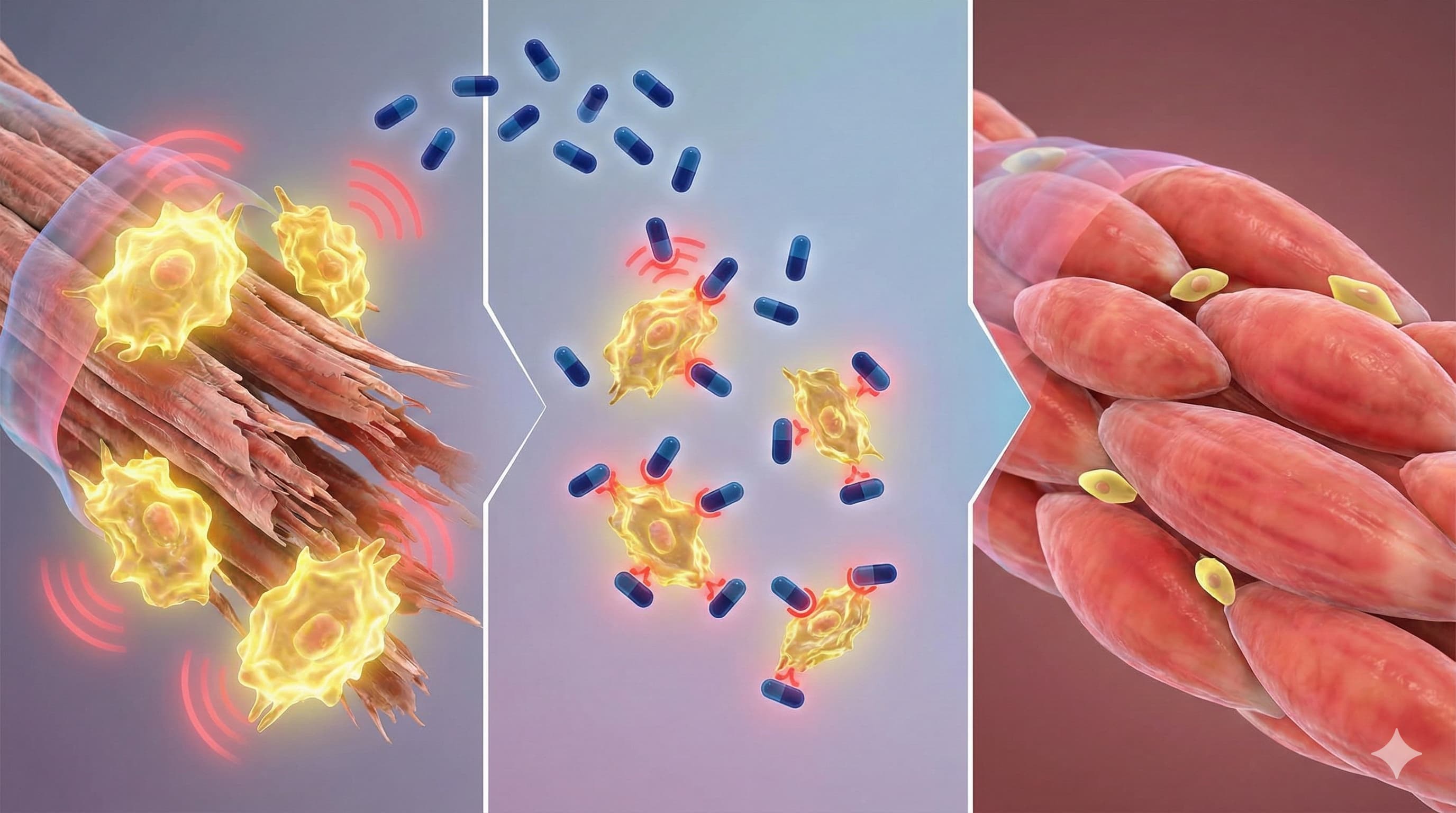
The big idea is that aging muscle is shaped by its neighbors as much as by the muscle fibers. Between the fibers live stem cells, connective tissue progenitors, blood vessel cells and immune cells. As we age, more of these cells become senescent. They stop dividing but stay metabolically active, releasing a stream of inflammatory signals known as the SASP (senescence-associated secretory phenotype). These signals spread inflammation, encourage scarring and impair the stem cells that repair muscle.
The Hong Kong team took hamstring samples from men aged 19 to 27 having knee ligament surgery and men aged 60 to 77 having knee replacements. They profiled gene activity and DNA accessibility in each of roughly 53,000 cell nuclei. The result is described as the first senescence atlas of human muscle. Senescent cells increased in every major cell type with age. The rise in connective tissue progenitors was eightfold, and in smooth muscle cells it was more than eightfold. Each cell type produced its own mix of inflammatory signals, though 16 were shared by all four.
One cluster of signals stood out: the chemokines CCL3, CCL4 and CCL5 and their docking receptor, CCR5, were sharply elevated in aged muscle stem cells. The same pattern appeared in old mice. The researchers saw an opportunity, because CCR5 is the target of maraviroc, a drug approved in 2007 to stop HIV from entering immune cells.
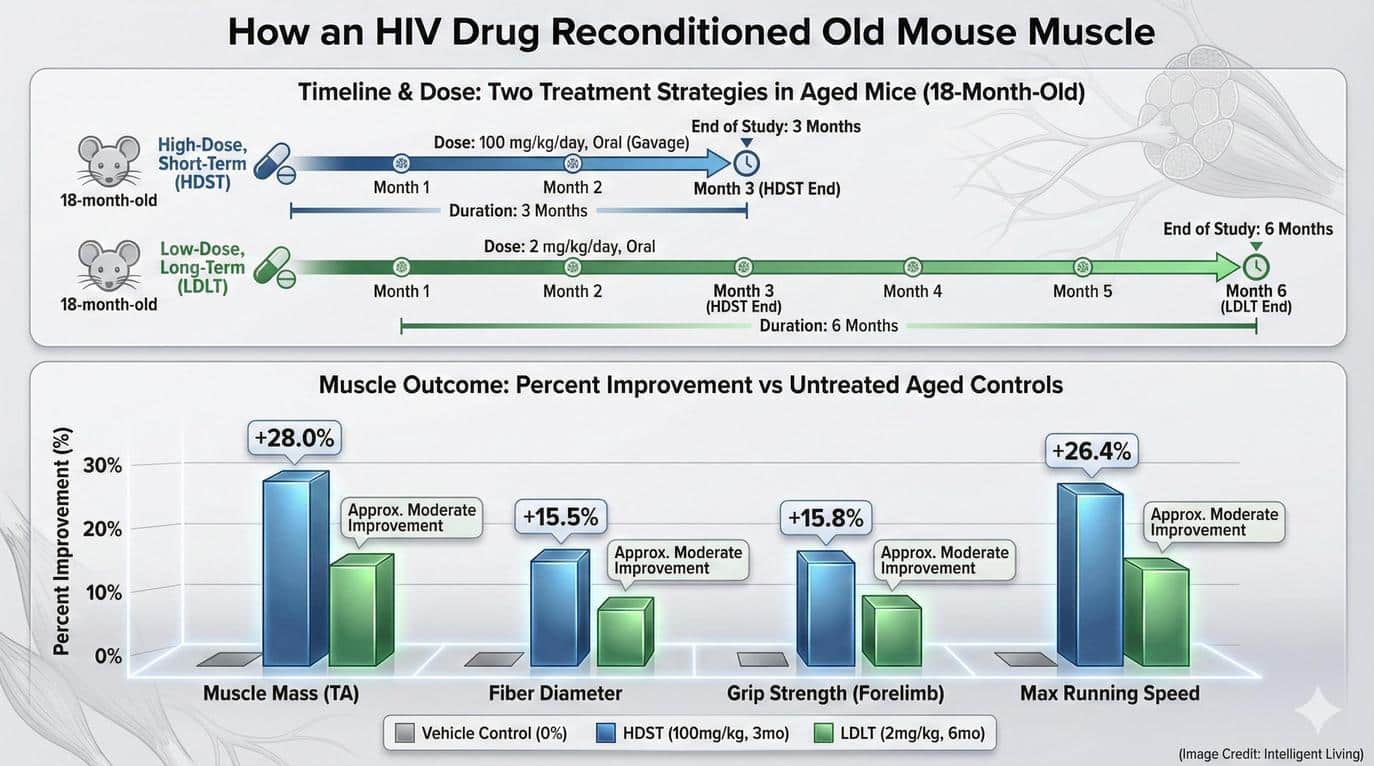
They injected 18-month-old mice with maraviroc every two days for three months. Compared with untreated old mice, treated animals had 28 percent heavier leg muscles relative to body weight and 15 percent larger muscle fibers. Grip strength was 16 percent higher, top running speed 26 percent higher, and running distance 50 percent longer. Muscle stem cells became more plentiful, inflammatory macrophages decreased, and the share of senescent cells dropped in every cell type examined. The drug works as a “senomorphic.” It does not kill senescent cells. It mutes their signals.
A lower dose given for six months also worked. The same low dose for three months did not reliably improve muscle structure. Young mice gained nothing, which suggests the drug corrects an age-related problem rather than acting as a general performance booster.
This finding suggests that sarcopenia is not an inevitable slide into frailty but an active, reversible process driven by immune signaling. Because Maraviroc is already FDA-approved with a well-known safety profile, this research bypasses the decade-long safety testing required for novel compounds, offering a potential fast-track to clinical trials for frailty (and immediate use by biohackers).
Source:
- Open Access Research Paper: “Multiomics and cellular senescence profiling of aging human skeletal muscle uncovers Maraviroc as a senotherapeutic approach for sarcopenia”.
- Institution: The Chinese University of Hong Kong (CUHK), Hong Kong SAR, China.
- Journal: Nature Communications (Published online July 5, 2025).
- Impact Evaluation: The impact score of this journal is ~15.7 (2024/2025 JIF), therefore this is a High impact journal.
Benefits over 3 months of treatment
Metric / Improvement
- Muscle Mass, +28%
- Fiber Diameter, +15%
- Grip Strength, +16%
- Endurance, +20%
Related reading: Maraviroc Fights Middle-Aged Memory Loss (& Muscle Aging)