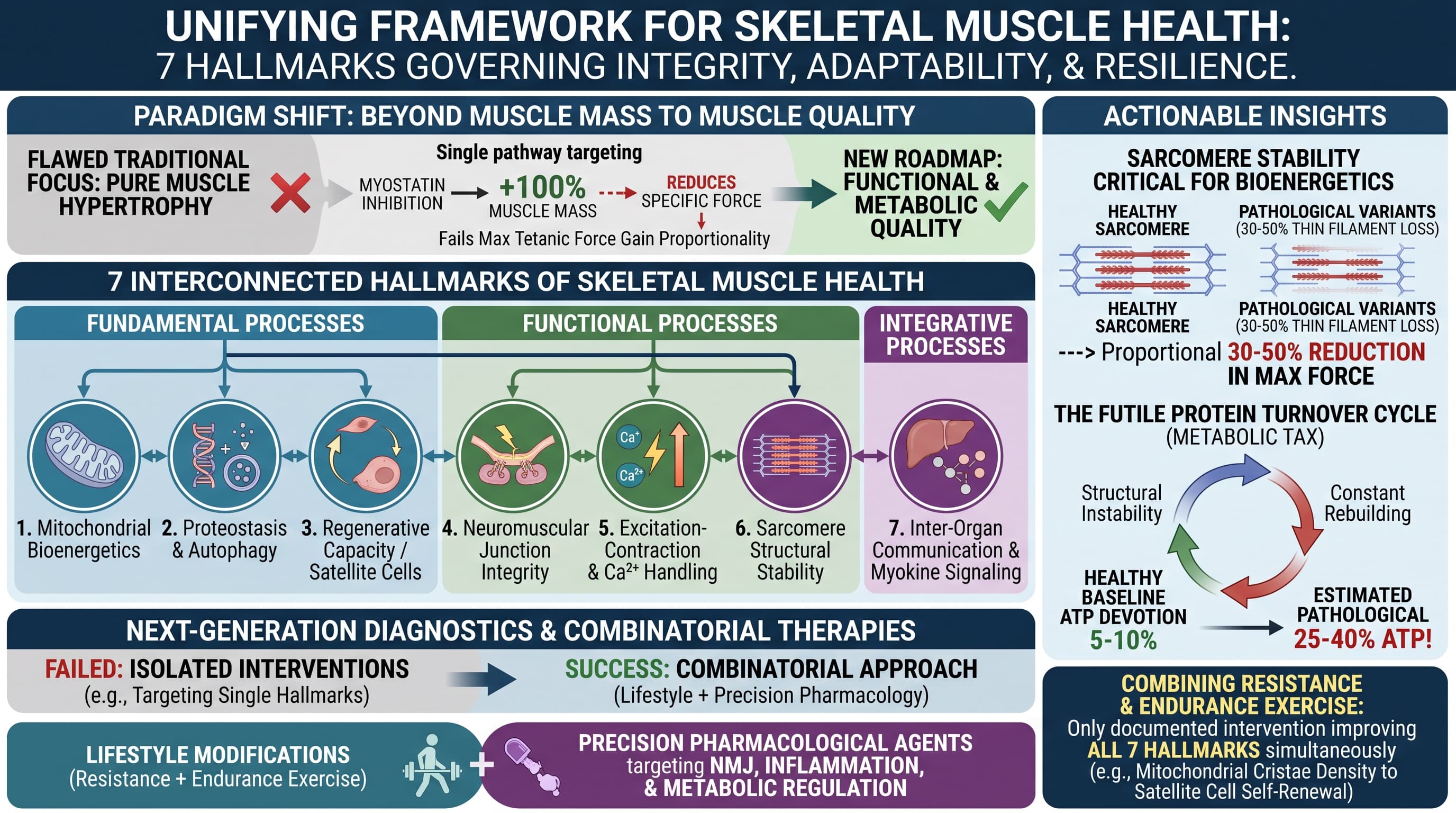
This comprehensive review establishes a unifying framework for skeletal muscle health by identifying seven interconnected hallmarks that govern muscle integrity, adaptability, and resilience across the lifespan. The authors argue that the traditional clinical focus on muscle mass is fundamentally flawed, as mass often dissociates from functional strength and metabolic quality. By categorizing muscle health into fundamental, functional, and integrative processes, this paper provides a roadmap for developing next-generation diagnostics and targeted longevity therapies.
For decades, the medical and fitness communities have largely equated muscle health with muscle size. This review article completely dismantles that dogma. The authors present a new consensus model that views skeletal muscle not merely as a mechanical engine for movement, but as a central metabolic hub and an endocrine organ critical to systemic longevity.
The framework outlines seven interdependent hallmarks. Metabolism and bioenergetics, proteostasis, and genomics form the fundamental processes. Structure and excitability dictate the functional properties. Regeneration and cross-talk serve as the integrative processes that link muscle tissue to the rest of the body. The central thesis is that deterioration in any single hallmark inevitably propagates across the others. For example, age-related denervation does not just cause weakness; it initiates a destructive cycle that disrupts metabolic programs and impairs stem cell regeneration.
A critical concept explored in this paper is the frequent dissociation between muscle size and muscle quality. Genetic mutations or pharmacological interventions that massively increase muscle size, such as myostatin inhibition, routinely fail to produce proportional increases in actual strength or physical function. This occurs because forcing cellular hypertrophy without simultaneously optimizing mitochondrial density, neuromuscular junction stability, and protein folding capacity leads to structural instability.
The paper strongly suggests that isolated interventions will fail. Muscle aging is a multi-system collapse, meaning future therapeutics must be combinatorial. The authors advocate for combining lifestyle modifications like resistance training with precision pharmacological agents that target neuromuscular integrity, inflammation, and metabolic regulation simultaneously. This framework shifts the longevity focus from merely preventing muscle wasting to actively preserving metabolic flexibility and inter-organ communication.
Actionable Insights The data strongly indicates that prioritizing muscle quality and functional output is vastly superior to pursuing pure hypertrophy.
-
Targeting single genetic pathways like myostatin can result in a 100 percent increase in total muscle mass, yet this doubling fails to yield proportional gains in maximum tetanic force and actually reduces specific force.
-
Maintaining sarcomere structural stability is critical for basic bioenergetics. Pathological structural variants can reduce thin filament length by 30 to 50 percent, which creates a proportional 30 to 50 percent reduction in maximum force.
-
Furthermore, structural instability forces the body to constantly rebuild damaged proteins. This futile cycle escalates the resting ATP energy devoted to protein turnover from a healthy baseline of 5 to 10 percent up to an estimated 25 to 40 percent. This represents a massive metabolic tax on the body.
-
Practically, combining resistance and endurance exercise is the only documented intervention that improves all seven hallmarks simultaneously, improving everything from mitochondrial cristae density to satellite cell self-renewal.
Context/Source
- Paywalled Paper: The hallmarks of skeletal muscle health
- Institution: Multinational consortium led by the University of Padova and the Veneto Institute of Molecular Medicine.
- Country: Italy, Switzerland, USA, Spain, Netherlands, Denmark, France, Canada.
- Journal Name: Nature Metabolism.
- Impact Evaluation: The impact score of this journal is 20.8, evaluated against a typical high-end range of 0 to 60+ for top general science, therefore this is a Elite impact journal.
Related Reading:
- HIV Drug (Maraviroc) Reverses Muscle Aging by purging “Zombie Cell” Signals
- Human skeletal muscle-specific atrophy with aging: a comprehensive review
- BioAge Results for Phase 1b Clinical Trial on Anti Muscle-Aging Drug
- Genetic Jackpot: Rare Myostatin Mutations Unlock Increased Muscle and Reduced Adiposity in Humans
- Why Old Muscle Still Hears the Growth Signal but Goes Deaf to the Repair Signal
- Increasing Muscle Mass in the Elderly
- Muscle Is the New Longevity Drug Target, and the Pipeline Just Got Crowded