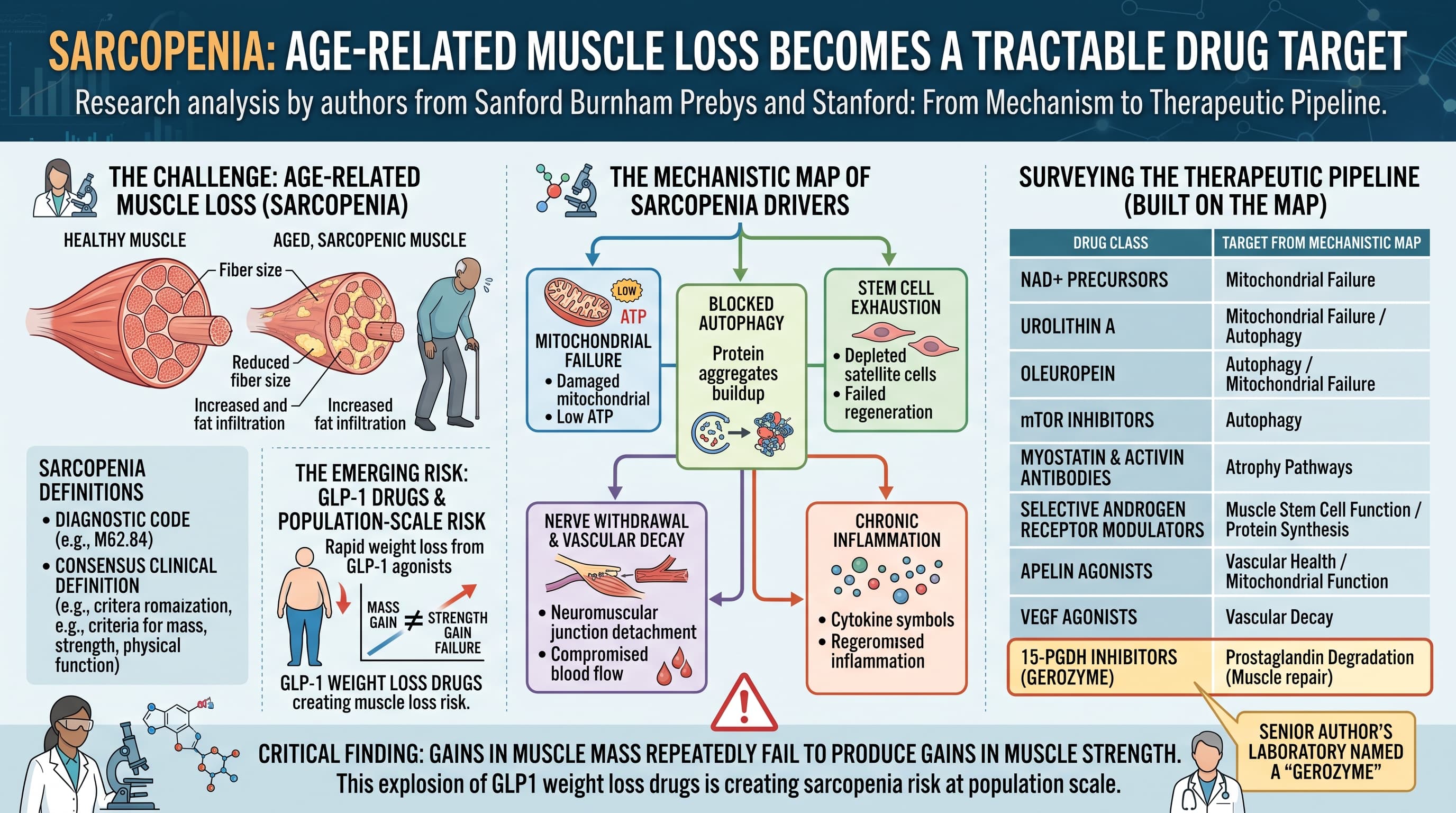
Four researchers from Sanford Burnham Prebys and Stanford argue that age-related muscle loss has finally become a tractable drug target. Sarcopenia now has a diagnostic code, a consensus clinical definition, and a mechanistic map spanning mitochondrial failure, blocked autophagy, stem cell exhaustion, nerve withdrawal, chronic inflammation, and vascular decay. The authors survey the therapeutic pipeline built on that map: NAD+ precursors, urolithin A, oleuropein, mTOR inhibitors, myostatin and activin antibodies, selective androgen receptor modulators, apelin and VEGF agonists, and inhibitors of the enzyme 15-PGDH, which the senior author’s laboratory named a “gerozyme.” Their central warning is that gains in muscle mass have repeatedly failed to produce gains in muscle strength, and that the explosion of GLP1 weight loss drugs is now creating sarcopenia risk at population scale.
For most of the last century, losing muscle as you age was treated as scenery rather than pathology. That framing is now gone. Sarcopenia received an ICD-10 code in 2016 and a consensus clinical definition in 2019, and with those two administrative facts came insurance reimbursement, trial endpoints, and pharmaceutical interest. A new review in Nature Reviews Drug Discovery takes stock of what that interest has produced.
The numbers that motivate the field are unforgiving. After 50, people lose roughly 10 percent of their muscle mass per decade. Between 40 and 80, somewhere between 30 and 50 percent of skeletal muscle is gone. Up to one in ten people across 26 surveyed countries meets criteria for sarcopenia. In 2014 the United States spent more than 40 billion dollars on hospitalizations in which nearly half the burden traced back to muscle wasting.
The big idea in the review is that muscle wasting is not one failure but a network of them, and that single-target drugs have kept failing for exactly that reason. Mitochondria in aged muscle swell, lose cristae, leak calcium, and accumulate DNA damage. The mTORC1 pathway is stuck in the “on” position yet somehow fails to build protein, while simultaneously shutting down the cellular recycling that clears damaged mitochondria. Motor neurons retreat from the muscles they once controlled. Muscle stem cell numbers fall by 24 percent in women and 37 percent in men, and two-thirds of the survivors are functionally broken. Fast-twitch fibres, the ones that catch you when you trip, shrink by about 40 percent while slow fibres barely change.
Against that, the authors line up a pipeline. Some entries are supplements already on shelves, including urolithin A, nicotinamide riboside, trigonelline, and the olive polyphenol oleuropein. Some are repurposed drugs, including rapamycin analogues and the arthritis drug tofacitinib. The most commercially advanced are antibodies that block myostatin and activin, which reliably grow muscle in mice and reliably underdeliver in humans.
The authors’ own preferred candidate belongs to a category they invented a word for. A “gerozyme” is an enzyme that becomes more active with age and spends that activity destroying something the body needs. Their example is 15-PGDH, which degrades prostaglandin E2. Force it into young muscle and the muscle ages. Block it in old mice and, according to the review, muscle strength, nerve connections, cartilage, blood, and even the blood-brain barrier improve together. A drug based on this idea has cleared phase I safety testing. The senior author cofounded the company developing it, a disclosure the paper states openly.
The sharpest section concerns GLP1 receptor agonists. Semaglutide and tirzepatide strip 25 to 30 percent of adipose tissue, but lean tissue leaves with it, and when the drug stops, fat returns while muscle does not. With roughly 13 percent of the world living with obesity and a projected billion by 2030, that asymmetry is a public health problem in the making. Several companies are now running combination trials pairing weight loss drugs with muscle-preserving antibodies.
The authors end on an unresolved tension. The field can add muscle. It has not reliably added strength. Until trials measure force and function rather than kilograms, the pipeline’s promise stays theoretical.
Actionable Insights
The single most useful takeaway is a benchmarking one: the review states plainly that exercise plus adequate protein is the standard every drug in this pipeline is measured against, and most drugs lose.
Concrete magnitudes worth knowing:
Myostatin-blocking antibodies, the most advanced muscle drugs in human testing, produce muscle mass gains of 3 to 9 percent with “limited functional improvements.” For a person carrying 28 kg of lean mass, that is roughly 0.8 to 2.5 kg. Supervised resistance training in older adults typically delivers a similar mass change plus large strength gains that the drugs do not match.
Fast-twitch fibres shrink about 40 percent with age while slow fibres are largely spared. Training that only involves walking or steady cardio does not address the fibre type actually being lost. Loaded, explosive, or heavy work does.
If you use a GLP1 receptor agonist, treat muscle preservation as part of the protocol rather than an optional extra. Fat loss of 25 to 30 percent comes with lean tissue loss, and after discontinuation fat returns faster than muscle.
On supplements: human evidence for urolithin A and NAD+ precursors is real but modest, and one mouse experiment in this review found that cutting muscle NAD+ by 85 percent produced no measurable muscle deficit at all.
Context and Source
- Paywalled Paper: Strengthening muscle for healthy ageing: innovative treatments for sarcopenia
- Authors: Sara Ancel, Emmeran Le Moal, Yu Xin Wang, Helen M. Blau (Ancel and Le Moal contributed equally)
- Institutions: Center for Cardiovascular and Muscular Diseases, Sanford Burnham Prebys Medical Discovery Institute, San Diego, California, USA; Baxter Laboratory for Stem Cell Biology, Department of Microbiology and Immunology, Stanford University School of Medicine, Stanford, California, USA. Present addresses include Nestlé Institute of Health Sciences (Lausanne, Switzerland) and Regeneron Pharmaceuticals (Tarrytown, New York, USA).
- Country: United States, with Swiss industry affiliation
- Journal: Nature Reviews Drug Discovery
- Publication date: Published online 07 September 2026.
- Article type: Review article, peer reviewed.
- Impact evaluation: The impact score of this journal is 91.2 (2025 Journal Impact Factor, publisher-reported; 5-year JIF 131.3), evaluated against a typical high-end range of 0 to 60+ for top general science, therefore this is an Elite impact journal.
Related Reading:
- The Culprit of Aging - Helen Blau's work at Stanford / PGE2, 15-PDGH
- Longevity Summit 2025 Reporting - Helen Blau PGDH Presentation
- Why Your Fastest, Most Powerful Muscle Fibers Age and Decay First
- BioAge Results for Phase 1b Clinical Trial on Anti Muscle-Aging Drug
- Increasing Muscle Mass in the Elderly
- HIV Drug (Maraviroc) Reverses Muscle Aging by purging “Zombie Cell” Signals