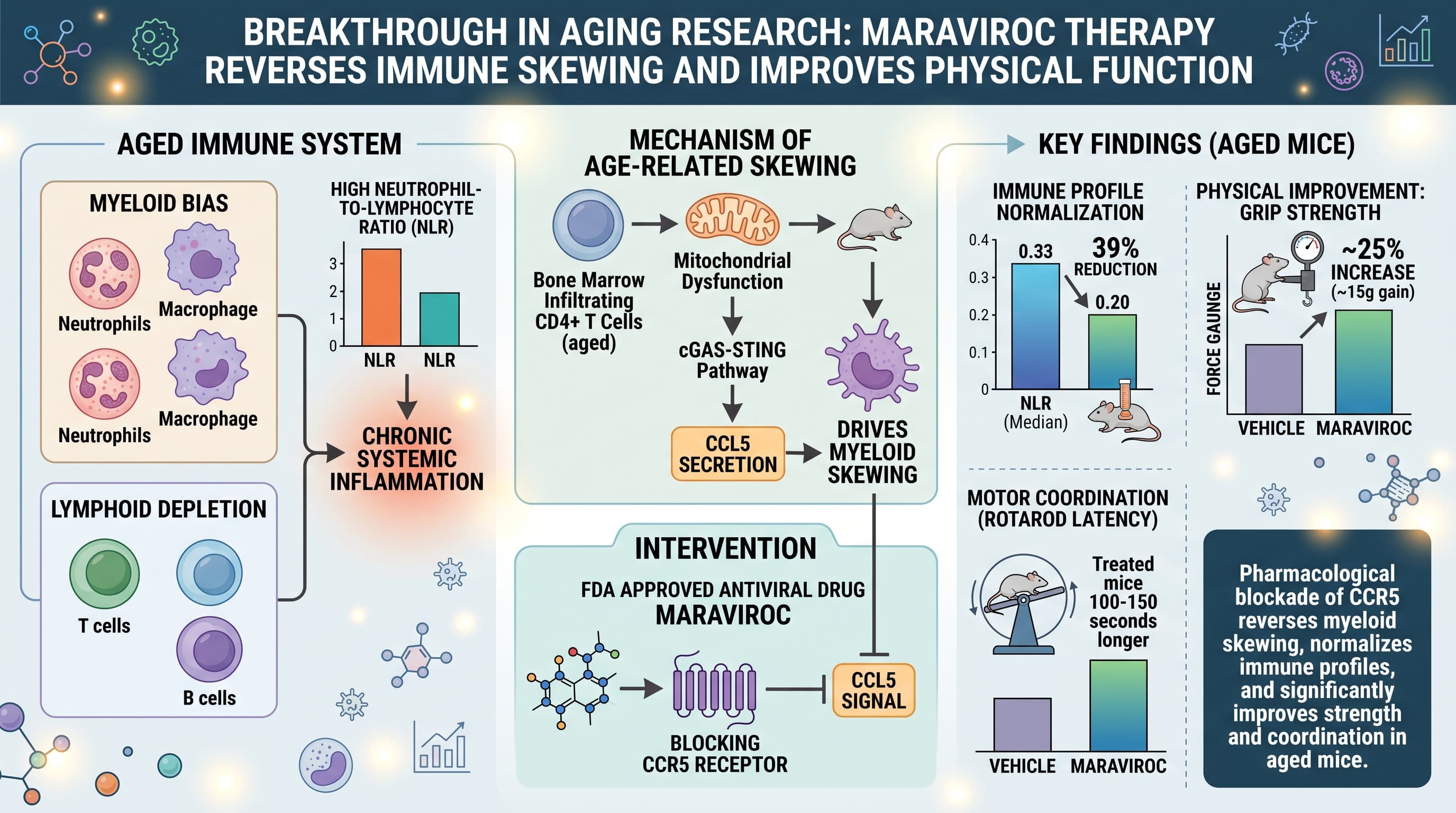
As mammals age, the immune system becomes increasingly biased toward producing myeloid cells over lymphoid cells, driving chronic systemic inflammation and elevating the neutrophil to lymphocyte ratio. This paper demonstrates that bone marrow infiltrating CD4+ T cells acquire mitochondrial dysfunction over time, which activates the cGAS-STING pathway and triggers the secretion of the signaling protein CCL5. This protein binds to CCR5 receptors on hematopoietic stem cells, forcing them to overproduce neutrophils. Pharmacological blockade of the CCR5 receptor using the FDA approved antiviral drug maraviroc reversed this myeloid skewing, normalized circulating immune profiles, and significantly improved physical strength and motor coordination in aged mice.
The neutrophil-to-lymphocyte ratio is one of the least glamorous numbers on a standard blood panel. It costs nothing extra, falls out of any complete blood count, and predicts death from nearly every age-associated disease studied. It also climbs steadily with age. Until now the reason it climbs has been largely a matter of description rather than mechanism.
A team led by María Mittelbrunn and Enrique Gabandé-Rodríguez at the Centro de Biología Molecular Severo Ochoa in Madrid, working with collaborators across Spain, Italy, Switzerland, Germany, and the US National Institute on Aging, has now traced a specific causal chain. The culprit is a type of T cell that should not really exist in large numbers. CD4+ T cells are conventionally the coordinators of immunity, not the assassins. But with age a subset acquires the killing machinery of CD8+ cells: perforin, granzymes, the transcription factor EOMES. These cytotoxic CD4+ cells have been noted in aged humans and in supercentenarians, and their significance has been argued about for years.
The Madrid group found these cells piling up specifically in bone marrow. When they transferred T cells from old mice into young T-cell-deficient recipients, myeloid output jumped within seven days. Transfer young T cells instead and nothing much happens. The bone marrow, it turns out, is where these cells preferentially accumulate, more than spleen, liver, fat, or colon.
The mechanism runs through the mitochondria. Persistent antigenic stimulation wrecks mitochondrial function in these cells. Damaged mitochondria spill DNA into the cytosol, where the cGAS-STING pathway reads it as an infection signal and switches on CCL5 production. Mice engineered to have broken mitochondria only in their T cells developed the same picture at eight months of age that normal mice reach at twenty-four. That is a compression of roughly two-thirds of the mouse lifespan into a single genetic lesion, which is a strong argument that the mitochondrial defect is upstream rather than incidental.
The receiving end matters too. Aged hematopoietic stem cells and granulocyte-monocyte progenitors upregulate CCR5. In elegant competitive chimera experiments where half the marrow could see CCL5 and half could not, only the CCR5-competent progenitors expanded when old T cells arrived. The signal is being received, not merely broadcast.
The translational hook is that a CCR5 blocker already sits on pharmacy shelves. Maraviroc has been approved for HIV since 2007. One month of daily injections in old mice pushed the NLR back toward youthful levels, reduced neutrophils infiltrating lung and liver, and improved a spread of physiological markers. Young mice given the same drug showed essentially no change, which suggests the drug corrects a pathological signal rather than broadly suppressing immunity.
Actionable Insights
For individuals focused on longevity therapeutics, this paper provides highly practical value regarding the neutrophil to lymphocyte ratio (NLR). This ratio is easily obtained from standard complete blood count panels and serves as a highly sensitive, low cost proxy for systemic aging and bone marrow niche health. In large human cohorts a rising NLR ratio tracks with mortality risk across cardiovascular disease, cancer, and infection. This study supplies a mechanistic reason to take that number seriously rather than treating it as noise, because in mice the ratio is not a passive readout but a consequence of an active signaling loop that can be interrupted.
The application of a CCR5 inhibitor successfully lowered this ratio and reversed associated physical decline. In the study, 23 month old mice treated with maraviroc experienced an approximate 39 percent reduction in their neutrophil to lymphocyte ratio, dropping from a median of 0.33 to 0.20. This intervention generated physical improvements with substantial effect sizes. Grip strength increased by roughly 25 percent, representing an absolute gain of approximately 15 grams of force compared to vehicle treated controls. Furthermore, motor coordination measured by rotarod latency improved dramatically, with treated mice remaining on the apparatus for roughly 100 to 150 seconds longer than untreated age matched controls.
Maraviroc carries a black box warning for liver toxicity in humans. While maraviroc is currently available, it carries immunosuppressive risks that require careful clinical management.
Context and Source
- Open Access Paper: Cytotoxic CD4+ T cells induce age-associated myelopoiesis through CCL5–CCR5 signaling
- Primary institution: Centro de Biología Molecular Severo Ochoa (CSIC-Universidad Autónoma de Madrid), Madrid, Spain. Corresponding authors Enrique Gabandé-Rodríguez and María Mittelbrunn.
- Country: Spain (lead), with international consortium.
-
Journal: Nature Aging (Springer Nature)
Dates: Published online 26 August 2026. - Impact evaluation: The impact score of this journal is 25.0 (2025 two-year Journal Impact Factor; five-year JIF 26.0), evaluated against a typical high-end range of 0–60+ for top general science, therefore this is a High impact journal.