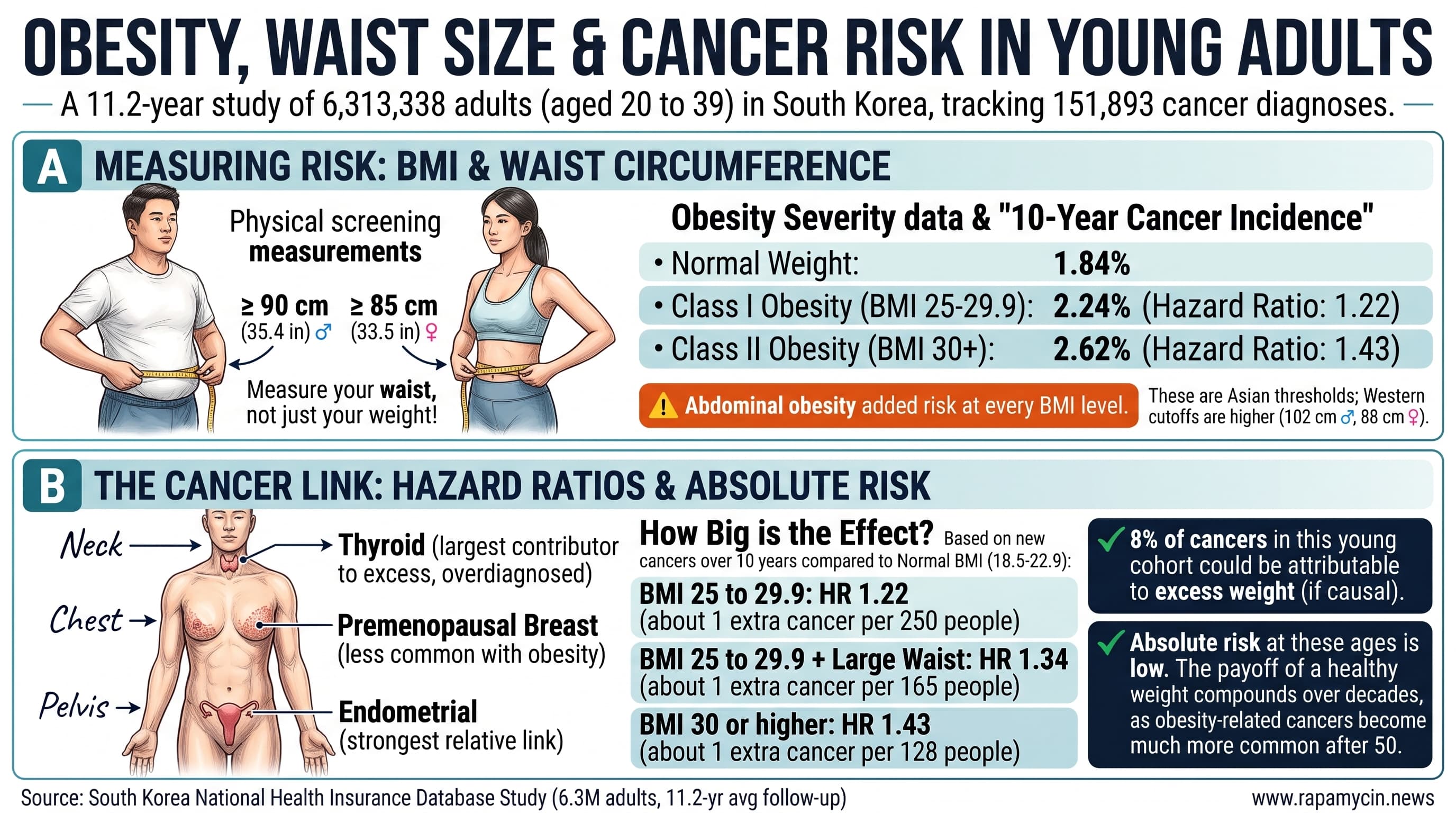
Using South Korea’s national health insurance database, researchers followed 6,313,338 adults aged 20 to 39 who had a health screening between 2009 and 2012, for an average of 11.2 years. Height, weight and waist were measured, not self-reported. A total of 151,893 cancers were diagnosed. Ten-year cancer incidence rose stepwise from 1.84% at normal weight to 2.24% in class I obesity and 2.62% in class II obesity (Asian criteria: BMI 25 to 29.9 and 30 or higher), corresponding to adjusted hazard ratios of 1.22 and 1.43. Abdominal obesity added risk at every BMI level. Relative associations were stronger in men, but absolute excess risk was larger in women. Endometrial cancer showed the strongest relative link, and premenopausal breast cancer was less common with obesity. Absolute risk differences were small (under 1 percentage point over 10 years).
Cancer is increasingly a disease of the young. Rates of colorectal, endometrial, kidney and pancreatic cancer have been climbing among adults under 50 in many countries, and rising obesity has long been a prime suspect. A study of more than 6.3 million young South Korean adults now offers some of the clearest evidence yet that excess weight in your 20s and 30s is linked to cancer before middle age.
Researchers at the Catholic University of Korea and Soongsil University drew on the national health insurance database, which covers virtually the entire population and offers health checkups every two years. They took everyone aged 20 to 39 who had a checkup between 2009 and 2012, recorded their measured height, weight and waist size, and tracked insurance claims through the end of 2021, about 11 years on average.
About 152,000 people, or 2.4%, were diagnosed with cancer. Risk rose step by step with body weight. Over ten years, 1.84% of normal-weight participants developed cancer, compared with 2.24% in the first obesity class and 2.62% in the second. After accounting for age, sex, smoking, drinking, exercise, income and metabolic conditions, the heaviest group had a 43% higher cancer rate.
Two details matter for readers outside Asia. First, the study used Asian weight categories, which have lower cutoffs than Western ones. “Class I obesity” here means a body mass index of 25 to 29.9, which most Western guidelines call overweight. Second, where fat sits counts. People in that class I group who also carried a large waist had a higher ten-year cancer risk than people with a higher BMI but a smaller waist.
The pattern differed by sex. In relative terms the link was stronger in men. Young women develop more cancer to begin with, mainly thyroid, breast, cervical and ovarian, so the absolute excess was larger in women. Endometrial cancer showed the strongest relative link, consistent with fat tissue converting other hormones into estrogen. Breast cancer before age 50 went the other way and was slightly less common with obesity, a pattern seen before for premenopausal breast cancer.
The proposed biology is familiar. Excess fat, especially abdominal fat, drives chronic inflammation, high insulin and growth-factor signaling, and hormonal shifts that favor tumor growth. Starting that exposure earlier in life means more years of it.
There are important caveats. The absolute numbers are small: the heaviest group had less than one extra cancer per 100 people over ten years. Thyroid cancer was among the biggest contributors, and South Korea is known for overdiagnosing small, mostly harmless thyroid cancers through ultrasound screening. Heavier people, who see doctors more often, may simply have had more of them found. Cancers not usually considered obesity-related also rose with weight, which hints that part of the signal reflects detection or factors the data could not capture, such as diet or lifetime smoking.
Still, the clear dose-response, the waist findings and the sheer size of the cohort make a persuasive case. Weight, and especially waistline, in early adulthood looks like a meaningful lever on cancer risk, and it operates well before the ages when routine cancer screening begins.
Actionable insights
Measure your waist, not just your weight. A waist of 90 cm (35.4 in) or more in men, or 85 cm (33.5 in) or more in women, added cancer risk at every BMI level in this study. Those are Asian thresholds. Common Western cutoffs are higher (102 cm and 88 cm in US guidance), but this study suggests lower thresholds may matter for some people.
How big is the effect? Results are reported as hazard ratios (HR), where 1.22 means a 22% higher rate of new cancers. Compared with a BMI of 18.5 to 22.9:
- BMI 25 to 29.9: HR 1.22, about 1 extra cancer per 250 people over 10 years.
- BMI 30 or higher: HR 1.43, about 1 extra cancer per 128 people over 10 years.
- BMI 25 to 29.9 plus a large waist: HR 1.34, about 1 extra cancer per 165 people over 10 years.
If causal, roughly 8% of cancers in this young cohort would be attributable to excess weight. That is a rough estimate from the paper’s numbers.
Absolute risk at these ages is low. The payoff from a healthy weight compounds over decades, because obesity-related cancers become much more common after 50.
Women with obesity should not dismiss abnormal uterine bleeding, since endometrial cancer showed the strongest relative link.
This study did not test whether losing weight lowers risk.
Context and source
- Paywalled Paper: Obesity and Cancer Risk in Young Adults in Korea: A Nationwide Health Screening Cohort Study, Published October 27, 2026.
- Institutions: College of Medicine, The Catholic University of Korea (St. Vincent’s, Bucheon St. Mary’s and Yeouido St. Mary’s Hospitals); Department of Statistics and Actuarial Science, Soongsil University; Samsung Biomedical Research Institute, Sungkyunkwan University
- Country: South Korea
- Journal: Annals of Internal Medicine (American College of Physicians)
- Impact evaluation: The impact score of this journal is about 15 to 17 (sources differ: 15.4 in the 2025 JCR per one tracker and 17.3 per another; 5-year JIF about 20; Q1), evaluated against a typical high-end range of 0 to 100+ for general and internal medicine, therefore this is a High impact journal.
Related Reading:
- How Obesity May Wear Down the Brain
- How Lifelong Obesity Starves the Aging Brain of Oxygen
- Target Midsection Visceral Fat to Halt Arterial Encasement Decades Before Heart Disease
- Insulin Sensitivity as the Ultimate Shield Against Aging
- The Body Remembers: How Echoes of Your Past Diet and Metabolism Dictate Modern Aging
- Wear the Weight You Lost: A Weighted Vest May Blunt the Post-Diet Rebound in Older Adults