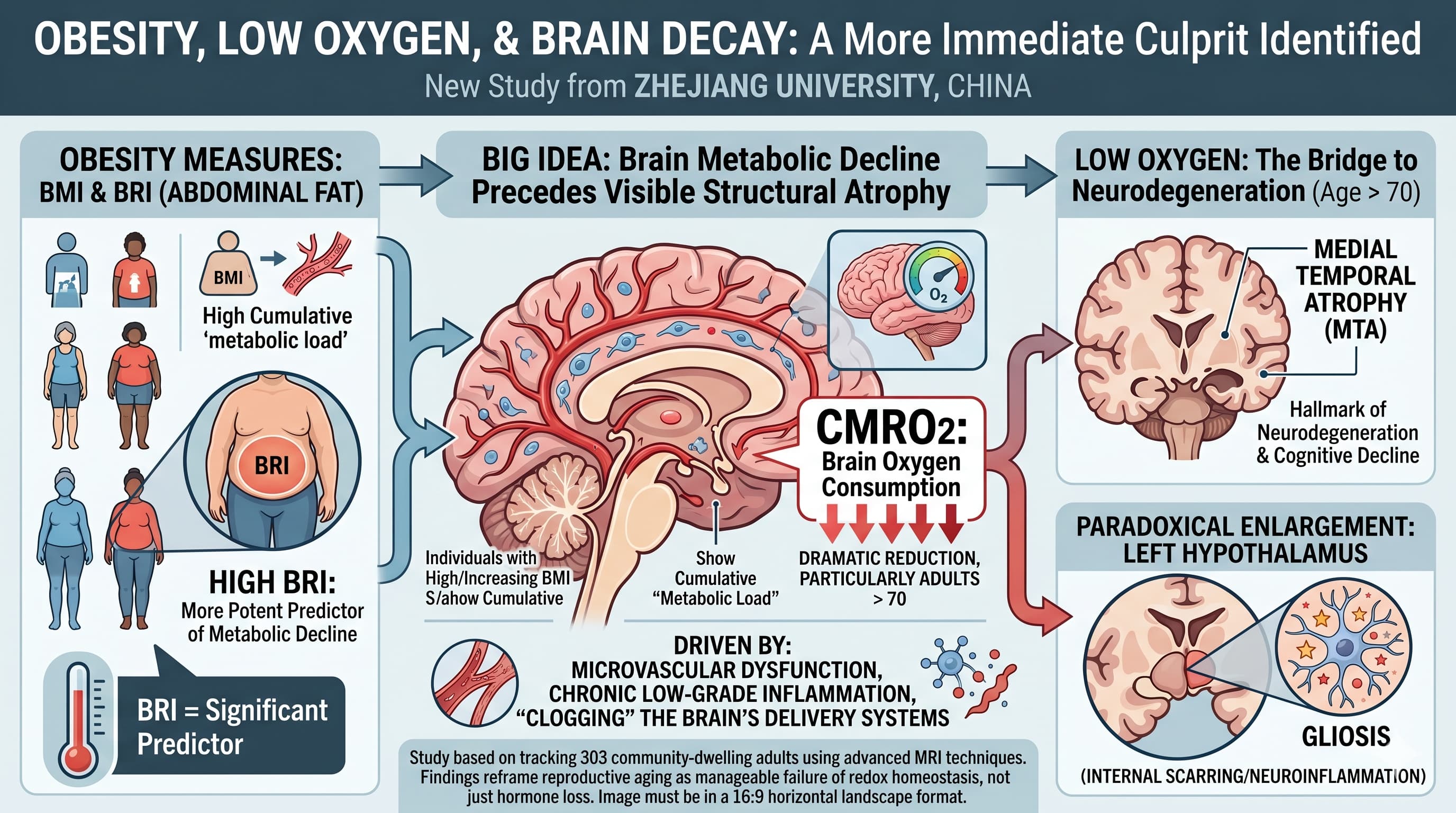
Research published in GeroScience (2026) reveals a critical link between lifelong weight gain and the “suffocation” of the aging brain. While scientists have long known that obesity correlates with structural brain damage, this study identifies a more immediate culprit: a significant decline in the cerebral metabolic rate of oxygen (CMRO2). By tracking 303 community-dwelling adults, researchers from Zhejiang University, China , demonstrated that current and historical body-shape patterns directly predict how efficiently the brain utilizes its primary fuel—oxygen.
The “Big Idea” here is that brain metabolic decline precedes visible structural atrophy. Using advanced MRI techniques, the team found that individuals with high or increasing Body Mass Index (BMI) across adulthood exhibit a cumulative “metabolic load”. This load manifests as a dramatic reduction in global oxygen consumption, particularly in adults over the age of 70. Specifically, for those in their eighth decade, impaired oxygen metabolism acts as the bridge connecting excess weight to medial temporal atrophy (MTA) —a hallmark of neurodegeneration and cognitive decline.
Intriguingly, the study highlighted the Body Roundness Index (BRI) —a measure of abdominal fat—as a more potent predictor of metabolic decline than traditional BMI. High BRI was associated with a steep decline in oxygen metabolism, likely driven by microvascular dysfunction and chronic low-grade inflammation that “clogs” the brain’s delivery systems. Furthermore, the researchers identified a paradoxical enlargement of the left hypothalamus in individuals with the worst metabolic profiles. This structural change is hypothesized to be a result of neuroinflammation or “gliosis”—a form of internal scarring—within the brain’s metabolic control center.
Actionable Insights
-
Prioritize BRI over BMI: Conventional BMI fails to capture visceral fat distributions that are most toxic to the brain. Using the Body Roundness Index (BRI) or measuring waist circumference is more predictive of cerebral metabolic risk. Target a lower BRI to preserve brain oxygen homeostasis.
-
The “70-Year Cliff”: The relationship between adiposity and brain suffocation becomes significantly more aggressive after age 70. Maintaining a lean profile in midlife is essential, but aggressive weight management in late-life may be the final defense against rapid metabolic-driven atrophy.
-
Hypothalamic Health: Be aware that “normal-stable” weight trajectories throughout adulthood correlate with better-preserved hypothalamic volume and higher CMRO2. Since the hypothalamus regulates appetite and energy, avoiding midlife “creeping” obesity prevents a vicious cycle of hypothalamic inflammation that further disrupts metabolic control.
-
Monitor Metabolic Efficiency: Oxygen delivery efficiency (measured via CMRO2) is a modifiable biomarker. Interventions that improve vascular health—such as exercise or compounds targeting neurovascular coupling—may mitigate the “metabolic burden” imposed by past adiposity.
Source:
- Open Access Paper: Life-course body shape trajectories and cerebral oxygen metabolism in community-dwelling older adults
- Institution: Zhejiang University.
- Country: China.
- Journal Name: GeroScience (Official Journal of the American Aging Association).
- Impact Evaluation: The impact score (CiteScore/JIF) of this journal is approximately 7.5, therefore, this is a High impact journal within the specialized field of gerontology and aging biology.