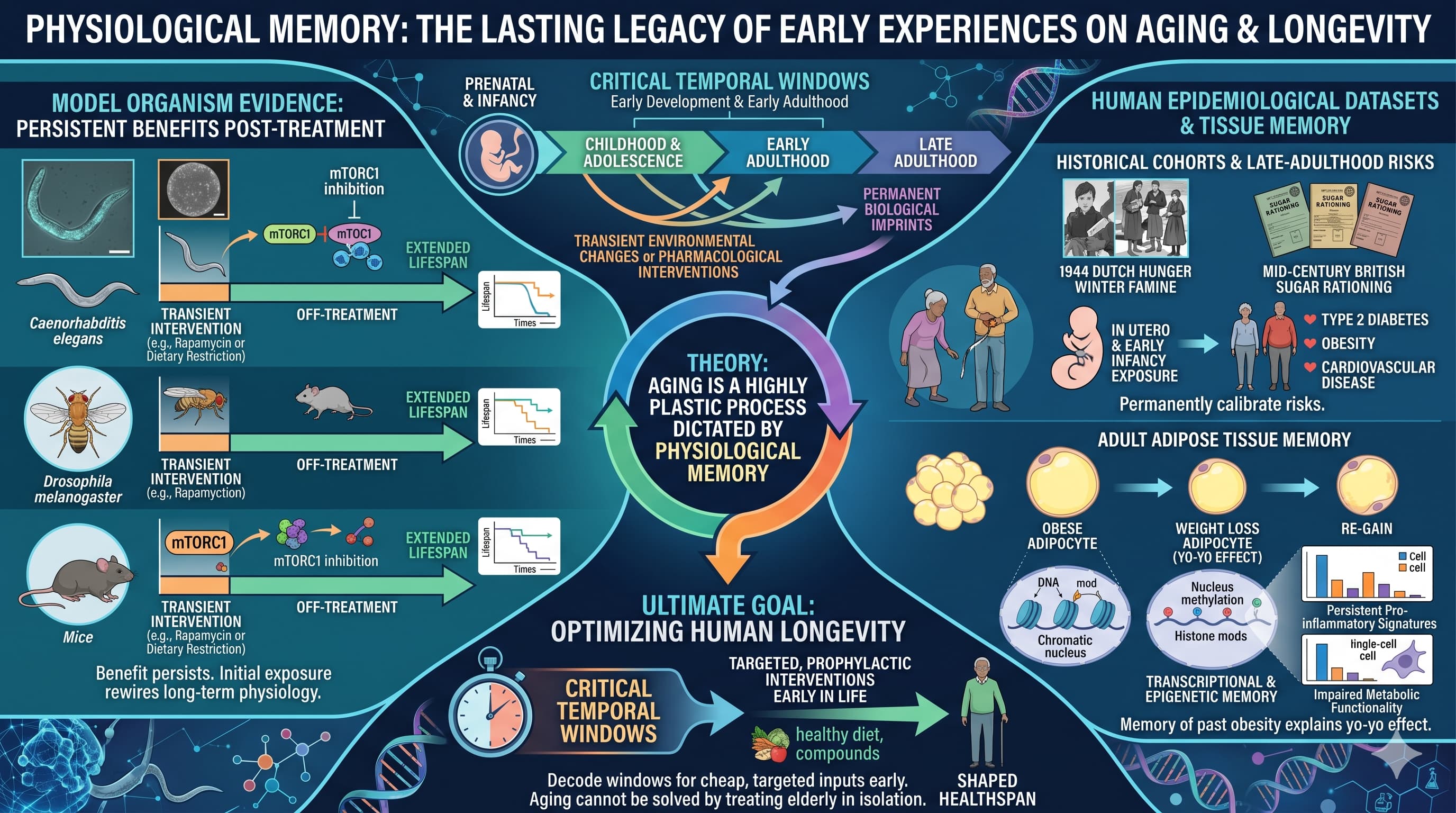
An important shift is underway in biogerontology, altering our understanding of how early-life environmental exposures govern late-stage cellular decline. Historically, aging was viewed as an immutable, progressive accumulation of wear-and-tear. Recent breakthroughs have fundamentally shattered this notion, demonstrating that aging is a highly plastic process dictated by a phenomenon known as “physiological memory”. This conceptual framework argues that transient environmental changes or pharmacological interventions experienced during critical developmental or early adult windows leave permanent biological imprints that shape healthspan and longevity decades later.
The primary evidence for this durable systemic programming spans from evolutionary biology models to definitive human epidemiological datasets. In model organisms like Caenorhabditis elegans , Drosophila , and mice, brief exposure to nutrient-signaling interventions—such as transient administration of the mTORC1 inhibitor rapamycin or short-term dietary restriction—extends lifespan long after the treatment is stopped (though in the case of rapamycin, better longevity effects result from higher doses, at least in animals). Strikingly, this survival benefit persists even when downstream signaling pathway inhibition returns to baseline, indicating that the initial exposure successfully rewired the organism’s long-term physiology.
In humans, this phenomenon is mirrored in robust historical cohorts. Epidemiological evaluations of populations exposed to the 1944 Dutch Hunger Winter famine or mid-century British sugar rationing confirm that nutritional environments experienced in utero and during early infancy permanently calibrate late-adulthood risks for type 2 diabetes, obesity, and cardiovascular disease. Furthermore, this memory isn’t isolated to early development. Emerging single-cell data reveals that human adult adipose tissue retains a persistent “transcriptional and epigenetic memory” of past obesity. Even after significant weight loss, previously obese adipocytes maintain pro-inflammatory signatures and impaired metabolic functionality, offering a clear molecular explanation for the notorious “yo-yo” weight re-gain effect.
Ultimately, this research underscores that the biology of aging cannot be solved by treating the elderly in isolation. To optimize human longevity, science must decode the precise temporal windows where metabolic inputs lock in physiological memory, opening the door for cheap, highly targeted, prophylactic interventions early in life.
Actionable Insights
This paper provides a vital conceptual framework for optimizing human longevity. Rather than relying exclusively on continuous, lifelong therapeutic protocols, individuals must recognize that metabolic health in early and mid-adulthood acts as a permanent ledger.
-
Prevent Weight-Cycling (Yo-Yo Dieting): Because adult adipose tissue retains an epigenetic memory of obesity-induced inflammation and insulin insensitivity despite weight reduction, avoiding prolonged periods of metabolic dysfunction is critical. Maintaining stable body composition prevents the cementing of a pro-inflammatory adipose phenotype that accelerates systemic aging.
-
Leverage Periodic Interventions: The evidence that short-term nutrient signaling modulation (via transient calorie restriction, intermittent fasting, or compounds like rapamycin and metformin) can imprint lasting geroprotection implies that continuous dosing may not be necessary. Periodic, cyclical fasting or pulse-dosing of geroprotectors may achieve optimal lifespan extension while minimizing chronic side effects.
-
Monitor Legacy Data: Longevity professionals should closely follow the upcoming 10-to-15-year long-term data from the human CALERIE phase 2 legacy study. This trial tracks whether a historical 2-year window of moderate calorie restriction in healthy adults successfully hardwired long-term cardiometabolic protection.
Source:
- Open Access Paper: Remembrance of things past: Towards a life-course biology of aging
- Institution: Institute of Healthy Ageing and the Research Department of Genetics, Evolution, and Environment, University College London.
- Country: United Kingdom.
- Journal Name: PLOS Biology.
- Impact Evaluation: The impact score of this journal is 7.8, evaluated against a typical high-end range of 0–60+ for top general science, therefore this is a High impact journal.