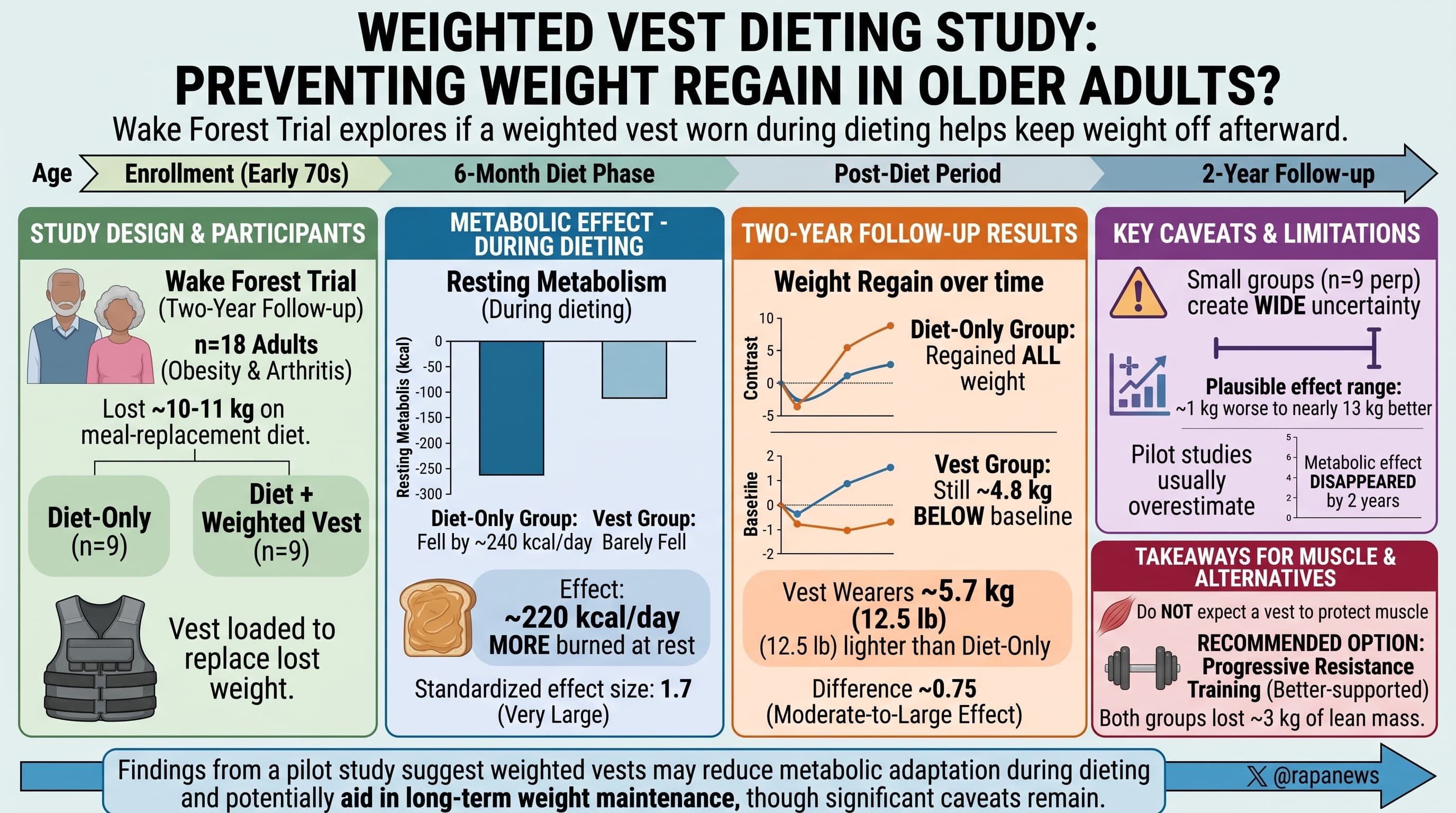
A two-year follow-up of a small Wake Forest trial asked whether wearing a weighted vest while dieting helps older adults keep the weight off afterward. Eighteen adults in their early seventies, with obesity and arthritis, had lost about 10 to 11 kg on a six-month meal-replacement diet. Half of them had also worn a vest loaded to replace the weight they lost. About 19 months after the program ended, the diet-only group had regained everything, while the vest group was still 4.8 kg below its starting weight. The vest group’s resting metabolism barely fell during dieting. The diet-only group’s fell by about 240 kcal a day.
Losing weight is hard. Keeping it off is harder, and for older adults the rebound carries an extra cost, because regained weight can come back with proportionally more fat than was lost. A small study from Wake Forest University in North Carolina points to a low-tech way to tilt the odds: put the lost weight back on, in a vest.
The idea comes from the “gravitostat,” a hypothesis Swedish researchers proposed in 2018. In rodents, bone cells in the legs appear to sense how much weight the body carries and signal the brain to defend a set amount of fat. When a heavy capsule is implanted in a mouse, the animal sheds fat to compensate. If people have a similar sensor, dieting would register as lost load, and the body might respond by conserving energy and nudging appetite upward. A vest that restores the load could, in principle, blunt that response.
Carson DeLong, Kristen Beavers and colleagues went back to volunteers from an earlier trial in which older adults with obesity followed a six-month meal-replacement diet. Half were also asked to wear a vest for up to 10 hours a day, with weight added weekly to replace what they had lost. About two years after the start, 18 of the original 37 participants returned to be measured.
Both groups lost similar amounts during the diet, around 10 to 11 kg, or roughly 11 to 12 percent of body weight. The difference appeared later. By the two-year visit, the diet-only group had regained all of it and a little more. The vest group had regained only about half and was 4.8 kg below where it began.
The team suspects metabolism. Dieting usually lowers resting metabolic rate, the energy the body burns at rest, and that slowdown is often blamed for regain. In the diet-only group, resting metabolism dropped by about 240 kcal a day over six months. In the vest group it barely moved. Across all participants, people whose metabolism fell more during the diet tended to regain more afterward.
The caveats are large. With nine people per group, the weight difference could be chance, and its p-value of 0.10 misses the usual threshold. Only half the original volunteers came back, and they chose to. No one tracked diet, activity, or whether vest users kept wearing their vests. The vest also did not protect lean tissue: both groups lost about 3 kg of it. That makes the metabolic result harder to explain.
Still, the signal is not a one-off. The same group’s larger INVEST in Bone Health trial enrolled 150 older adults. A conference abstract covering a 21-person follow-up subset reported the same pattern: better-preserved resting metabolism with vests and less regain in the year after the program ended. That result is not yet peer reviewed, and it also fell short of statistical significance.
Other human tests of the gravitostat are mixed. A three-week Swedish trial found that heavy vests trimmed about 1.4 percent more body weight than light ones. A later five-week trial from the same group improved body composition without changing weight.
The appeal is obvious. A vest is cheap, needs no gym, and can be worn while doing the dishes. Whether it can do the heavy lifting of weight maintenance is a question only a properly sized trial can answer.
Actionable Insights
- Treat a weighted vest as a low-cost experiment, not a proven tool. It was well tolerated in these trials, but its benefit for keeping weight off is unconfirmed.
- How big could the benefit be? Two years out, vest wearers were about 5.7 kg (12.5 lb) lighter than diet-only participants. In standardized terms that difference is about 0.75, which statisticians would normally call moderate to large. With only nine people per group, though, the plausible true effect runs from about 1 kg worse to nearly 13 kg better, and small pilot studies usually overestimate.
- The metabolic effect is the stronger number. During dieting, vest wearers burned about 220 kcal a day more at rest, roughly a slice of toast with peanut butter. Its standardized size (about 1.7) is very large, yet the difference had disappeared by two years.
- Do not expect a vest to protect muscle. Both groups lost about 3 kg of lean mass. Progressive resistance training remains the better-supported option.
- The trials used this protocol: add weight gradually, replacing half to most of what you lose, and wear the vest 6 to 8 hours a day while upright.
- If you have knee or hip arthritis, ask a clinician first. This study did not report joint outcomes.
Context/Source
- Open Access Paper: Does weighted vest use during weight loss influence long-term weight loss maintenance? A pilot study in older adults living with obesity and osteoarthritis
- Institution: Wake Forest University and Wake Forest University School of Medicine, Winston-Salem, North Carolina
- Country: United States
- Journal: International Journal of Obesity (Springer Nature)
- Impact Evaluation: The publisher lists a 2025 Journal Impact Factor of 5.4, The publisher ranks the journal in the top quartile of Endocrinology and Metabolism and of Nutrition and Dietetics.
Related Reading:
- Half of Muscle Aging Never Happens in People Who Kept Training
- Favourite Exercise Hacks - #2 by RapAdmin
- Longevity Doctor, Stanford Medical School MD, Hillary Lin, Podcasts - #3 by RapAdmin
- The Longevity Threshold: Mapping the Curvilinear Response of Biological Aging to Physical Activity Volume
- Aging Athletes Need to Stay Explosive. Here’s How