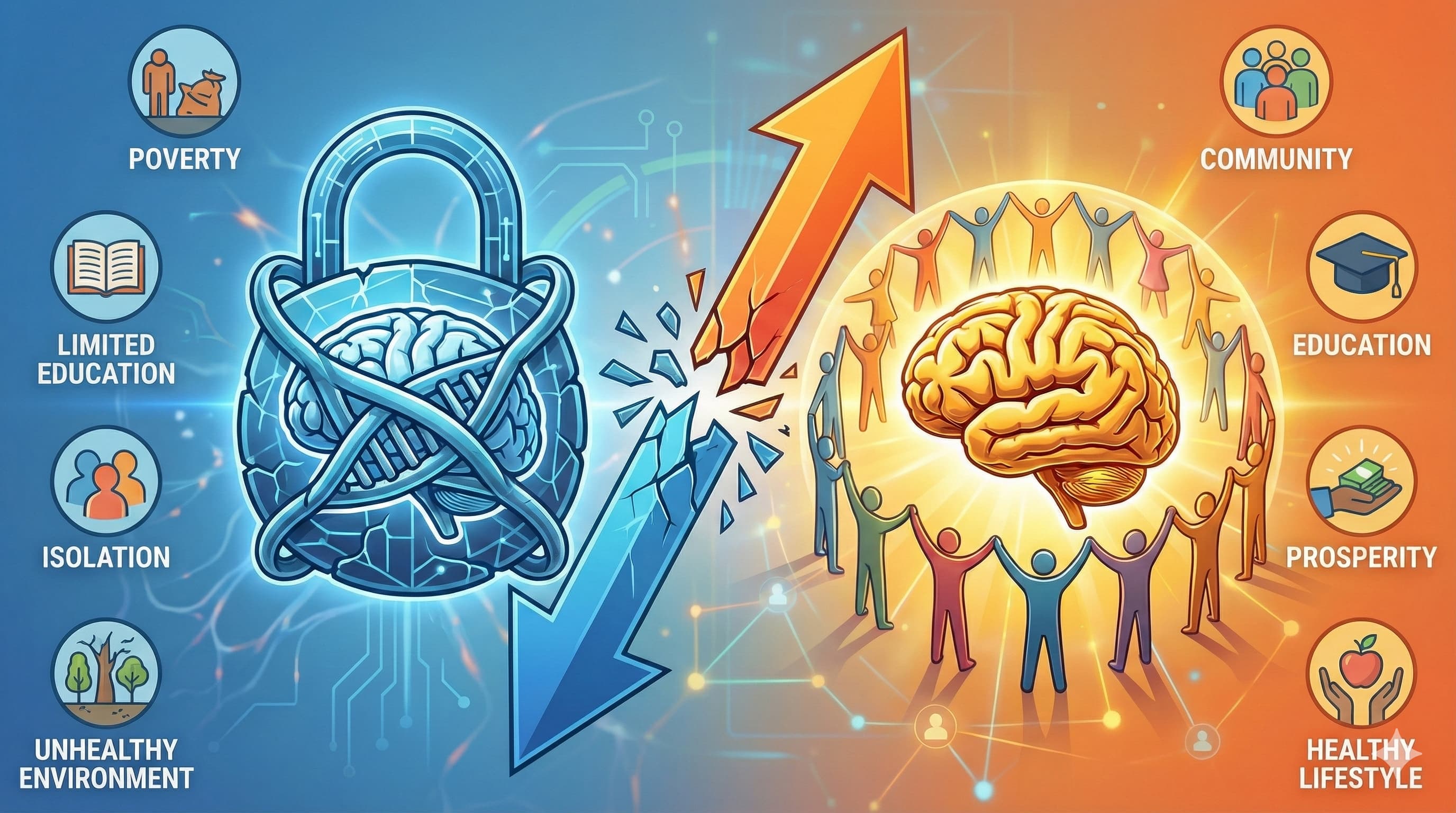
In a landmark epidemiological study published in PLOS ONE, researchers from Yale University (USA) utilizing data from the US and UK have delivered a sobering reality check to the “genes are destiny” narrative. While the longevity community obsessively genotypes for APOE status to predict Alzheimer’s risk, this study of 9,849 older adults reveals that your social environment may be the ultimate arbiter of your cognitive lifespan.
The “Big Idea” here is the empirical validation of the Social Distinction Model over the “Social Trigger Model.” Previously, it was thought that social stress might “trigger” bad genes. Instead, this paper demonstrates that high social adversity (a composite of low income, poor neighborhood, and limited education) is so toxic that it overrides genetic protection. Individuals with the “longevity lottery ticket” (APOE-ε2, typically protective against dementia) who lived in high adversity had the same sky-high dementia risk as those with the dreaded APOE-ε4 allele. Conversely, social advantage acted as a permissive environment, allowing genetic differences to actually matter. Put simply: If your environment is toxic enough, your “good genes” cannot save you; if your environment is optimized, your “bad genes” are manageable.
Impact Evaluation: The impact score of this journal (PLOS ONE) is ~2.6 (2024 JIF), evaluated against a typical high-end range of 0–60+ (e.g., Nature or NEJM). Therefore, this is a Medium impact journal. However, its massive readership and open-access model ensure high visibility for this crucial gene-environment interaction data.
Open Access Paper: Unequal expression: Social position modulates APOE genotype risk of dementia
The Biohacker Analysis
Study Design Specifications:
- Type: Longitudinal Observational Cohort Study (Retrospective analysis of prospective data).
-
Subjects: Humans (N=9,849).
- Cohorts: Health and Retirement Study (HRS, USA) and English Longitudinal Study of Ageing (ELSA, UK).
- Age: 55+ years.
- Genetics: Stratified by APOE status (ε2/ε2 or ε2/ε3 [Low Risk], ε3/ε3 [Intermediate], ε2/ε4 or ε4/ε4 [High Risk]).
- Lifespan Data: Not applicable (Endpoint was Time-to-Dementia onset over ~12 years).
Mechanistic Deep Dive:
- The “Social Toxicity” Pathway: The authors propose that cumulative social disadvantage functions as a “biological accelerant,” likely driving pathology via Epigenetic Aging (e.g., GrimAge acceleration) and Chronic Inflammation (Inflammaging).
- Stress Signaling: High social adversity creates a “constitutive active” stress state (HPA axis dysregulation), leading to elevated cortisol and downstream neurotoxicity in the hippocampus—the exact region APOE-ε4 tends to atrophy first.
- The Override Switch: In high adversity, the “noise” of environmental toxicity (oxidative stress, vascular damage) is so loud it drowns out the subtle protective “signal” of the APOE-ε2 allele.
Novelty:
- Destruction of the “Protective Shield”: We knew adversity was bad, but we didn’t know it was this bad. This paper proves that APOE-ε2 carriers (usually celebrated for longevity) lose all their protection in high-adversity settings (HR ~3.26 vs. reference).
- Equivalence Principle: The study establishes a “Risk Equivalence”: Living with High Social Adversity confers roughly the same dementia hazard ratio (HR ~3.12–3.26) as being born with the high-risk APOE-ε4 genotype (HR ~3.21).
Critical Limitations:
- Observational Nature: As with all epidemiology, causality is inferred, not proven. Reverse causality (early cognitive decline causing a drop in social status) was adjusted for but remains a specter.
- Broad “Adversity” Definitions: The “Social Adversity Index” is a composite (education, income, neighborhood). It does not isolate which factor is the “active ingredient” (e.g., is it the toxic mold in the poor neighborhood, or the psychological stress of poverty?).
- Missing Biomarkers: The study lacks direct “wet” data—no inflammatory cytokines (IL-6, TNF-a) or methylation clock data were measured in this specific paper to verify the mechanism.
Actionable Intelligence
The Translational Protocol (Lifestyle as a Drug)
1. “Human Equivalent Dose” (HED) of Adversity:
- The Toxic Dose: The study defines the “toxic threshold” as ≥4 Unfavorable Social Determinants (e.g., low education + low income + neighborhood disorder + discrimination).
- The “Safe” Dose: 0-1 Unfavorable Determinants.
- Protocol: Conduct a personal “Social Audit.” If you score ≥4, you are effectively “dosing” yourself with an APOE-ε4 equivalent risk profile daily.
- Mitigation: If structural factors (income/location) cannot be changed immediately, you must treat the downstreameffects (inflammation/stress) aggressively (see below).
2. Pharmacokinetics (Chronicity):
- Bioavailability: Social stress is “100% bioavailable” to the brain via the HPA axis.
- Half-Life: Unlike a drug that clears in hours, social adversity often has a decades-long half-life. Epigenetic “scarring” (methylation changes) from mid-life adversity can persist into late life.
Biomarker Verification Panel
-
Efficacy Markers (Target Engagement):
- hs-CRP: Target < 1.0 mg/L. If elevated despite diet/exercise, consider it a readout of “psychosocial load.”
- Cortisol (4-point salivary): Check for flattened diurnal rhythm (adrenal fatigue/dysregulation) common in chronic adversity.
- Epigenetic Pace of Aging (DunedinPoAm): The gold standard for measuring if your lifestyle/stress is accelerating your biological clock faster than chronological time.
Feasibility & ROI (Cost-Benefit Analysis)
-
Cost vs. Effect:
- Intervention: Relocation to a “High Social Cohesion” neighborhood or investment in higher education/financial stability.
- Cost: High ($$$$$).
- ROI: Massive. The study suggests optimizing social environment yields a ~67% reduction in dementia risk (HR drops from ~3.0 to ~1.0) for high-risk genotypes. This outperforms almost any monotherapy drug currently on the market.
Population Applicability
-
Genotype Specific:
- APOE-ε4 Carriers: You are most sensitive to the environment. You cannot afford “toxic” neighborhoods or chronic isolation.
- APOE-ε2 Carriers: Do not get complacent. Your genetic protection is revocable by high social stress.