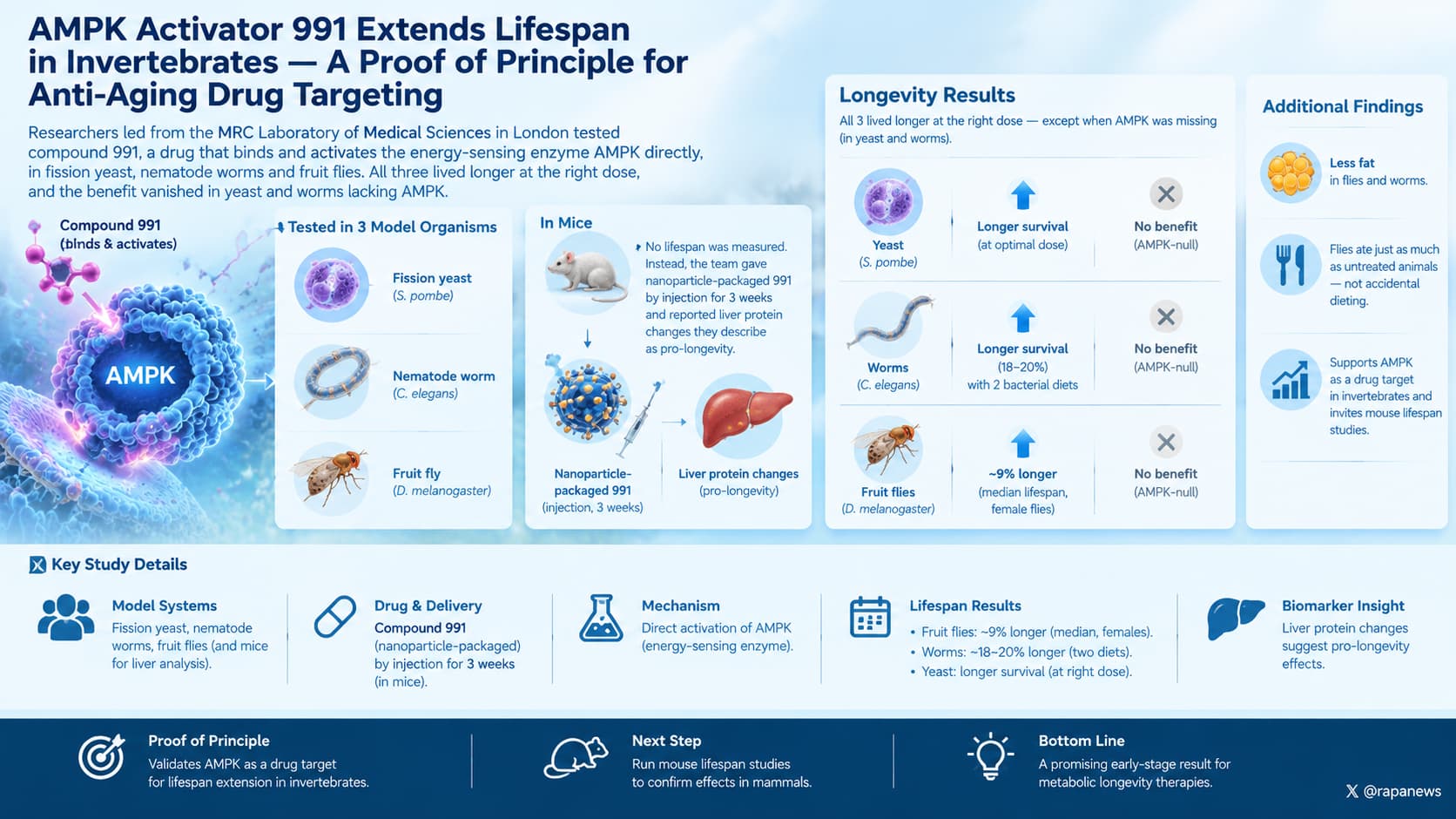
Researchers led from the MRC Laboratory of Medical Sciences in London tested compound 991, a drug that binds and activates the energy-sensing enzyme AMPK directly, in fission yeast, nematode worms and fruit flies. All three lived longer at the right dose, and the benefit vanished in yeast and worms lacking AMPK. They gave nanoparticle-packaged 991 by injection for three weeks and reported liver protein changes they describe as pro-longevity. The work is a clean proof of principle for AMPK as a drug target in invertebrates and an invitation to run mouse lifespan studies.
For two decades, AMPK has been one of the most talked-about targets in aging biology. The enzyme works like a cellular fuel gauge: when energy runs low, it switches on fat burning and recycling programs and dials down costly growth. Animals engineered to have more active AMPK tend to live longer. The trouble has been proving that a drug can do the same thing.
Metformin, the usual stand-in, is a poor test. It activates AMPK only indirectly, by mildly stressing mitochondria, and it hits many other targets. In worms and flies, its lifespan effects even run through gut bacteria rather than the animal itself. So a positive metformin result says little about AMPK, and a negative one says little either.
The new study in Aging Cell takes the direct route. Compound 991 slots into a pocket on the AMPK protein itself and turns the enzyme on. The team first showed that this pocket is conserved from humans down to yeast, and that 991 activates fly and worm AMPK at concentrations roughly a thousand times lower than metformin requires.
Then came the survival experiments. Female fruit flies fed a low dose lived about 9 percent longer at the median. Worms lived roughly 18 to 20 percent longer on two different bacterial diets, which argues against a microbiome explanation. Fission yeast cultures also survived longer. Flies and worms carried less fat, and flies ate just as much as untreated animals, so this was not accidental dieting.
The most persuasive experiment is the genetic control. In yeast and worms with the AMPK gene deleted, 991 did nothing for lifespan. That is strong evidence the drug works through its intended target.
The mouse section is the weakest part. Three mice per group received intravenous nanoparticles for three weeks, and their liver proteins shifted in ways consistent with AMPK activation: more mitochondrial machinery, less general protein synthesis. The authors call this a pro-longevity signature. No mouse lived a day longer in this study, because lifespan was not measured.
There is also a safety question the paper leaves largely unaddressed. A related, more drug-like AMPK activator from Merck caused heart enlargement in rodents and monkeys. Chronic, whole-body AMPK activation may not be benign, so a pulsatile approach may be necessary.
The bottom line: this is the cleanest pharmacological evidence so far that turning on AMPK itself can extend life in simple organisms. Whether that holds in a mammal remains untested.
Actionable Insights
Compound 991 is a laboratory tool with poor absorption in mammals and known toxicity, which is why the mouse work needed nanoparticle packaging and injections.
The real-world magnitude was modest. In flies, the best dose added about 7 days to a 76-day median lifespan, roughly 9 percent. In worms, about 2.5 to 3 days on a 14-day median, roughly 18 to 20 percent. These figures cannot be converted into human years. Most interventions that work in worms and flies shrink or disappear in mice.
Three practical lessons do carry over:
- More is not better. The dose that helped flies most was the lowest tested for lifespan. Higher doses helped less, then harmed. Anyone stacking multiple AMPK-activating compounds should take that seriously.
- This paper does not validate metformin or berberine for longevity. Its premise is that indirect activators are too messy to interpret.
- Exercise and periods without food remain the only well-established, low-risk ways to activate AMPK in humans.
Watch for mouse lifespan trials of second-generation direct activators.
Context and Source
- Open Access Paper: Direct Pharmacological Activation of AMPK Extends Lifespan in Yeast, Worms and Flies
- Lead institutions: MRC Laboratory of Medical Sciences and Imperial College London, United Kingdom
- Collaborating institutions: University of Cologne (CECAD and CMMC), Germany; Queen Mary University of London and The Francis Crick Institute, United Kingdom; Universite Claude Bernard Lyon 1, France
- Journal: Aging Cell (Wiley, for the Anatomical Society), 2026
- Impact evaluation: The impact score of this journal is 7.1 (Journal Impact Factor), evaluated against a typical high-end range of 0 to 60+ for top general science, therefore this is a High impact journal.
Related Reading:
- The Vascular Pacemaker: How the Secretory Engine of Aging Arteries Synchronizes Whole-Body Decay
- The Ticking Clock in Men's Gonads: Why Your Sperm Age Faster Than You Think
- Three Proteins in Your Blood Predict How Fast You're Aging. Here's What You Can Do About It
- Beyond Blood Sugar: How Eight Classes of Diabetes Drugs Target the Hallmarks of Aging
- Cardiologists Name SGLT Inhibitors the Leading Geroprotector Candidate, Ahead of Rapamycin and Metformin
- Evolutionary Blueprints of the Bowhead Whale: Activating FOXO Proteins for Human Cancer Resistance