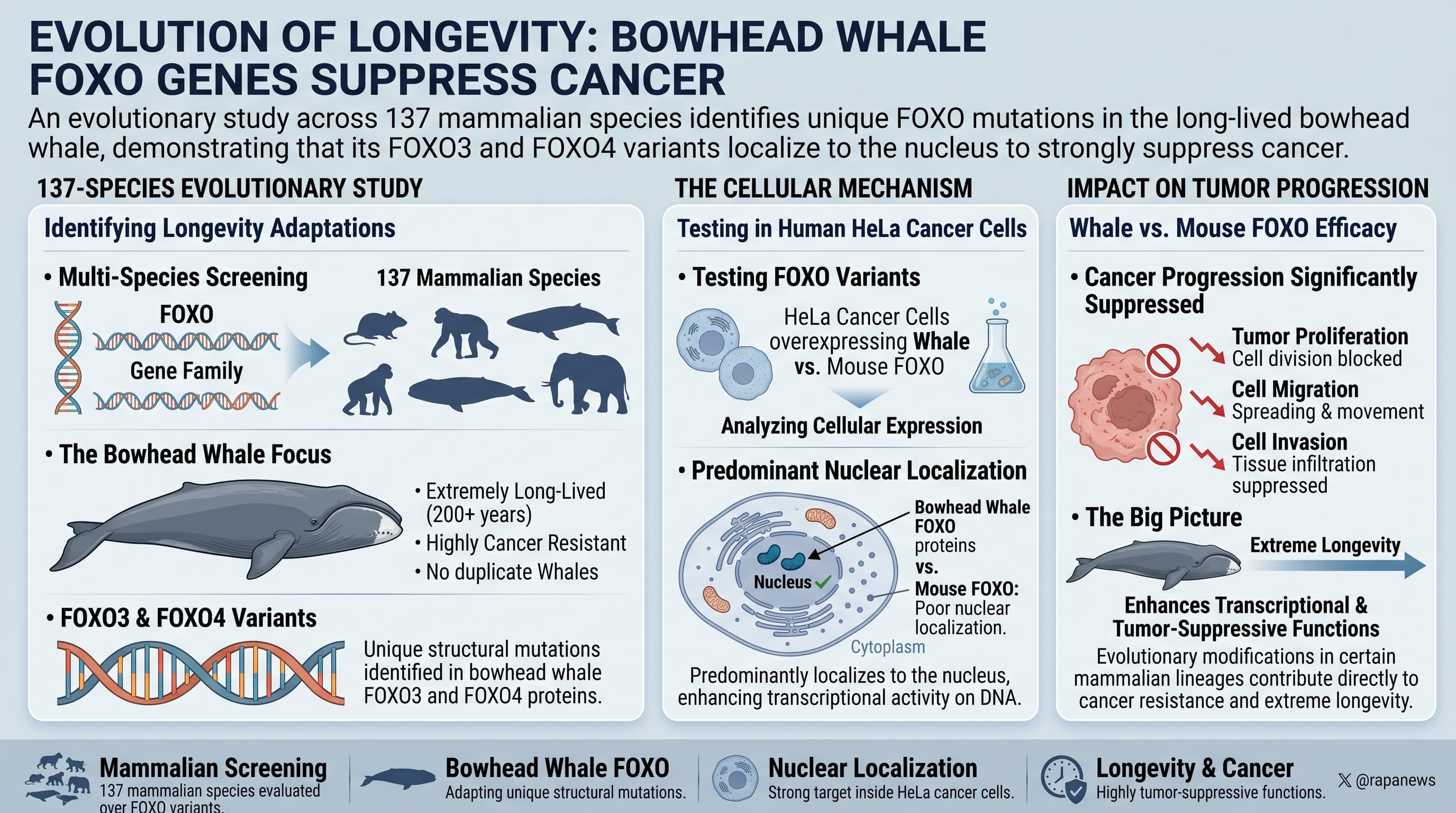
This study investigates the evolutionary adaptations of the FOXO gene family across 137 mammalian species, identifying unique structural mutations in long-lived mammals such as the bowhead whale. By overexpressing bowhead whale FOXO3 and FOXO4 variants in human HeLa cancer cells, researchers demonstrated that these specific proteins predominantly localize to the nucleus and significantly suppress tumor proliferation, migration, and invasion compared to their mouse counterparts. The findings indicate that evolutionary modifications in FOXO proteins enhance their transcriptional activity and tumor-suppressive functions, contributing to the extreme longevity and cancer resistance observed in certain mammalian lineages.
A central question in aging research is why large, long-lived animals do not invariably die of cancer, a phenomenon known as Peto’s Paradox. This paper targets the FOXO family of transcription factors, well-known nodes in longevity and stress resistance pathways, to determine if evolutionary changes in these genes explain the extreme lifespans of species like the 211-year-old bowhead whale.
The research team analyzed FOXO1, FOXO3, FOXO4, and FOXO6 across 137 mammals. They identified 18 positively selected mutation sites unique to long-lived species, suggesting an adaptive evolutionary pressure on these specific genetic sequences. To move beyond computational correlation, the researchers engineered human cervical cancer cells (HeLa) to overexpress either the bowhead whale versions of FOXO3 and FOXO4 or the standard short-lived mouse versions.
The physiological differences were distinct. Whale FOXO proteins naturally migrated into the cell nucleus, the command center where transcription factors must reside to be active. In contrast, mouse FOXO proteins remained largely trapped in the cytosol. Once in the nucleus, the whale FOXO3 protein aggressively upended the cancer cell’s survival programming. It formed a strong bond with STAT1, a known tumor suppressor. It subsequently increased the expression of PTEN (a major inhibitor of cell growth pathways) and FasL (a trigger for programmed cell death), while shutting down BCL6, an oncogene that normally protects cancer cells from dying. Furthermore, it upregulated SOD2, an enzyme that neutralizes mitochondrial oxidative stress.
The clinical implication is that longevity is not just governed by the presence or basic expression levels of FOXO genes, but by structural protein modifications that dictate their cellular localization and binding affinity. These evolutionary tweaks ensure the proteins remain highly active and situated in the nucleus, constantly surveying and suppressing oncogenic activity and oxidative damage.
Actionable Insights
The practical application of this research lies in mimicking the effects of the bowhead whale’s hyper-active FOXO variants. While human gene editing for these specific traits is not currently viable, individuals can target the downstream pathways identified in this paper to improve healthspan. The whale FOXO3 variant successfully upregulates PTEN and SOD2. Individuals can stimulate these same pathways via lifestyle interventions known to drive human FOXO3 into the nucleus, such as intermittent fasting, AMP-activated protein kinase (AMPK) activation, and hormetic stressors like cold exposure and hypoxia conditioning.
The magnitude of the benefit observed when these pathways are optimally activated is substantial. In the human cell models, replacing standard mammalian FOXO3 with the whale variant reduced cancer cell proliferation by approximately 53 percent relative to the mouse baseline (dropping from 32 percent to 15 percent EdU positive cells). It also reduced tumor cell invasion by nearly 60 percent (dropping from roughly 500 to 200 invading cells). By focusing on interventions that upregulate SOD2 for mitochondrial defense and PTEN for cell cycle regulation, health optimization strategies can replicate the mechanistic advantages of these evolutionary adaptations.
Context/Source
- Open Access Paper: Adaptive Evolution of FOXO Family Regulating Lifespan Extension and Cancer Resistance in Long-Lived Species, Published September, 2026.
- Institution: Nanjing Normal University
- Country: China
- Journal: Integrative Zoology
- Impact Evaluation: The impact score of this journal is 3.5, evaluated against a typical high-end range of 0–60+ for top general science, therefore this is a Medium impact journal.