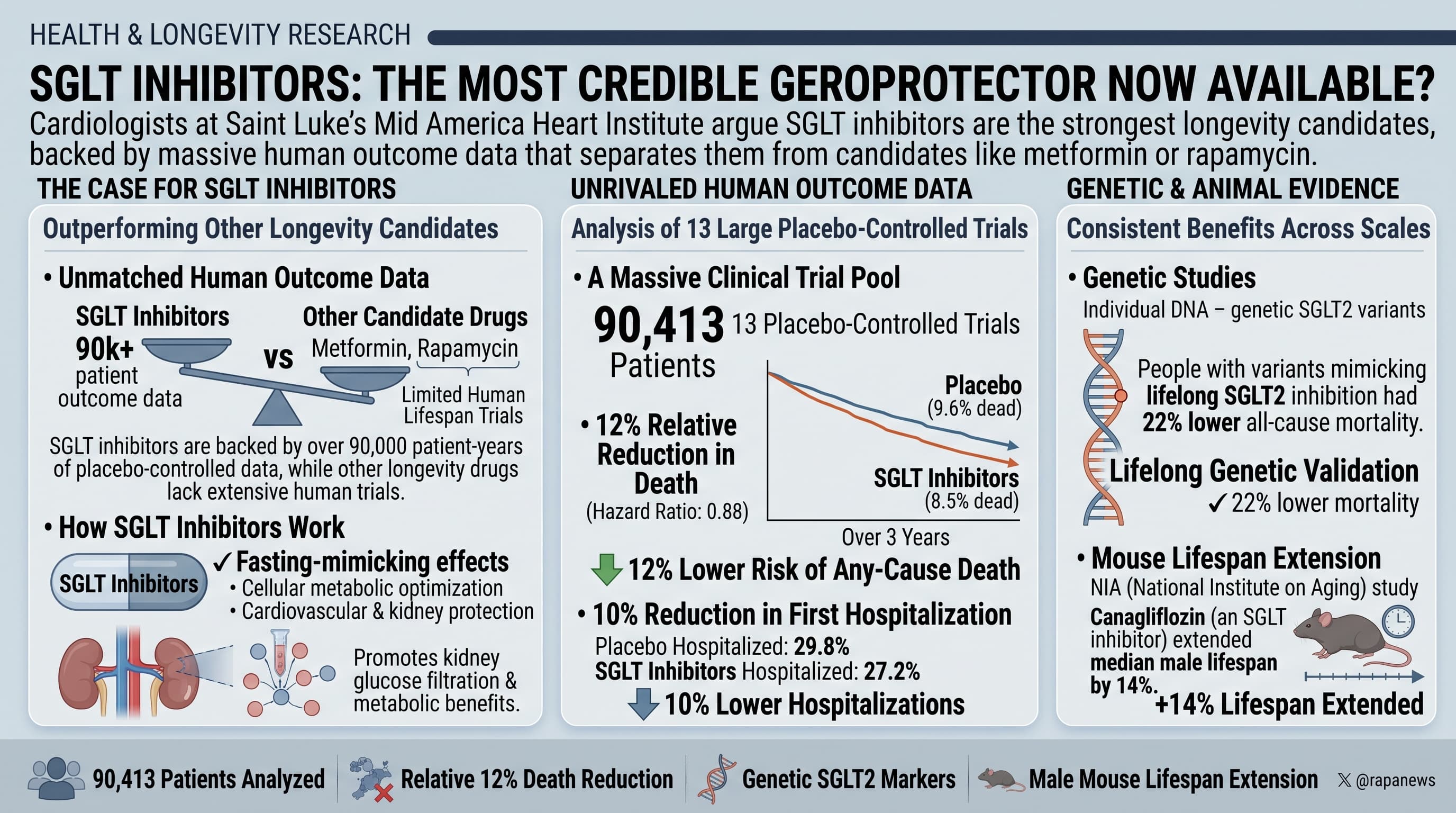
Four cardiologists at Saint Luke’s Mid America Heart Institute argue that SGLT inhibitors (dapagliflozin, empagliflozin and relatives) are the most credible geroprotector now available, ahead of rapamycin and metformin. They pool 13 placebo-controlled outcome trials covering 90,413 patients and find a 12% relative reduction in death from any cause and a 10% reduction in first hospitalization. They then add mouse lifespan data, genetic studies and proposed fasting-mimicking mechanisms.
For a decade, SGLT inhibitors have been the quiet success story of cardiology. Designed to lower blood sugar by making the kidneys dump glucose into urine, they turned out to keep heart failure patients out of hospital and slow kidney decline, whether or not the patient had diabetes. A new review asks whether the class is doing something more basic: slowing aging itself.
The argument runs like this. Blocking the SGLT2 transporter sends 60 to 80 grams of glucose a day out in the urine, around 240 to 320 calories. Insulin falls, glucagon rises, and blood ketones climb from about 0.1 to 0.3 to 0.6 millimoles per liter. The body, the authors propose, reads this as mild fasting. In animal and cell experiments that state activates the energy sensor AMPK, quiets the growth pathway mTOR and increases autophagy, the cell’s recycling system. These are the same pathways targeted by calorie restriction and rapamycin.
What separates this class from other longevity candidates is human outcome data. Pooling 13 large trials, the authors calculate a hazard ratio for death of 0.88. In their model, 9.6% of placebo patients died within three years against 8.5% on the drug. First hospitalization for any reason fell from 29.8% to 27.2%. They also cite a genetic study in which people who carry variants that mimic lifelong SGLT2 inhibition had 22% lower all-cause mortality, and a National Institute on Aging mouse study in which canagliflozin extended median lifespan by 14% in males.
There are large caveats. Every trial participant was already ill, with an average risk of death many times that of a healthy 50-year-old. Preventing deaths in people with failing hearts and kidneys is what a good cardiorenal drug does, and it is not the same as slowing aging. The benefit in heart failure appears within weeks, which is far too quick for any change in the rate of aging and points instead to effects on fluid balance and cardiac workload. The mouse result held only in males, and a later study from the same program found that female mice started on the drug in midlife died sooner.
The paper is also a narrative review, not a systematic one. It appears in the first issue of a brand-new journal that does not yet have an impact factor or confirmed indexing. Its scorecard ranking SGLT inhibitors above rapamycin and metformin was graded by the authors themselves.
Insights
Assuming the same 12% relative benefit carries over (unproven), a 50-year-old with a yearly death risk near 0.4% would see about 700 people treated for three years to prevent one death. By comparison, genital yeast infections occur in roughly 6 in 100 women and 2 in 100 men.
Practical points from the paper:
- The dose used for heart and kidney benefit is 10 mg daily of dapagliflozin or empagliflozin.
- Generic dapagliflozin now costs about $25 to $55 for 90 days in the US.
- Stop the drug during prolonged fasting, very-low-carbohydrate dieting, heavy drinking, severe illness and before surgery, because of the risk of ketoacidosis. This matters for anyone combining it with fasting or keto protocols.
- Canagliflozin is the agent with good mouse lifespan data.
Context/Source
- Open Access Paper: SGLT Inhibitors as Geroprotectors for Age-Related Disease Prevention
- Institution: Saint Luke’s Mid America Heart Institute, University of Missouri-Kansas City
- Country: USA
- Journal: OpenSource: Cardiology, Volume 1, Issue 1, September 2026
- Impact evaluation: A new publication, (unrated) impact journal.
Related Reading:
- Canagliflozin - Another Top Longevity Drug
- SGLT2i: The Diabetes Drug That Sweeps Out "Zombie" Cells: Peeing Out Sugar Slows Aging?
- SGLT2 Inhibitors Supercharge Human Hearts by Activating Pantothenate Kinase
- SGLT2 Inhibitor Canagliflozin eliminates senescent cells and alleviates pathological aging (in mice)
- Beyond Glucose: SGLT2 Inhibitors Reprogram "Zombie" Macrophages to Reverse Inflammaging