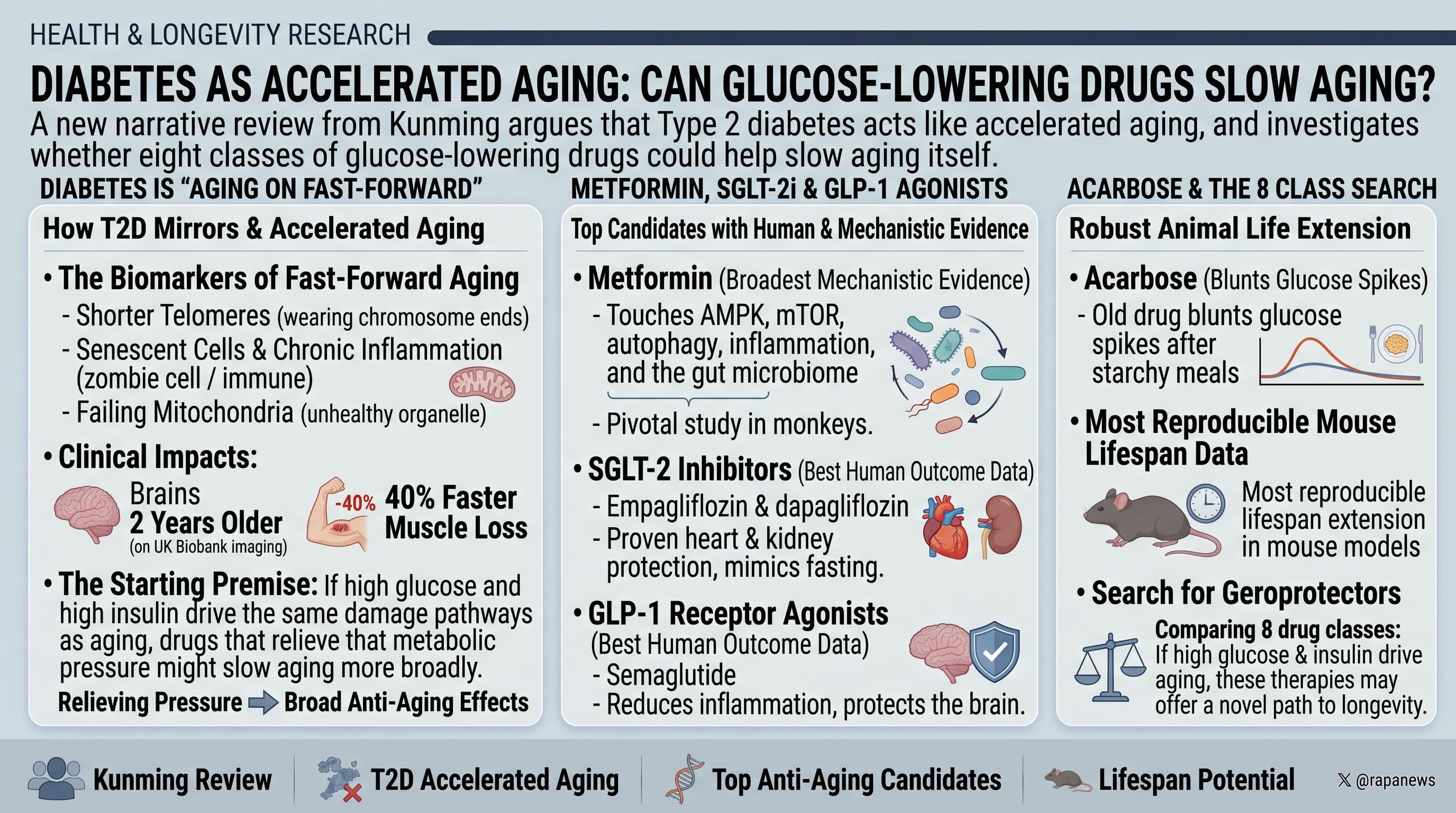
This narrative review from Kunming argues that type 2 diabetes behaves like accelerated aging and asks whether eight classes of glucose-lowering drugs could slow aging itself. Metformin has the broadest mechanistic evidence, SGLT-2 inhibitors and GLP-1 receptor agonists have the best human outcome data, and acarbose has the most reproducible mouse lifespan data.
For two decades, metformin has been the poster child of the idea that a cheap diabetes pill might slow aging. A new review in Pharmacological Research widens the lens to every major class of glucose-lowering drug and asks which, if any, deserve the label “geroprotector.”
The starting premise is that type 2 diabetes looks like aging on fast-forward. People with diabetes show shorter telomeres, more senescent cells, more chronic inflammation and failing mitochondria. In UK Biobank imaging data, diabetic brains appeared about two years older than expected. Muscle is lost roughly 40 percent faster. If high glucose and high insulin drive the same damage pathways as aging, drugs that relieve that pressure might slow aging more broadly.
The review then ranks the candidates. Metformin has the widest mechanistic footprint, touching AMPK, mTOR, autophagy, inflammation and the gut microbiome, plus one eye-catching monkey study. SGLT-2 inhibitors such as empagliflozin and dapagliflozin bring proven heart and kidney protection and mimic some features of fasting. GLP-1 drugs such as semaglutide reduce inflammation and may protect the brain. Acarbose, an old drug that blunts the glucose spike after starchy meals, has the most reproducible lifespan extension in mice.
The human trial section is where the data has lagged. In a randomized trial of older adults with frailty or sarcopenia, metformin did not improve walking speed, grip strength or frailty, and many participants tolerated it poorly. Another trial found metformin blunted the mitochondrial gains older adults normally get from aerobic exercise. For dementia, observational data and pooled trial data hint at 33 to 45 percent lower risk with GLP-1 drugs and SGLT-2 inhibitors in people with diabetes.
The authors’ own conclusion is, despite strong pre-clinical support, translational relevance remains uncertain due to model heterogeneity, limited randomized clinical evidence, and insufficient long-term follow-up. Clarifying tissue specificity, timing, dose, and patient selection will be essential for determining whether anti-diabetic agents can be safely repurposed as gerotherapeutics.
Actionable Insights
- Keep glucose in check. This is the best-supported lever. In UK Biobank data cited by the review, diabetes was linked to a brain that looked about 2.0 years older, versus 0.2 years for prediabetes, and a healthy lifestyle shrank the gap. Newly diagnosed diabetes was tied to 68 percent faster cognitive decline over four years.
- Protect muscle. People with diabetes lost about 0.24 kg of muscle per year versus roughly 0.17 kg in non-diabetics. That works out to about 1.1 kg of extra loss over 16 years.
- Do not assume metformin helps healthy older adults. The MET-PREVENT trial showed no functional benefit, and a separate trial showed blunted exercise adaptations.
- If you have diabetes, the choice of drug may matter for the brain. GLP-1 drugs were associated with 45 percent lower odds of dementia in pooled trials, and SGLT-2 inhibitors with a 43 percent lower rate in observational data. These are relative figures. Absolute benefits are probably much smaller, and the data are indirect.
- Dapagliflozin’s heart failure benefit is real even without diabetes. In DAPA-HF, as I recall the published result, about 5 fewer patients per 100 had an event over 18 months.
- Acarbose’s mouse data are interesting. See more here: Acarbose - Details On Another Top Anti-Aging Drug
Context and Source
- Open Access Paper: Geroprotective potential of anti-diabetic medications: Bridging type 2 diabetes and accelerated aging, Sept. 2026
- Institutions: Second Affiliated Hospital of Dali University (Third People’s Hospital of Yunnan Province), and the Kunming Institute of Zoology, Chinese Academy of Sciences
- Country: China
-
Journal: Pharmacological Research, online 8 September 2026
Impact evaluation: The impact score of this journal is approximately 10.8, evaluated against a typical high-end range of 0 to 60+ for top general science, therefore this is a High impact journal.