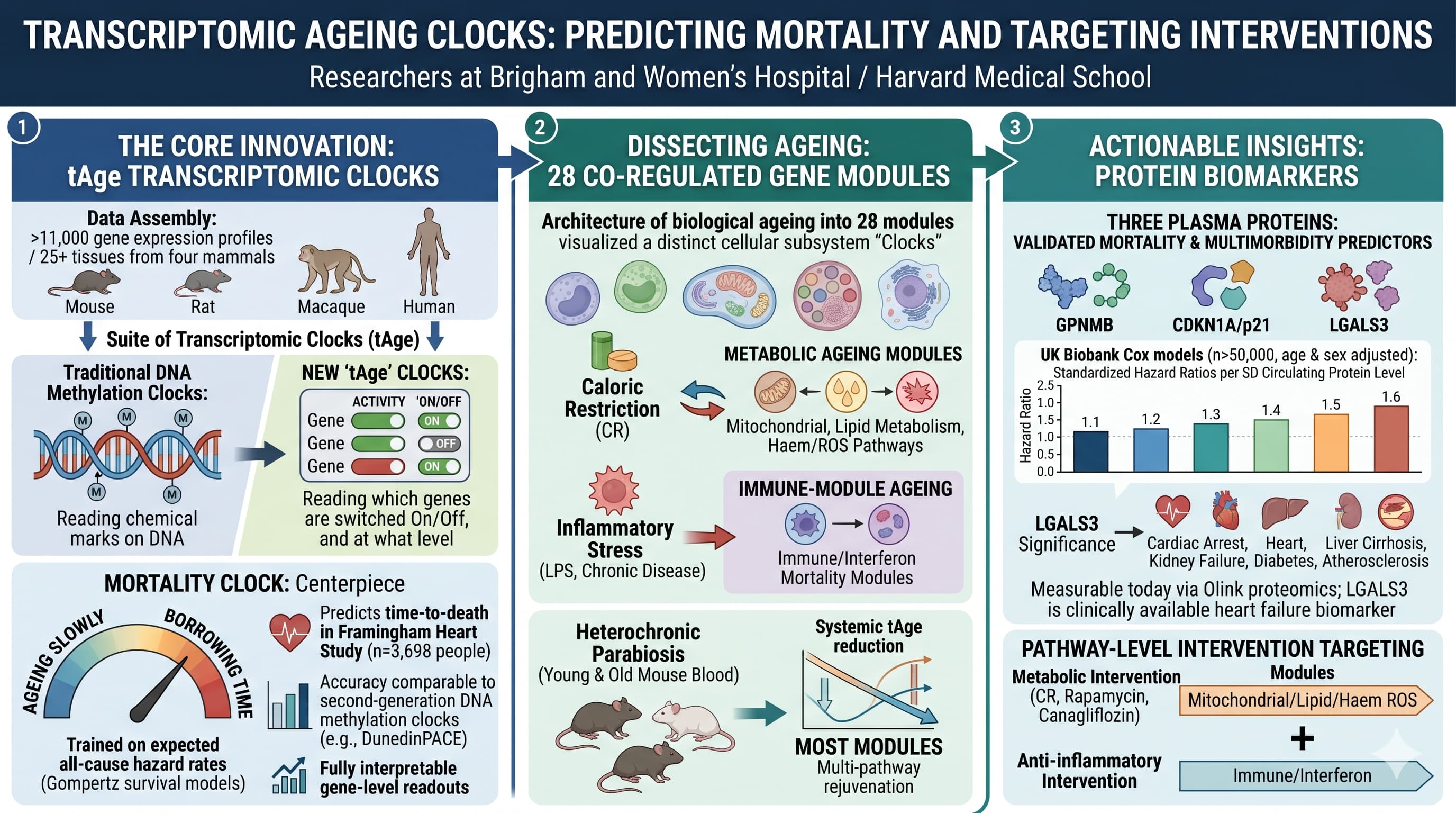
In-depth Review of Actionable Longevity Interventions:
Given the new information provided in this study, following are the 5 most actionable and cost-effective longevity interventions that address the mortality risks associated with three plasma proteins — GPNMB, CDKN1A/p21, and LGALS3. These are the most consistent molecular markers of mortality across every species, tissue, and disease model tested.
Source Study: Tyshkovskiy et al. (2026). Universal transcriptomic hallmarks of mammalian ageing and mortality. Nature 654:173–188.
Analysis from Claude Sonnet 4.6 (paid)
PART 1: ACTIONABLE INTERVENTIONS & EVIDENCE VALIDATION
Intervention 1: Rapamycin + Acarbose Combination
The Core Strategy
The combination of rapamycin (an mTORC1 inhibitor) and acarbose (an alpha-glucosidase inhibitor) is the highest-ranked lifespan-extending intervention in the paper’s ITP transcriptomic dataset. At 22 months, Rapa+Aca-treated UM-HET3 mice show significantly lower mortality transcriptomic age (tAge) than all other ITP interventions, placing them furthest from their expected hazard rate at a given chronological age. The module-specific clock data from the study shows Rapa+Aca primarily attenuates metabolic/mitochondrial module ageing: oxidative phosphorylation, cholesterol/mTOR, and fatty acid metabolism modules — distinct from and complementary to each other.
Rapamycin mechanism: Inhibits mTORC1 via FKBP12 binding, suppressing protein synthesis, activating autophagy, reducing cellular senescence (a key CDKN1A/p21 driver), and dampening innate immune activation. The study shows the innate immunity/inflammation module is a top pro-mortality driver — mTOR sits upstream of this module.
Acarbose mechanism: Slows intestinal carbohydrate absorption, blunts postprandial glucose and insulin spikes, shifts gut microbiome toward butyrate producers, and partially counteracts rapamycin-induced insulin resistance. The rational for combination is mechanistic complementarity: rapamycin desensitizes insulin signalling while acarbose ameliorates postprandial glucose load, making co-administration more metabolically neutral than either alone.
Intended longevity outcome: Reduction in mortality tAge across metabolic and mTOR/cholesterol modules; extension of maximum lifespan. Rapa+Aca started at 9 months in UM-HET3 males outperformed all prior rapamycin-only cohorts.
Translational Dosing Protocol
ITP Mouse Doses:
- Rapamycin: 14.7 ppm in chow (mid-life start, 9 months)
- Acarbose: 1,000 ppm in chow
HED Calculation (BSA normalization; Km_mouse = 3, Km_human = 37):
Rapamycin:
- Mouse chow consumption ~3.5 g/day; body weight ~28 g
- Daily dose = 14.7 mg/kg chow × 0.0035 kg = 0.051 mg/day per mouse
- mg/kg/day = 0.051 / 0.028 kg = 1.84 mg/kg/day
- HED = 1.84 × (3 / 37) = 0.149 mg/kg/day
- 70 kg human equivalent: ~10.4 mg/day (continuous)
- Clinical translation: This continuous daily dose exceeds what is used for longevity. The PEARL trial established that 5–10 mg/week (intermittent) is tolerated in healthy adults. Continuous mTOR suppression is not required for longevity benefit and increases immunosuppressive risk. Intermittent dosing is strongly preferred. Note: For people working to maximize muscle growth and strength while on rapamycin, some people are now extending the periods between rapamycin dosing (with higher dosing less frequently administered). For more details, see discussion here: Update on Brad Stanfield's Rapamycin Clinical Study in NZ - #68 by RapAdmin
Acarbose:
- Daily dose = 1,000 mg/kg chow × 0.0035 kg = 3.5 mg/day
- mg/kg/day = 3.5 / 0.028 kg = 125 mg/kg/day
- HED = 125 × (3 / 37) = 10.1 mg/kg/day
- 70 kg human equivalent: ~710 mg/day
- Clinical translation: This HED exceeds the FDA-approved ceiling of 300 mg/day (100 mg TID). A pragmatic protocol uses the maximum approved dose of 100 mg with each of 3 daily meals (300 mg/day total) and accepts that this is 42% of the theoretical HED. Dose escalation from 25 mg TID over 4–8 weeks minimises GI side effects.
Pharmacokinetics (Rapamycin):
- Oral bioavailability: ~14–15% (highly variable; influenced by food, CYP3A4 status)
- Half-life: ~62 hours (permits once-weekly dosing)
- Peak blood level (Cmax) at 5–10 mg weekly dose: ~15–30 ng/mL; trough below 5 ng/mL (below transplant therapeutic range)
Pharmacokinetics (Acarbose):
- Oral bioavailability: <2% as intact drug (intentional — acts locally in gut)
- Half-life of active metabolite: ~3–4 hours
- Systemic absorption is minimal; renal excretion of metabolites
Literature Validation & Source Verification
Safety, Toxicity, & Interaction Profile
Rapamycin:
- NOAEL: In rodents, approximately 2.5 mg/kg/day (chronic oral; above ITP dose). No established NOAEL for healthy human longevity use.
- Known adverse effects at immunosuppressive doses: dyslipidaemia (triglycerides elevated), hyperglycaemia, delayed wound healing, oral ulcers, lymphoedema, pneumonitis (rare but serious), increased infection susceptibility.
- At PEARL trial doses (5–10 mg/week): AEs similar to placebo; wound healing concerns and infection risk lower than transplant doses but not zero.
- CYP450: Strong CYP3A4 and P-glycoprotein substrate. Co-administration with CYP3A4 inhibitors (clarithromycin, ketoconazole, grapefruit) dramatically increases blood levels. CYP3A4 inducers (rifampicin, St. John’s Wort) reduce efficacy.
- Liver/kidney: Hepatic metabolism; transient LFT elevations possible. Renal function should be monitored (rare nephrotoxicity at high doses).
Acarbose:
- NOAEL: >1,600 mg/kg/day in rats (chronic 52-week study). Extremely low systemic absorption confers high safety margin.
- Adverse effects: Flatulence (most common; up to 74% of users at initiation), abdominal distension, diarrhoea — all dose-dependent and predominantly GI. Rare: elevated transaminases at doses >300 mg/day; generally reversible.
- CYP450: Not metabolised by CYP450 system (exclusively GI bacterial metabolism). No relevant CYP interactions.
- Contraindications: Inflammatory bowel disease, partial intestinal obstruction, cirrhosis (hepatic involvement in metabolite processing at high doses), severe renal impairment (CrCl <25 mL/min).
Longevity Stack Compatibility:
- With rapamycin: Rational combination (ITP-tested); acarbose partially offsets rapamycin-induced glucose intolerance. Compatible.
- With SGLT2 inhibitors: Additive glucose-lowering; GI side effects may compound. Use caution; separate dosing timing.
- With metformin: No pharmacokinetic interaction; additive glucose lowering; GI side effects additive. Clinically used together for T2DM.
- With 17-alpha estradiol: No known interaction; ITP tests these separately.
- With PDE5 inhibitors: No known interaction with acarbose. Rapamycin has no clinically significant PDE5 interaction.
Intervention 2: Canagliflozin (SGLT2 Inhibition)
The Core Strategy
Canagliflozin, a sodium-glucose cotransporter 2 (SGLT2) inhibitor, extended median survival in male UM-HET3 mice by 14% in the ITP (Miller et al. 2020). The paper’s transcriptomic analysis places canagliflozin within interventions that shift mortality tAge in the anti-aging direction via metabolic modules.
Mechanistic targets: SGLT2 inhibition forces glycosuria (urinary glucose excretion), shifting cellular fuel utilisation from glucose to fatty acid oxidation and ketogenesis. This triggers AMPK activation (via rising AMP:ATP ratio and AICAR elevation), which phosphorylates and activates PGC-1α, driving mitochondrial biogenesis. Canagliflozin additionally inhibits mTORC1 signalling in male mice (sex-specific effect). Recent data confirm a senescent cell clearance mechanism via AMPK-mediated metabolic reprogramming — connecting it to the paper’s CDKN1A/p21 pro-mortality axis. The study’s cholesterol/mTOR and respiration/mitochondrial translation module clocks capture exactly the subsystems engaged by SGLT2 inhibition.
Intended longevity outcome: Reduction in metabolic module tAge; indirect attenuation of CDKN1A/p21-driven senescent cell burden; cardiovascular mortality risk reduction (already established in human outcome trials).
Critical caveat: In UM-HET3 mice, lifespan benefit was male-only. Sex-differential mechanisms (differential mTORC1 inhibition) are not fully resolved. Human cardiovascular outcome data (CANVAS, CREDENCE, DAPA-HF) show mortality benefits in both sexes in patients with cardiometabolic disease, but there are no lifespan data in healthy humans.
Translational Dosing Protocol
ITP Mouse Dose: 180 ppm in chow, initiated at 7 months of age.
HED Calculation:
- Mouse chow consumption ~3.5 g/day; body weight ~28 g
- Daily dose = 180 mg/kg chow × 0.0035 kg = 0.63 mg/day per mouse
- mg/kg/day = 0.63 / 0.028 kg = 22.5 mg/kg/day
- HED = 22.5 × (3 / 37) = 1.82 mg/kg/day
- 70 kg human equivalent: ~127 mg/day
- Clinical alignment: FDA-approved canagliflozin doses are 100 mg/day (cardiovascular protection, heart failure) and 300 mg/day (T2DM glycaemic control). The HED of 127 mg/day maps almost exactly to the 100 mg/day approved human longevity-relevant dose — an unusually clean translational alignment.
Pharmacokinetics:
- Oral bioavailability: ~65%
- Half-life: ~10–13 hours; once-daily dosing appropriate
- Time to Cmax: ~1–2 hours; taken before the first meal of the day
- Renal threshold for glucosuria activation: serum glucose ~70–80 mg/dL (active even in euglycaemic individuals)
Literature Validation & Source Verification
Safety, Toxicity, & Interaction Profile
- NOAEL: >300 mg/kg/day in rat chronic studies (far above HED at 1.82 mg/kg/day). Extensive clinical safety data in >50,000 human participants across cardiovascular outcome trials (CANVAS, CREDENCE, CANVAS-R).
- Known adverse effects: Urogenital fungal infections (yeast vaginitis/balanitis, ~10% incidence), urinary tract infections (modest elevation), euglycaemic diabetic ketoacidosis (rare; primarily in T1DM or perioperative settings), Fournier’s gangrene (extremely rare, <1:10,000). Modest volume depletion — relevant in elderly or diuretic users.
- Bone fracture signal: Observed in CANVAS trial with canagliflozin specifically (not a class effect for all SGLT2i); possibly related to phosphaturia and FGF-23 changes. Monitor BMD in long-term users.
- CYP450: Primarily metabolised via UGT1A9 and UGT2B4 (glucuronidation), NOT CYP450. Therefore low pharmacokinetic drug interaction risk. Rifampicin (UGT inducer) can reduce canagliflozin exposure by ~51%.
- Liver/kidney: No hepatotoxicity signals. Renal: Efficacy reduces at eGFR <45 mL/min/1.73m²; contraindicated below eGFR 30. Paradoxically, CREDENCE trial showed renal protection at eGFR >30.
Longevity Stack Compatibility:
- With rapamycin: Canagliflozin may partially counteract rapamycin-induced glucose intolerance and mTOR dysregulation. Complementary. No pharmacokinetic interaction (different metabolic pathways).
- With acarbose: Both reduce postprandial glucose; additive and compatible. GI side effects may compound. Clinical use together is rational.
- With metformin: No pharmacokinetic interaction; additive glucose lowering; extensively co-prescribed in T2DM. Compatible.
- With 17-alpha estradiol: No known interaction. Volume depletion from SGLT2i may theoretically compound oestrogen-related fluid changes; clinical relevance unknown.
- With PDE5 inhibitors: Volume depletion from SGLT2i and vasodilatory effects of PDE5i could additively lower blood pressure. Monitor blood pressure; use caution in hypotension-prone individuals.
Intervention 3: Galectin-3 Inhibition (LGALS3 Pathway) via Modified Citrus Pectin
The Core Strategy
LGALS3 (galectin-3) is identified in this paper as one of the three most consistent pro-mortality transcriptomic biomarkers across species, tissues, cell types, chronic disease models, and interventions. Its protein product (galectin-3) is positively associated with all-cause mortality, cardiac arrest, heart failure, liver cirrhosis, kidney failure, diabetes, atherosclerosis, and multimorbidity in over 51,647 UK Biobank participants (standardised HR ~1.2–1.5 per SD). LGALS3 expression increases with ageing, is suppressed during caloric restriction, heterochronic parabiosis, and early embryogenesis, and is upregulated across all major chronic disease models in the paper.
Galectin-3 biology: A beta-galactoside-binding lectin secreted by macrophages and other immune cells. It drives: TGF-beta-mediated fibrosis (cardiac, renal, hepatic), NLRP3 inflammasome activation, pro-inflammatory M1 macrophage polarisation, cellular adhesion in senescent cells, and tumour microenvironment remodelling. Its protein-level association with outcomes in UK Biobank validates the transcriptomic finding at a clinically actionable molecular layer.
Modified citrus pectin (MCP): A low-molecular-weight (<10 kDa) polysaccharide derived from citrus peel pectin via enzymatic and pH modification. At reduced molecular weight, MCP fragments are absorbed systemically and competitively inhibit galectin-3’s carbohydrate recognition domain (CRD), blocking its binding to cell-surface glycoconjugates. This is currently the only orally bioavailable, clinically tested galectin-3 inhibitor available outside of investigational drugs.
Important caveat: This intervention is inferred from a biomarker finding. The paper does not test MCP or any galectin-3 inhibitor. The translational logic is: LGALS3 is a validated, outcome-linked mortality biomarker → galectin-3 inhibition may attenuate the associated downstream biology → MCP is the most clinically accessible tool. This is a mechanistic inference, not a direct paper finding.
Intended longevity outcome: Attenuation of galectin-3-mediated fibrosis, chronic inflammation, senescent cell accumulation, and multimorbidity risk.
Translational Dosing Protocol
MCP is not an ITP compound. No murine HED calculation is directly applicable. The clinical dose is derived from published human trials.
Standard MCP clinical dosing from published trials:
- PectaSol-C (ecoNugenics) prostate cancer PSA studies: 4.8 g three times daily (14.4 g/day total), taken on an empty stomach, in divided doses
- Phase II prostate cancer study (Arad et al.): 14.4 g/day powder for 6 months
Representative calculation for longevity framing (if applying animal data):
- Rat cardiac fibrosis studies used ~250 mg/kg/day MCP
- HED = 250 × (6/37) [using rat Km = 6] = 40.5 mg/kg/day
- 70 kg human: 2,838 mg/day (~2.8 g/day)
- The clinical trial dose (14.4 g/day) substantially exceeds this animal-derived HED, suggesting the human clinical dose is in excess of what pharmacokinetics would predict — possibly reflecting poor absorption and the need for high luminal concentrations.
Practical starting dose: 5 g three times daily (15 g/day) in water, taken 30 minutes before meals. Titrate from 5 g once daily over 2 weeks to reduce GI tolerance issues.
Pharmacokinetics:
- Oral bioavailability of the low-MW fraction: Limited systemic data. MW <10 kDa fragments are absorbed paracellularly; plasma galectin-3 levels measured as a surrogate biomarker.
- No established half-life for the active fraction in human tissue; based on functional galectin-3 inhibition assays.
Literature Validation & Source Verification
Safety, Toxicity, & Interaction Profile
- MCP NOAEL: Not formally established in regulatory toxicology studies. GRAS (Generally Recognised As Safe) status under 21 CFR 184.1588 for pectin in food.
- Adverse effects: Predominantly GI — flatulence, loose stools, mild cramping, particularly at initiation. Typically self-limiting within 1–2 weeks. No hepatotoxicity or nephrotoxicity reported in human trials at up to 14.4 g/day for >6 months.
- Drug interactions: No CYP450 interactions documented. Theoretical concern: pectin may reduce absorption of co-administered oral medications if taken simultaneously; administer separately from other oral drugs by at least 2 hours.
- Heavy metal chelation: MCP has documented lead and cadmium chelation activity (reduces blood lead by ~74% in children; Eliaz et al.). This is generally beneficial but could theoretically reduce absorption of zinc or other minerals with chronic high-dose use.
- Immune caution: Galectin-3 has pro-inflammatory AND anti-tumour roles. Systemic inhibition could theoretically impair anti-tumour immune surveillance. No clinical evidence of this risk at MCP doses, but a legitimate theoretical concern. Safety Data Absent for long-term (>12 months) systemic galectin-3 inhibition in humans.
Longevity Stack Compatibility:
- With rapamycin: No pharmacokinetic interaction. Mechanistically complementary: rapamycin reduces mTOR-driven protein synthesis/inflammation; MCP attenuates galectin-3-driven fibrosis and inflammasome activity. Compatible.
- With SGLT2 inhibitors: No known interaction. Potentially complementary via independent mechanisms (AMPK/metabolism vs. galectin-3/fibrosis).
- With metformin: No known interaction.
- With acarbose: Separate GI mechanisms; both cause GI side effects — additive GI tolerability concerns. Space dosing times.
- With 17-alpha estradiol or PDE5 inhibitors: No known interactions.
Intervention 4: Senolytic Targeting of CDKN1A/p21 — Dasatinib + Quercetin (D+Q)
The Core Strategy
CDKN1A (encoding p21/CIP1/WAF1) is identified in this paper as the single most consistent pro-mortality gene across all models: ageing in 26 tissues, Klotho-KO progeria, caloric restriction (suppressed), heterochronic parabiosis (suppressed), early embryogenesis ground zero (suppressed), and all 9 chronic disease models (upregulated). Its protein levels in UK Biobank predict all-cause mortality and a wide disease spectrum.
CDKN1A is the canonical enforcer of the p53-driven senescent cell cycle arrest. Senescent cells — characterised by permanent CDKN1A/p21 and CDKN2A/p16 upregulation and the Senescence-Associated Secretory Phenotype (SASP) — are a direct mechanistic driver of the paper’s top pro-mortality pathways: innate immunity/inflammation, interferon signalling, and ECM disruption.
Dasatinib mechanism: BCR-ABL/Src kinase inhibitor that eliminates senescent fat cell progenitors and endothelial cells by inducing apoptosis in cells dependent on pro-survival kinase signalling (BCL-2, PI3K, Src). Selectively kills the senescent fraction because they have upregulated pro-survival kinases as a counter to apoptosis.
Quercetin mechanism: Flavonoid that inhibits PI3K, Akt, and BCL-xL — complementary pro-survival pathways in different senescent cell populations. Together, D+Q achieve broader senescent cell elimination than either alone (Mayo Clinic mouse data, Xu et al. 2018 Nature Medicine).
Administration protocol: Intermittent (“hit-and-run”) — not daily dosing. Senolytics are given in short pulses (3 consecutive days) monthly or quarterly. Rationale: senescent cells do not re-accumulate immediately; continuous dosing unnecessary and increases toxicity.
Intended longevity outcome: Selective elimination of CDKN1A/p21-high senescent cells; reduction of SASP-driven chronic inflammation, interferon production, ECM degradation, and fibrosis — directly targeting the paper’s top pro-mortality modules.
CRITICAL SAFETY ALERT — CNS DEMYELINATION [New PNAS Evidence, March 2026]
A peer-reviewed PNAS study (Lombardo et al. 2026; DOI: 10.1073/pnas.2524897123; University of Connecticut) demonstrates that intermittent D+Q at the standard senolytic dose used in all current human protocols (dasatinib 5 mg/kg + quercetin 50 mg/kg, given over 4 weeks) causes significant demyelination of the corpus callosum in healthy wild-type mice, in both young (3–4 months) and aged (22 months) animals. The damage is not caused by oligodendrocyte cell death — TUNEL and LDH assays confirmed cell survival — but by severe oligodendrocyte dysfunction: within 24 hours, mature oligodendrocytes undergo morphological simplification and active process retraction. The mechanism is ER stress/Unfolded Protein Response (UPR) activation (ATF4, XBP1, BiP/HSPA5 upregulation), which initiates a translational block that prevents synthesis of myelin-sustaining proteins. Downregulation of mRNA transport genes (hnRNPs, Kif1b) further impairs local translation of myelin basic protein (MBP) at distal cell extensions. A counter-intuitive finding: demyelination was more severe in younger mice than older ones, suggesting the mechanism targets metabolically active myelination rather than aged-tissue fragility.
Mechanistic convergence with Tyshkovskiy 2026: The source paper shows that oligodendrocytes, neurons, and astrocytes in the Klotho-KO brain exhibit tAge acceleration via the same pro-mortality gene programmes as peripheral tissues (CDKN1A/p21, LGALS3 upregulation). This indicates CNS cells physiologically express CDKN1A in contexts unrelated to pathological senescence — normal post-mitotic gene regulation, differentiation checkpoints, and DNA damage response during routine turnover. Senolytic agents targeting p21-expressing cells may cause off-target dysfunction in CNS cells expressing p21 for functional, non-pathological reasons.
Updated risk classification: D+Q is reclassified from “use under physician supervision” to HIGH RISK — evidence insufficient to recommend in healthy adults without dedicated CNS safety monitoring. Prospective human neuroimaging (corpus callosum DTI-MRI, white matter integrity) and neuropsychological assessment should be mandatory endpoints before senolytic use in non-disease longevity contexts. No currently available human D+Q trial has collected this data.
Additional community signal: Forum-based reports from experienced self-experimenters include unexplained fatigue and general health setbacks after senolytic cycles. Unpublished work cited by forum researchers (rapamycin.news, user nym, March 2026) suggests minimal measurable change in senescent cell burden in individuals without very high baseline senescence — implying that for healthy middle-aged individuals with low baseline senescent cell load, D+Q may deliver CNS risk without meaningful peripheral senolytic benefit.
Translational Dosing Protocol
Mouse study doses (Xu et al. 2018 Nature Medicine):
- Dasatinib: 5 mg/kg orally
- Quercetin: 50 mg/kg orally (days 1, 3, 5 per cycle)
HED Calculation (Km_mouse = 3, Km_human = 37):
Dasatinib:
- HED = 5 × (3 / 37) = 0.405 mg/kg
- 70 kg human: ~28.4 mg per dose
- Clinical senolytic dose used in Mayo Clinic trials (Hickson et al. 2019): 100 mg dasatinib × 3 consecutive days
- Note: The clinical dose (100 mg) substantially exceeds the HED (28 mg), reflecting dose selection based on oncology pharmacokinetic data and tolerability. The longevity field has adopted 100 mg as the empirical human senolytic dose.
Quercetin:
- HED = 50 × (3 / 37) = 4.05 mg/kg
- 70 kg human: ~284 mg per dose
- Clinical dose: 500–1,000 mg quercetin × 3 consecutive days (Hickson 2019 used 1,000 mg)
- Note: Quercetin oral bioavailability is poor (~17%) and variable; clinical studies use 1,000 mg to ensure adequate plasma levels. Quercetin phytosome formulations may improve bioavailability.
Cycle frequency: Monthly (for accelerated clearance in disease states) or every 3 months (for maintenance in healthy aging). No consensus established.
Pharmacokinetics (Dasatinib):
- Oral bioavailability: 14–34% (food reduces Cmax)
- Half-life: 3–5 hours; taken fasted for peak absorption
- CYP3A4 substrate AND inhibitor — significant interaction risk (see below)
Pharmacokinetics (Quercetin):
- Oral bioavailability: 17% (aglycone); food increases absorption
- Half-life: ~3.5 hours
- Extensive phase II metabolism; CYP3A4 inhibitor
Literature Validation & Source Verification
Safety, Toxicity, & Interaction Profile
Dasatinib:
- NOAEL: Not established for healthy aging use. It is an oncology drug (FDA-approved for CML/ALL at 100–140 mg/day continuous). Senolytic protocol uses intermittent 100 mg × 3 days, not continuous.
-
CNS DEMYELINATION [PRIMARY CONCERN — PNAS 2026]: Lombardo et al. 2026 (PNAS) demonstrates intermittent D+Q at standard senolytic doses causes corpus callosum demyelination in healthy mice via oligodendrocyte ER stress/UPR dysfunction — without cell death. The effect is worse in younger animals. Dasatinib crosses the blood-brain barrier; CNS exposure at 100 mg clinical doses has not been systematically characterised in the context of white matter integrity. Existing human trial reports (Hickson 2019, N=9) did not include CNS imaging or cognitive endpoints. This is now the primary, highest-priority safety concern for D+Q in longevity contexts.
- Peripheral demyelination: Case reports of dasatinib-associated reversible demyelinating peripheral polyneuropathy exist in the CML oncology literature (PMID 29027647, PMID 32611965). These were reversible on discontinuation in cancer patients receiving continuous dosing; reversibility of intermittent-dose CNS damage is uncharacterised.
- Adverse effects at 100 mg continuous (oncology): Myelosuppression, pleural effusion (10–35%), QT prolongation, bleeding (platelet inhibition via Src). At intermittent 3-day dosing: AEs substantially lower; Hickson 2019 reported no serious AEs in 9 participants. The safety database for intermittent longevity dosing in healthy adults is extremely limited (N<100 across all trials) and collected before the CNS demyelination finding.
- CYP3A4: Major substrate AND inhibitor. Co-administration with rapamycin is a significant pharmacokinetic concern: Dasatinib will increase rapamycin blood levels by inhibiting CYP3A4 metabolism. If combining, DO NOT take on the same days as rapamycin. Space by at least 5 half-lives.
- QT prolongation: Modest risk; screen baseline ECG and avoid co-administration with other QT-prolonging drugs (fluoroquinolones, azithromycin, antipsychotics).
- Platelet inhibition: Dasatinib inhibits Src, which reduces platelet function. Avoid in patients on anticoagulants or antiplatelet therapy without haematology oversight.
Quercetin:
- NOAEL: ~160 mg/kg in rats (90-day); up to 1,000 mg/day appears safe in humans across multiple trials.
- Adverse effects: Well-tolerated; mild GI symptoms at high doses. Quercetin at 1g/day for 12 weeks showed no significant AEs in healthy adults.
- CYP3A4 inhibitor: Quercetin inhibits CYP3A4, increasing levels of rapamycin, dasatinib, and other CYP3A4 substrates. Monitor rapamycin blood levels if overlapping dosing windows.
- P-glycoprotein inhibitor: May increase absorption of drugs that are P-gp substrates.
Longevity Stack Compatibility:
- With rapamycin: Do NOT take simultaneously. Dasatinib + quercetin both inhibit CYP3A4, dramatically elevating rapamycin blood levels and risk of toxicity. Pulse D+Q on weeks without rapamycin. Space by minimum 5 days from last rapamycin dose.
- With SGLT2 inhibitors: No pharmacokinetic interaction expected. Mechanistically complementary (AMPK-mediated senescent cell clearance by canagliflozin + direct senolysis by D+Q). Safe to co-prescribe on different days.
- With metformin: No significant pharmacokinetic interaction. Metformin has senomorphic (SASP-modulating) but not directly senolytic properties; compatible.
- With acarbose: No interaction. Compatible.
- With 17-alpha estradiol: 17-alpha estradiol is CYP3A4-metabolised; quercetin co-administration may increase circulating 17-alpha estradiol levels. Monitor.
- With PDE5 inhibitors: PDE5 inhibitors (sildenafil, tadalafil) are CYP3A4 substrates; quercetin may increase their plasma levels. Avoid same-day co-administration; monitor for hypotension/adverse effects.
Intervention 5: NAD+ Augmentation via Nicotinamide Riboside (NR) — Targeting the NMRK1 Longevity Pathway
The Core Strategy
The paper identifies NMRK1 (Nicotinamide riboside kinase 1) as positively associated with maximum lifespan and negatively associated with expected mortality in the rodent meta-dataset — placing it among genes whose expression predicts longevity. NMRK1 encodes the rate-limiting enzyme for NAD+ biosynthesis via the salvage pathway from nicotinamide riboside (NR). Separately, FMO3 — an mTOR and inflammation inhibitor — is identified as a top pro-longevity gene in the paper; FMO3 activity is NAD±dependent, linking NAD+ status to mTOR suppression and inflammatory pathway downregulation.
NAD+ decline in ageing [CONTESTED PREMISE — May 2026]: The widely-cited claim that human NAD+ levels fall ~50% between age 20 and 60 is now directly challenged by a May 2026 Nature Metabolism publication (Kuegelgen et al. 2026; DOI: 10.1038/s42255-026-01537-5). This rigorous multi-cohort study (>300 participants across 7 independent cohorts including cross-sectional ageing groups, elite athletes, frail elderly, and a monozygotic twin-pair NR supplementation RCT) found: whole-blood NAD+ concentrations do not decline with age and are unaffected by lifestyle interventions including elite endurance training. Crucially, the paper identifies that prior reports of age-related NAD+ decline were largely methodological artifacts: freezing whole blood without immediate metabolic quenching (methanol/acid) triggers ex vivo cell lysis and enzyme-mediated NAD+ degradation, creating false appearance of age-related depletion in stored biobank samples.
Important caveats that partially preserve the NAD+ rationale: (1) The Kuegelgen finding applies specifically to whole blood — erythrocytes lack mitochondria and operate under a constrained NAD+ metabolic context fundamentally different from post-mitotic solid tissues. The study explicitly cannot generalise to skeletal muscle, liver, or brain, where separate tissue biopsies would be required. (2) A plasma NAD+ study by Clement et al. (PMID 30124109) did show significant age-related decline in plasma NAD+, NADP+, and NAAD — supporting the view that compartment-specific depletion may still occur outside erythrocytes. (3) The paper’s finding that NMRK1 expression positively predicts longevity is a separate observation from whether blood NAD+ declines with age; NMRK1 may matter for tissue-specific flux rather than steady-state levels. (4) The Kuegelgen cohorts focused on ages 28–87; very elderly populations (>90) are underrepresented. Bottom line: the foundational premise has shifted from “restoring universally depleted NAD+” to “potentially supporting NAD+ in tissues where local depletion may still occur” — a weaker but not invalidated rationale.
NR mechanism [Updated January 2026 — gut-mediated pathway]: The traditional model assumed direct NR absorption → NMRK1/NMRK2 phosphorylation to NMN → NMNAT to NAD+. A head-to-head human RCT (Christen et al. 2026; Nature Metabolism; PMC12855009; Nestlé Research + Université de Sherbrooke; N=65 healthy adults, 14 days) overturns this model. NR and NMN added directly to human whole blood do NOT raise NAD+ concentrations in vitro; nicotinic acid (NA) does. In vivo, NR and NMN are metabolised by gut microbiota — NR is cleaved to nicotinamide then deamidated to NA by colonic bacteria (notably Enterocloster aldensis); NMN follows a similar pathway — and it is this bacterially produced NA that enters the Preiss-Handler pathway in blood cells to generate NAD+. NMN is not directly absorbed intact into the systemic circulation in meaningful quantities. Practical implications: (a) gut microbiome health is a critical and previously unrecognised modifier of NR/NMN efficacy; (b) recent antibiotic use, significant gut dysbiosis, or a microbiome lacking adequate deamidating capacity could substantially impair NAD+ response; (c) NMRK1 enzyme may not be the rate-limiting step for blood NAD+ elevation — gut microbial conversion capacity may be; (d) this also explains why NR and NMN are comparably effective despite different molecular structures — they share the gut-mediated NA conversion pathway. The study confirmed that both NR (1g/day) and NMN (1g/day) raised whole-blood NAD+ ~2-fold equivalently over 14 days; nicotinamide (Nam, 0.5g/day) did NOT raise chronic NAD+ levels despite providing an acute transient salvage-pathway elevation.
Intended longevity outcome: Restoration of NAD+ levels in aged tissues; SIRT1/3-mediated activation of mitochondrial biogenesis and fatty acid oxidation modules; attenuation of PARP1-driven NAD+ depletion in senescent cells; support of CDKN1A/p21 context (SIRT1 deacetylates p21, modulating its stability). These align directly with the paper’s metabolic anti-mortality modules.
Important calibration [Updated June 2026]: NMRK1 expression predicts longevity in rodent models, but this does not prove that supplementing NR causally extends lifespan in humans. The mechanistic logic has weakened since initial drafting: (1) the foundational premise that systemic NAD+ declines with age in humans is now contested by a 2026 Nature Metabolism paper; (2) the mechanism of action for NR/NMN is gut-mediated rather than NMRK1-direct, meaning the paper’s NMRK1 longevity finding does not straightforwardly predict benefit from oral NR supplementation. The direct interventional evidence in humans remains limited to surrogate endpoints (NAD+ levels, insulin sensitivity, muscle bioenergetics) rather than mortality or functional longevity outcomes. Confidence: Low-Medium (foundational premise contested; target engagement confirmed; longevity benefit unproven).
Translational Dosing Protocol
Mouse study dose (representative): 300–400 mg/kg/day NR (Cantó et al. 2012 Cell Metabolism and Gomes et al. 2013 Cell).
HED Calculation (Km_mouse = 3, Km_human = 37):
- Mouse dose: 400 mg/kg/day NR
- HED = 400 × (3 / 37) = 32.4 mg/kg/day
- 70 kg human: ~2,268 mg/day
- Comparison to clinical trials: Martens et al. (2018) used 500–1,000 mg/day; the dose-finding NMN study (Yi et al. 2022) found optimal NAD+ elevation at 600 mg/day and maximum tolerated oral NMN at 900 mg/day.
- The theoretical HED of 2,268 mg/day substantially exceeds the currently studied clinical range (~250–2,000 mg/day NR or NMN). This gap likely reflects species differences in NAD+ turnover, tissue distribution, and baseline NAD+ levels — not necessarily that clinical doses are ineffective, but the dose-response relationship at the high end is uncharacterised in humans.
Practical dosing: 500–1,000 mg/day NR (Tru Niagen brand studied in Martens et al.) or 600 mg/day NMN (oral) once daily, morning. Studies suggest splitting into 300 mg twice daily may improve plasma NAD+ metabolite AUC.
Pharmacokinetics (NR):
- Oral bioavailability: Moderate; rapidly converted to NMN and NAD+ metabolites in intestinal epithelium. Circulating NR itself has short half-life (~1–2 hours); NAD+ metabolome elevation (NAAD, NAMN, NMN) is the measured endpoint.
- Martens et al. (2020): 500 mg/day NR for 6 weeks elevated whole-blood NAD+ by ~40–60% in healthy older adults.
Literature Validation & Source Verification
Safety, Toxicity, & Interaction Profile
- NOAEL: In rats, >3,000 mg/kg/day in 90-day repeated dose studies (exceptionally high safety margin relative to HED). No mutagenicity or reproductive toxicity signals.
- Adverse effects: Well-tolerated across all clinical trials. Most frequent: mild flushing (less than niacin), GI discomfort, headache — all dose-dependent and typically transient. No liver or kidney toxicity signals in clinical data up to 2,000 mg/day.
- Potential concerns:
- NAAD/NAAM elevation: NR supplementation consistently elevates not just NAD+ but also NAAD and NAAM. The functional significance of this is uncertain.
- Cancer proliferation: NAD+ is required for rapid proliferation; theoretical concern that NAD+ supplementation could support occult tumour growth. Not demonstrated clinically but a legitimate consideration in individuals with high cancer risk or active malignancy. Safety Data Absent for long-term (>1 year) continuous supplementation in humans.
- Methylation burden: High-dose NAD+ supplementation may theoretically increase methyl group demand (NAD+ metabolite clearance requires methylation). Some researchers advocate concurrent methyl donor support (methylfolate, TMG); no clinical evidence of clinical methylation deficiency at standard NR doses.
- CYP450: No significant CYP450 interactions documented. NR is not a CYP substrate or inhibitor.
- Liver/kidney: No hepatotoxicity or nephrotoxicity signals in clinical trials up to 2,000 mg/day.
Longevity Stack Compatibility:
- With rapamycin: No pharmacokinetic interaction. Mechanistically potentially complementary: rapamycin inhibits mTORC1 (suppresses anabolic pathways); NR supports mitochondrial function (maintains metabolic capacity). The combination has not been specifically studied but is commonly used together.
- With SGLT2 inhibitors: Both improve mitochondrial function via different mechanisms (AMPK vs. NAD+/SIRT1). Likely additive and compatible.
- With metformin: Caution. Metformin inhibits Complex I of the mitochondrial electron transport chain; NR/NAD+ supports ETC function via SIRT3-mediated deacetylation. There is theoretical antagonism, and one study found metformin may blunt exercise-induced NAD+ metabolome benefits. Clinically, the interaction is uncharacterised. Both are widely co-used without documented adverse events.
- With acarbose: No known interaction. Compatible.
- With 17-alpha estradiol: No known pharmacokinetic interaction.
- With PDE5 inhibitors: No known interaction. PDE5 inhibitors increase cGMP; NR supports NAD+. No conflict.
PART 2: STRATEGIC FEASIBILITY & TARGET ENGAGEMENT
Biomarker Verification: Target Engagement Confirmation
Verifying that any of these interventions is actually working requires measuring the specific molecular targets they are claimed to engage. The paper itself provides a roadmap: mortality tAge can be assessed from blood RNA-seq using the TACO platform (app.gladyshevlab.org/TACO/). The following biomarkers are recommended per intervention:
Rapamycin + Acarbose:
- S6K1 phosphorylation (p-S6K1, T389) in PBMCs or serum: Direct mTORC1 activity readout. Target: reduction vs. baseline.
- Fasting insulin and HOMA-IR: Acarbose target engagement. Target: reduction.
- Postprandial glucose (CGM AUC after standardised meal): Acarbose efficacy. Target: blunted glucose excursion.
- Rapamycin whole-blood trough level: Target 3–10 ng/mL (below transplant range). Essential for safety and PK monitoring.
- Complete blood count and IgG levels: Monitor for immunosuppression signal (quarterly).
- Plasma CDKN1A/p21 protein (Olink or Luminex): Primary pro-mortality biomarker from paper. Target: reduction.
Canagliflozin:
- Urine glucose-to-creatinine ratio: Direct SGLT2 inhibition confirmation. Target: elevated (>10 g/g creatinine).
- Fasting glucose and HbA1c: Glycaemic target engagement.
- Beta-hydroxybutyrate (BHB): Ketogenic shift confirmation. Target: mild elevation 0.3–0.8 mM.
- Phosphorylated AMPK (p-AMPK) in PBMCs: Mechanism confirmation. Target: elevated vs. baseline.
- eGFR and potassium: Safety monitoring (quarterly).
- BMD (DXA, annual): Monitor bone mineral density given canagliflozin-specific fracture signal.
Galectin-3 Inhibition (MCP):
- Serum galectin-3 protein level: Direct target engagement biomarker. Commercially available assay (Galectin-3 ELISA, BG Medicine). Target: reduction from baseline. Normal <17.8 ng/mL; cardiovascular risk >25.9 ng/mL.
- High-sensitivity CRP and IL-6: Downstream inflammatory resolution.
- Fibrosis markers (ELF score: HA, TIMP-1, P3NP): If hepatic or renal fibrosis is clinical concern.
- Urine albumin-to-creatinine ratio: Renal fibrosis endpoint.
Dasatinib + Quercetin (Senolytics):
- p16INK4a (CDKN2A) mRNA in PBMCs or adipose tissue biopsy: Established senescent cell burden biomarker. Target: reduction post-cycle.
- p21/CDKN1A mRNA in PBMCs: Primary paper biomarker. Target: reduction.
- SASP markers: IL-6, IL-8, GDF15, MCP-1 in plasma (Luminex panel). Target: reduction.
- Circulating cell-free DNA (cfDNA): Marker of senescent cell DNA damage and turnover.
- GrimAge or DunedinPACE (DNA methylation clocks): Epigenetic target engagement; the chromatin-modification transcriptomic clock in the paper correlates most strongly with DNAm clocks (Fig 5g).
- Dasatinib plasma PK level (if D+Q cycle): Confirm therapeutic exposure at 100 mg dose.
NR/NAD+ Augmentation:
- Whole-blood NAD+ level (enzymatic or LC-MS/MS assay): Target engagement marker for NR/NMN supplementation. Target: ~2-fold elevation from baseline (per Christen et al. 2026 and Martens et al. 2018). Laboratories: Jinfiniti Precision Medicine, LabCorp. Caveat [June 2026]: Whole-blood NAD+ does not decline with age in healthy individuals (Kuegelgen 2026) and is dominated by erythrocyte NAD+ pools with limited functional relevance to mitochondrial or nuclear NAD±dependent enzymes. An elevated whole-blood NAD+ on supplementation confirms gut-mediated target engagement but does not confirm NAD+ elevation in the most relevant tissue compartments (muscle, liver, brain).
- NAD+ metabolome (NAAD, NMN, NAM in plasma): A rising NAAD signal in plasma is a more specific marker of Preiss-Handler pathway activation (the confirmed NR/NMN mechanism per Christen 2026) and may be more informative than total blood NAD+.
- Gut microbiome profile (16S or shallow shotgun): Given that gut microbial conversion to NA is the established mechanism for NR/NMN efficacy, microbiome assessment (presence/abundance of deamidating bacteria including Enterocloster species) may predict individual responsiveness.
- SIRT1 activity (SIRT1 deacetylase activity assay in PBMCs): Functional downstream confirmation.
- Mitochondrial function (Seahorse XF assay in PBMCs, or VO2max testing): Functional mitochondrial endpoint.
- Transcriptomic tAge via TACO (blood RNA-seq): Paper-derived mortality module clocks specifically tracking mitochondrial translation and OxPhos/haem metabolism modules — the primary NR-targeted subsystems.
Sourcing, Financial ROI & Procurement Classification
| Intervention |
Status |
Procurement |
Monthly Cost Estimate (70 kg) |
Key Notes |
| Rapamycin (5 mg/week) |
Rx |
Requires physician prescription (off-label for longevity); compounded sirolimus available via longevity clinics (AgelessRx, Fountain Health) |
~$75–$300/month (compounded) |
Generic sirolimus ~$150–350/month without insurance. Prescription availability variable by jurisdiction. |
| Acarbose (300 mg/day) |
Rx |
Prescription; FDA-approved for T2DM; used off-label for longevity |
~$30–$100/month (generic) |
Generic acarbose is inexpensive; easily obtained with a prescription in most countries. |
| Canagliflozin (100 mg/day) |
Rx |
Prescription; FDA-approved for T2DM and heart failure; off-label for longevity |
~$80–$200/month (generic empagliflozin often cheaper) |
Generic canagliflozin becoming available; brand (Invokana) is more expensive. Insurance coverage requires T2DM or heart failure diagnosis. |
| Modified Citrus Pectin (15 g/day) |
Supplement |
OTC; PectaSol-C powder from ecoNugenics |
~$80–$150/month |
GRAS; no prescription required. Quality control varies by brand; PectaSol-C has the most clinical data. The high gram-per-day dose makes this expensive per month. |
| Dasatinib (100 mg × 3 days/month) |
Rx (Research Chemical use only) |
Rx required; FDA-approved for CML/ALL; extreme off-label use for longevity. Research chemical suppliers exist but are unregulated and NOT recommended. |
~$300–$1,200+/month (brand Sprycel); $50–$150 (generic; emerging) |
Dasatinib is a cancer chemotherapy agent. Off-label longevity prescribing is rare; requires an oncology-aware or longevity medicine physician. Generic dasatinib availability is improving. |
| Quercetin (1,000 mg × 3 days/month) |
Supplement |
OTC |
~$10–$20/month (for 3-day pulse) |
Low cost; highly accessible. Quality varies; look for phytosome form for improved bioavailability. |
| NR (1,000 mg/day) |
Supplement |
OTC; Tru Niagen, ChromaDex, Elysium |
~$60–$120/month |
Most studied NR brand is Tru Niagen (Niagen/ChromaDex NR). NMN is equivalent in mechanism and effect at 1g/day (Christen 2026). Nicotinamide (niacinamide, ~$5–10/month) is NOT equivalent — it does NOT raise chronic NAD+ levels and should not be substituted. |
Cost-Benefit Summary:
The most cost-effective interventions are acarbose (cheap Rx, strong animal data, ITP-validated) and canagliflozin (strong mechanistic alignment with paper’s metabolic modules, ITP-validated, established cardiovascular safety). These two provide the best evidence-to-cost ratio among the Rx options.
NR/NMN is accessible and safe, but the epistemic foundation has weakened in 2026. The mechanistic bet has shifted from “correcting universal NAD+ decline” (now contested) to “supporting gut-microbiome-mediated NA production → tissue NAD+ in compartments where depletion may persist.” The gut-mediated mechanism (Christen 2026) also adds prebiotic gut health as a plausible secondary benefit (SCFA elevation, E. aldensis enrichment). At ~$80/month, NR remains reasonable for the safety-conscious biohacker but should be accompanied by gut microbiome monitoring and re-evaluation as tissue-level human NAD+ biopsy data mature. NMN is a mechanistically equivalent, often cheaper alternative. Nicotinamide (niacinamide) is NOT equivalent and does not raise chronic NAD+ — its common recommendation as a cheap substitute is now directly contradicted by RCT data.
Modified citrus pectin provides the only tool to directly address the galectin-3/LGALS3 biomarker — the most consistently pro-mortality gene identified in the paper at both RNA and protein level. At 15 g/day it is expensive (~$80–$150/month) and GI-demanding, but the UK Biobank signal (HR 1.2–1.5 per SD LGALS3) justifies monitoring circulating galectin-3 as a primary mortality risk stratification tool regardless of whether MCP is used.
Dasatinib is the highest-risk, highest-barrier entry point, and its risk profile has materially worsened since initial publication of this report. Beyond the existing concerns (CYP3A4 interactions with rapamycin, QT prolongation, platelet inhibition), the March 2026 PNAS data (Lombardo et al.) adds corpus callosum demyelination as a primary CNS safety concern at the exact doses used in all current human protocols. The mechanistic case remains theoretically strong (p21-driven senescent cell elimination), but the clinical evidence is thin (N < 100 total), unpublished forum data suggests minimal effect in people without very high baseline senescence, and the CNS risk now materially changes the benefit-risk calculus for healthy adults. This intervention is not recommended without dedicated CNS neuroimaging (baseline + follow-up brain MRI/DTI of corpus callosum), and physician supervision is mandatory.
Critical Summary of Limitations Across All Interventions
No intervention described above has been demonstrated to extend lifespan in healthy humans in a randomised controlled trial. The translational hierarchy across all five is:
Strong ITP-validated rodent lifespan data + emerging human surrogate data → Rapa+Aca and Canagliflozin (best translational footing from this paper).
Validated human biomarker + preclinical mechanism + limited human interventional data → LGALS3/MCP (novel biomarker justification from this paper; weak interventional evidence).
Validated human clinical trial data for senescent cell clearance in disease populations → D+Q (risk classification upgraded to HIGH RISK — June 2026). The Lombardo et al. PNAS 2026 finding of corpus callosum demyelination at standard senolytic doses in healthy mice substantially changes the risk calculus. Human proof-of-concept for peripheral senescent cell clearance exists (Hickson 2019, N=9), but CNS safety data are absent, and the mechanistic convergence with Tyshkovskiy 2026’s oligodendrocyte tAge data raises a biologically coherent concern. D+Q is not recommended for healthy adults in longevity protocols without dedicated CNS neuroimaging monitoring. The case for D+Q is strongest in individuals with documented high senescent cell burden (high p16/p21 in adipose or skin biopsy) who are willing to undertake baseline and follow-up brain MRI.
Validated human NAD+ augmentation + mechanistic alignment → NR (confidence downgraded to Low-Medium — June 2026). The foundational premise (age-related NAD+ decline) is now contested by a Nature Metabolism 2026 paper showing no decline in whole-blood NAD+ with age. The mechanism of action (gut-to-NA conversion, not direct NMRK1 pathway) revises the link between the paper’s NMRK1 longevity finding and oral NR supplementation. NR remains the safest intervention of the five with the largest human safety database, but the rationale for healthy adults has weakened from “restoring depleted NAD+” to “potentially supporting tissue-specific NAD+ where local depletion may still occur.” NMN is mechanistically equivalent to NR (Christen 2026); nicotinamide (niacinamide) does not raise chronic NAD+ and should not be treated as an equivalent substitute.
All five interventions should be monitored with the biomarker panels above, and the decision to use any Rx compound requires a physician familiar with off-label longevity medicine. The field is pre-regulatory — none of these have approved longevity indications — and the evidence base, while growing rapidly, does not yet justify certainty about benefit in healthy human populations. The June 2026 update specifically lowers confidence in D+Q (new CNS safety concern) and NR (contested premise, revised mechanism) while leaving Interventions 1–3 (Rapamycin+Acarbose, Canagliflozin, MCP) unchanged in their relative standing.