Training Your VO2max, the Fitness Number That Best Predicts Lifespan

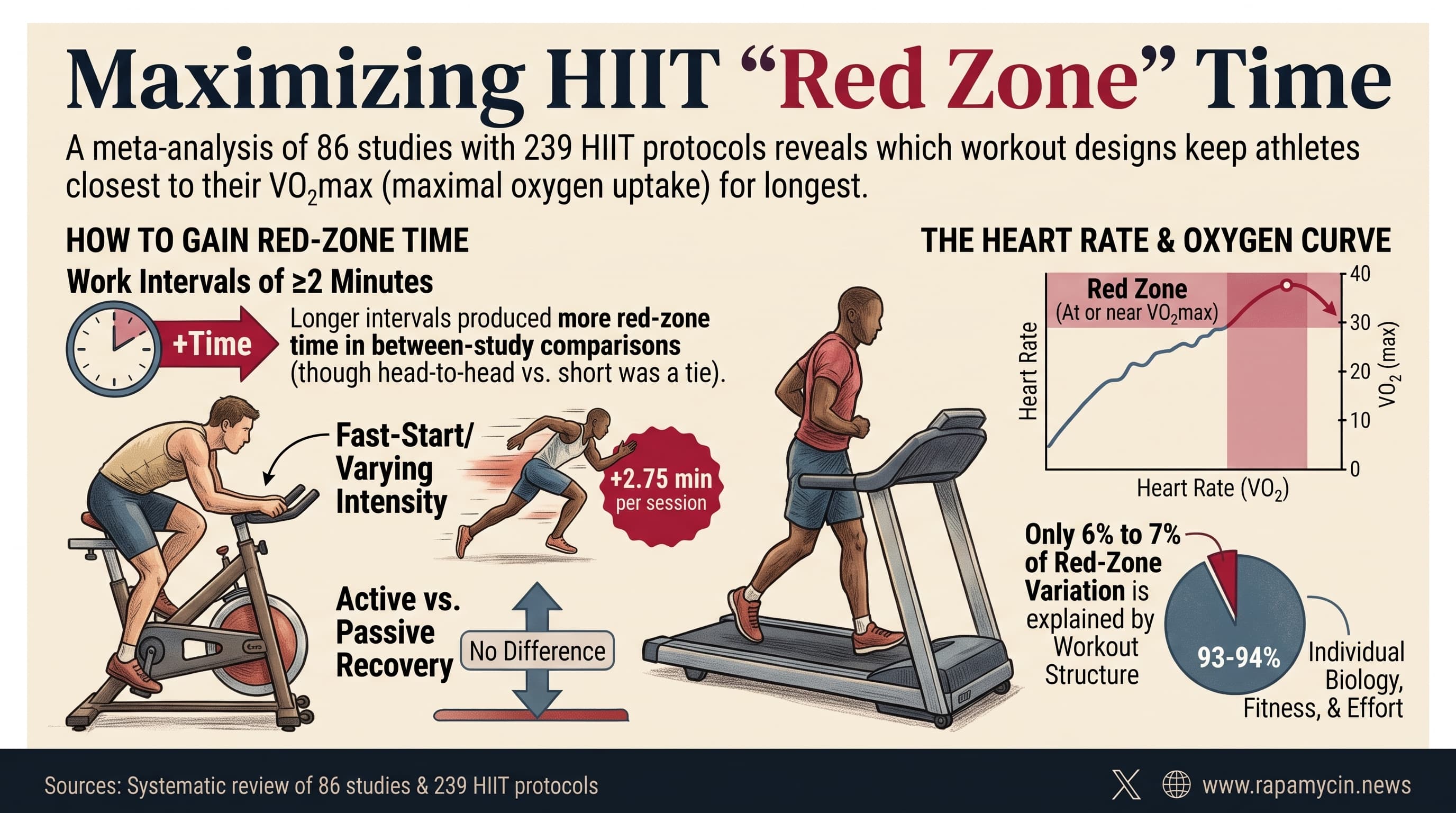
This systematic review and meta-analysis pooled 86 studies covering 239 high-intensity interval training (HIIT) protocols to find which workout designs keep people closest to their maximal oxygen uptake (VO2max) for longest, a measure called time at VO2max, or “red zone” time. Work intervals of 2 minutes or longer produced more red-zone time than shorter intervals in between-study comparisons, and varying intensity within each interval (especially starting fast) added about 2.75 minutes per session. Whether recovery between reps was active or passive made no difference. However, workout structure explained only about 6 to 7 percent of the variation in red-zone time, the head-to-head comparison of long versus short intervals was essentially a tie.

If you have ever ground through a set of intervals and wondered whether the suffering was paying off, a new analysis offers a partial answer. The payoff, it suggests, depends less on how hard you go than on how you arrange the effort.

Researchers led by the University of Essex pooled 86 studies covering 239 different interval workouts in running, cycling, rowing, swimming, kayaking and cross-country skiing. Rather than tracking fitness over months, they measured something more immediate: how many minutes each workout kept people near their VO2max, the ceiling of the body’s aerobic engine. Exercise physiologists call this the red zone, and many coaches treat it as the active ingredient of interval training. The logic is that the heart, lungs and muscles adapt most when pushed to their limit, so more time there should mean a stronger signal.

Three practical patterns emerged. First, intervals of two minutes or longer kept people in the red zone longer than short sprints or one-minute efforts. Long-interval sessions averaged a little over 9 minutes at or above 90 percent of VO2max, compared with about 5.5 minutes for shorter formats. Part of that gap reflects the fact that long-interval sessions also contained roughly twice as much total hard work.

Second, varying the effort within each interval helped. Starting each rep hard and then easing off, or adding surges to a steady effort, added close to three minutes in the red zone compared with holding a perfectly even pace. A fast start drives oxygen uptake up quickly, and the surges appear to recruit more fast-twitch muscle fibers, which raises oxygen demand.

Third, and perhaps most liberating, recovery style did not matter. Easy jogging or pedaling between reps did not keep oxygen uptake higher than simply standing or walking. In sessions taken to exhaustion, passive rest let people complete more reps and accumulate more total time at high intensity.

The catch is that red-zone time is a stand-in, not an outcome. The authors state that the link between minutes near VO2max and real fitness gains is shaky. In one study, cyclists doing short intervals improved VO2max by 6.3 percent despite spending less time in the red zone than a long-interval group that gained only 3.3 percent. Workout design explained only about 6 to 7 percent of the variation in red-zone time; the rest came down to the individual, the equipment and how researchers crunched their data.

There is also a tension inside the paper. When long and short intervals were compared directly in the same people, the long-interval advantage essentially vanished. Well-built short-interval sets, such as 30 seconds hard and 15 seconds easy repeated in blocks, matched long intervals.

Why should anyone not chasing race times care? VO2max is one of the strongest predictors of lifespan in large population studies, and in one major clinic cohort, low fitness carried a death risk comparable to smoking. Raising it in midlife is among the most dependable interventions available. Yet nearly everyone in these studies was a fit young man. Women made up about one in ten participants, and almost nobody was older than 50.

The take-home is sensible but modest: longer, front-loaded intervals with easy rest are a solid default, but the red zone is a guide, not a guarantee.

Actionable Insights

Use 3 to 5 minute work intervals as your default (the classic 4x4 format: four 4-minute hard efforts with 3 minutes easy). Across studies these produced about 9.3 minutes at or above 90 percent of VO2max, versus about 5.5 minutes for shorter formats, a moderate effect (Hedges’ g of 0.87 to 1.06). Put plainly, a typical long-interval session beats a typical short-interval session on red-zone time roughly 73 to 77 percent of the time.

Start each interval hard for the first 30 to 60 seconds, then settle. This added about 165 seconds (between 97 and 223 seconds) of red-zone time, a moderate effect (standardized difference 0.80; wins about 71 percent of the time).

Rest however you like. Active versus passive recovery made essentially no difference (standardized difference of -0.15, statistically indistinguishable from zero). In sessions to exhaustion, passive rest added about 5.5 minutes of high-intensity time because people could complete more reps.

If long reps feel unbearable, blocks of 30 seconds hard and 15 seconds easy are a reasonable substitute.

Why bother: each 1-MET gain in fitness (3.5 ml/kg/min) is linked to about 13 percent lower all-cause mortality in observational data. For someone at 35 ml/kg/min, that is a 10 percent improvement. Get medical clearance first if you are older or have heart disease; this paper contains no data on either group.

Context and Source

  • Open Access Paper: Time spent at or near VO2max during high-intensity interval training: a systematic review and meta-analysis
  • Institutions: University of Essex (lead); Edinburgh Napier University; Mountain Bike Centre of Scotland; University of Regina; independent researcher, Juiz de Fora
  • Country: United Kingdom (lead), with Canadian and Brazilian contributors
  • Journal: BMC Sports Science, Medicine and Rehabilitation, 2026
    Impact evaluation: The impact score of this journal is 3.4 (2025 Journal Impact Factor, Clarivate JCR released June 2026, up from 2.8 the prior year), evaluated against a typical high-end range of 0-60+ for top general science, therefore this is a Low impact journal. Within sports science and rehabilitation it is a respectable mid-tier, fully open-access specialty title, and its JCR listing places it in the upper half of its category.

Related Reading:

4 Likes

I would add one note of caution. For older exercisers, be careful with extreme protocols like SIT. It might be just me, but in my experience, after the age of about 65, initiating SIT was associated with muscle injuries. I would do 2 sessions a week of sprint interval training (SIT), and quite often, during the second session - sometimes it would take 2 weeks - I would pull a muscle at the start of the run, either the hip flexor or one of the thigh muscles. Let me emphasize one thing very strongly - I was in good shape before attempting the SIT, both aerobically and anearobically. I was a regular jogger logging in 200+ minutes a week, with very good conditioning, and for legs - extensive squatting sessions as well as exercises with elastic bands specifically targetting hip flexor muscles. So it wasn’t because my muscles were untrained or my aerobic capacity was poor. However, explosive SIT initiation and all out tempo would result in muscle injuries - very inconvenient as it would sideline me from further SIT/HIIT sessions for quite a while. This wouldn’t happen to me when I was younger (up to about 60-65). Now, maybe you don’t have these issues - in that case more power to you and you can ignore this post - but in case you are over 60, it’s something you might take into consideration.

As a result I have adopted a different protocol - and I write this post, because by an amazing coincidence, it shares certain characteristics with the study above.

My new protocol, which I adopted some 4 months ago, now has me doing all 4 of my weekly run/jog sessions with this new scheme. I do 3 miles in total (compared to 4 before), each segment (lap around a running track) is about 1/4 mile - I start off with one light jog lap (1/4 mile), the second I start off with a semi-HIIT run at about 85%-95% of max effort for some 30 seconds with the subsequent 15 seconds or so of slower tempo of about 65%-75% effort which covers half a lap (about 1/8 of a mile), then I slow to a rapid walk tempo for the other half of the lap (about 1/8 of a mile), and repeat on lap #3, and so on for 12 laps. Total high effort run (85%-95%) is about 5-6 minutes, the 65%-75% part of the run total is about 3 minutes - so the total run is some 8-9 minutes, with rapid walking the rest of the time (exactly half the total distance of the workout). And this is 4 times a week (sometimes 3 if something comes up). This I feel is sustainable at my age - although I’m not excluding the possibility of returning to SIT, but I’d do it much more gradually, by escalating the explosive run from 90% to 100% effort in a span of a couple of months, hoping my muscles adjust before trying the 100% SIT protocol again.

Of course, I still do my regular squat sessions.

I feel I need to adjust my exercise protocols as I age - others may feel differently, but that’s been my experience. YMMV.

5 Likes

My own general experience is that doing twice a week SIT running at my age (early 70’s) is by definition a delayed injury that will happen. Once a week on grass seems a lot more reasonable. But I do think your new protocol as it applies to running works well. My own general running training is primarily targeting a 5k race distance. I personally think doing 4 x 880 or 440 intervals is more stressful than doing a longer distance (like 1 mile) at a slightly slower 5k pace. It just feels less jarring. And that is what I see with your new protocol.

As far as dealing with tendon/ligament/and cartilage issues, I am evangelistic about Dr. Kevin Baar’s deep research into the mechanics of coming back from injuries to these tissues and also bullet proofing them for a high stress activity like SITS. All my strength exercises are complemented in some fashion with isometrics now. My run times are declining but at a rate significantly less than my peers. (Or the number of running participants just fall off a cliff after 65 - a big thing to note. They go into other sports like biking or swimming and leave running behind. )

I find there is a scarcity of research or even sound anecdotal accounts of how to train effectively and safely for high impact sports like running for the older athlete. A lot of platitudes exist, like you need more time to recover, but not much sound reasonable science. If anything, the aging process makes each of us a unique individual outlier to the research covering younger cohorts.

3 Likes

For me, SIT works great. After a short warm-up, I start explosively at 100% on a stationary bike, all-out with power starting to slowly decline after 9-10 seconds but I continue with maximal effort. After 20 seconds, easy peadlling for two minutes with pulse returning to resting state, then another 20 seconds all-out. Then 80 minutes of mainly resistance training, with repetitions to failure that yield heavy panting though not like SIT. Twice a week, so 80 seconds of SIT. Done this for ~ 10 years, never any problem and at 79 I am increasing VO2MAX slightly every year

This regime ups VO2MAX similarly as 4x4 minute protocols at 80% effort, as per the link (reduced exertion meaning shorter time, REHIT is SIT)

Reduced-exertion high-intensity interval training (REHIT): a feasible approach for improving health and fitness?

Richard S Metcalfe et al. Appl Physiol Nutr Metab. 2024.

1 Like

I am impressed Ulf! Particularly increasing VO2 max over the years rather than the “predicted” decline.

Do you think you could do the same SIT weekly workouts running (instead of biking)? I find the impact catches up with me and I need more recover time.

I do sprint interval training (SIT) on treadmills, and the foot / knee impact seems much lower than running on trails or tracks.

1 Like

To be clear SIT is “sprint interval training”, and running is very different than doing it on a bike. Looking at my injuries from SIT - in particular hip flexor muscle being pulled, it seems very different when running and on a bike. On a bike you are primarily pushing on a pedal, not lifting the pedal - by pushing on the pedal, you are automatically getting the other leg lifted just by bike mechanics - theoretically you need zero hip flexor involvement. Meanwhile in explosive sprints when running, a violent lifting of the legs is part and parcel of running mechanics. Therefore, while arguably there may be no difference between SIT on the tracks versus on a bike when it comes to aerobic conditioning and therefore impact on VO2MAX, there are profound differences in musculature impact - and leg muscles are only part of that, there are other muscle differences too wrt. engagement, not to mention bone and ligaments of running vs biking. I believe running SIT is much more prone to injury than bike effort at 100%. But of course, congrats to Ulf for being able to do this at his age and still gaining VO2MAX - nothing but kudos, my full admiration.

2 Likes

A summary:

For decades, public health guidelines have repeated the same standard formula: individuals must accumulate at least 150 minutes of moderate continuous exercise or 75 minutes of vigorous exercise each week to preserve cardiovascular health and optimize lifespan. Despite these warnings, long-term adherence remains remarkably low, with perceived lack of time routinely cited as the primary obstacle. In a comprehensive review, exercise physiologists Richard Metcalfe and Niels Vollaard challenge the dogma that cardiometabolic protection requires prolonged physical exertion. Their analysis reveals that a minimal protocol comprising just two 20-second supramaximal sprints embedded within a gentle 10-minute cycling session can generate the bulk of the physiological adaptations previously attributed only to extended aerobic workouts.

The mechanistic principle underlying this approach, known as Reduced-Exertion High-Intensity Interval Training, relies on acute homeostatic disruption rather than continuous volume. Standard endurance exercise alters cellular energy states slowly and mildly, requiring substantial duration to force biological adaptation. In contrast, an unconstrained all-out sprint unleashes an immediate metabolic crisis. Intramuscular adenosine triphosphate falls by roughly 50 percent within 30 seconds, phosphocreatine rapidly depletes, and stored glycogen plunges by up to 30 percent. Peak mechanical power outputs during these sprints reach 500 to 1000 watts, exceeding an untrained individual’s maximal aerobic power by several fold. This acute crisis triggers powerful signaling pathways, marked by immediate AMP-activated protein kinase phosphorylation and an extraordinary 15-fold surge in PGC-1alpha gene expression, the master regulator of mitochondrial biogenesis.

Crucially, the authors demonstrate that repeating these sprints four to six times, as demanded by classic interval protocols,provides no meaningful additional adaptive benefit. The biological threshold required to stimulate cardiovascular and mitochondrial remodeling is fully triggered within the first two sprint efforts. Across multiple randomized controlled trials, previously sedentary adults who performed two 20-second sprints two to three times per week gained an average 10 percent improvement in maximal oxygen uptake over six weeks. This rate of adaptation matches or exceeds the fitness improvements achieved by cohorts performing 45 minutes of continuous moderate cycling or brisk walking.

Central adaptations also explain these gains. Recent right-heart catheterization data confirm that the intense metabolic stress of REHIT triggers rapid fluid shifts and significant plasma volume expansion, increasing venous return, cardiac stroke volume, and systemic oxygen delivery. Furthermore, the researchers demonstrated that sedentary office workers could perform this routine unsupervised in ordinary work clothes without generating significant perspiration or requiring showers. While metabolic endpoints such as insulin sensitivity show variable responses across different sexes and populations, the cardiorespiratory fitness gains remain reliable. By compressing effective exercise to 40 seconds of actual work, the authors establish a new minimal biological threshold for human cardiovascular conditioning.

Actionable Insights

This research demonstrates that you can achieve meaningful cardiovascular fitness improvements with a remarkably modest time commitment. The validated protocol requires a stationary cycle ergometer twice weekly for 10 minutes per session. The routine consists of several minutes of low-intensity pedaling, a single 20-second all-out sprint against braking resistance, three minutes of slow pedaling recovery, a second 20-second all-out sprint, and a brief cool-down.Active pedaling during the recovery phase is essential to maintain the venous muscle pump and prevent post-exercise lightheadedness.

In real-world terms, this routine produces an average 10 percent gain in maximal oxygen uptake over six weeks, which equates to an absolute increase of approximately 3.5 milliliters of oxygen per kilogram per minute in previously sedentary individuals. In clinical medicine, this improvement represents one full metabolic equivalent (MET). Large prospective cohort studies establish that every 1 MET increase in cardiorespiratory fitness reduces all-cause mortality by 11 to 15 percent, establishing a standardized effect size of Cohen’s d between 0.60 and 0.80. However, this protocol does not induce meaningful caloric expenditure or fat loss on its own, nor does it replace the structural and bone-mineral benefits of progressive resistance training.

1 Like

I do my sprintervals on an elliptical machine as a whole-body exercise which includes arms/legs and push/pull all at once, all while being safe on the joints due to essentially zero impact.

4 Likes

I tried all~out 20 second sprints running outside a few times… I believe I was quite close to but perhaps not quite at the effort at the stationary bike. Maybe because the explosiveness in the first seconds may be more powerful at the stationary bike with it’s resistance that I have set for best effect. But I am uncertain I will read my pulse on my whoops to compare next time.

I prefer the bike because I can see the power number and I feel more in control. I reach maximum after two to three seconds hitting at or just above 100 whatever the number stands for, can only keep that for a few seconds… Then it slowly reduces and I pedal like my life depends on it to minimize the reduction.Approaching the end the reduction goes faster and I end at around 82, 83 when the 20 seconds have passed. A few months ago it was around 97 max ending at 78, 79 at the same resistance so very slowly I am gaining.

I have never heard anyone at the gym pant like me after the SIT. Afterwards I do some non-strenuous agility exercises before moving on the bar- and dumbbells, chins etc going to failure on each, targeting each muscle group.

SIT is so much easier than the for me unbearably tedious 4x4 minute 80% effort. I believe it has to be 100 % to replicate the VO2MAX benefit of the latter 98 % isn’t enough. It’s the short time that makes it so appealing and with the demand for 100 % there is no way you can miss it, all-out can only be all-out.

4 Likes

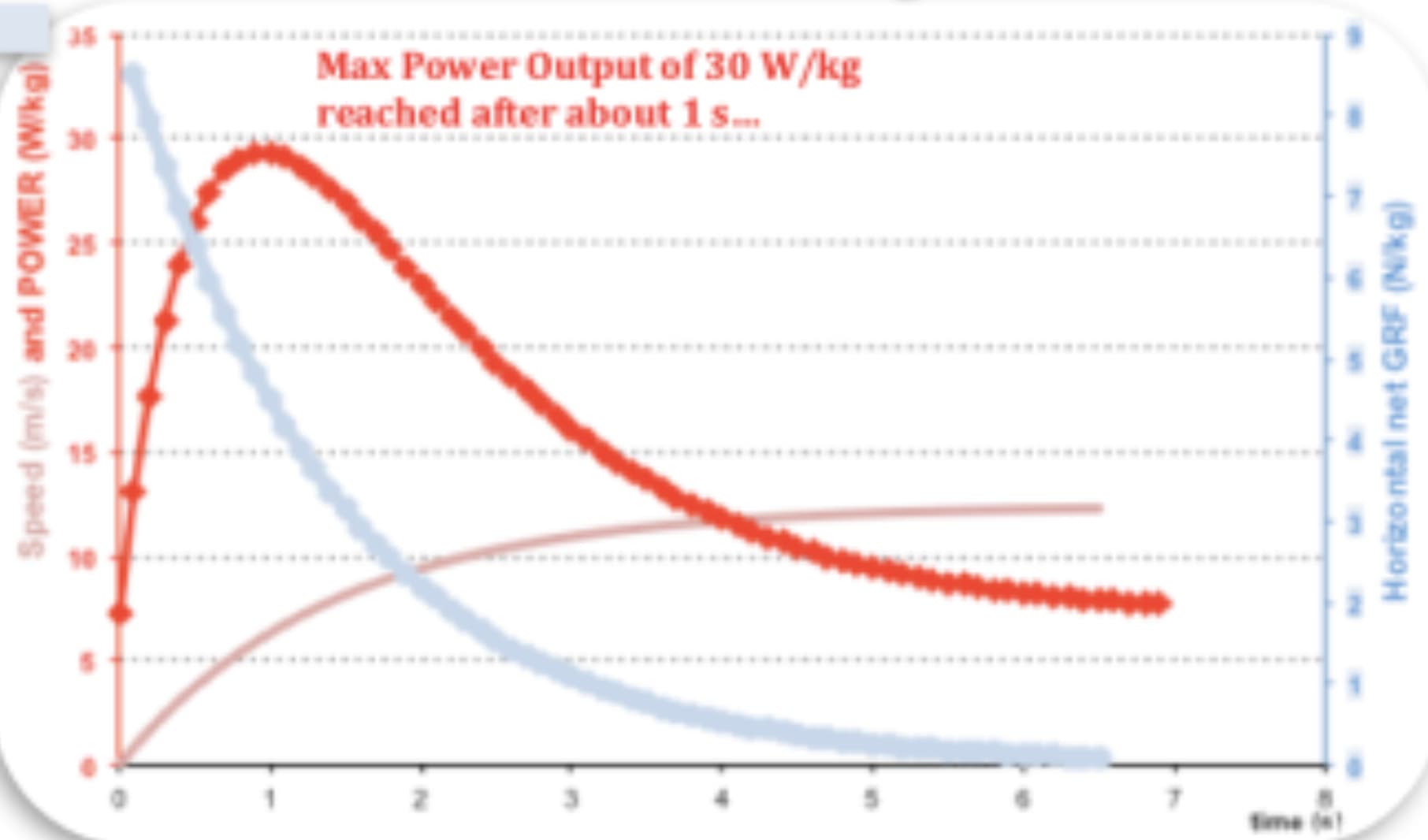
Uphill sprints and resisted sprints are safer training options because they produce a lower limb velocity and longer ground contact time for the same amount of generated power. The lower angular velocity is the most protective against hamstring and groin injuries.

In fact they are even much better because otherwise the acceleration phase is only 20 to 30 m and after you just cruise at high speed but without generating horizontal force and your power output is much lower. Basically about 2 to 3s at max power only.

Usain Bolt’s 100-m record force-velocity-power profile:

2 Likes

I used to run, at a steady pace (not fast), for about an hour. Occasionally I would do intervals as I heard how good they are. When I turned 70 I stopped running altogether because I didnt like how I ached after.

Shortly after that I tried jumping rope. In a short few months I learned to love this for a number of reasons.

The first is the joy of being able to go from being profoundly uncoordinated in the movement to begin to succeed and flow.

I watch jumprope videos on youtube and when I see the experts do a cool looking trick I try to learn it. This is the second thing I love. It works my brain hard to get the movement coordinated so I can do the trick. It usually takes me a week to learb a new trick. Working my brain to connect to my body parts is fantastic. Running (or bicycling) was never like that. Now a new trick starts with me feeling like a stroke victim but with a few days of practice it clicks and I can do it without thinking.

So, its good cardio exercise, it works my brain, and last thing, it’s actually HIIT training.

At first I couldn’t last 1 minute. I go steady with an alternating foot (boxers step) and when I progressed to 2 minutes I was hitting my h/r max. Now, a year later, I’m well over 3 minutes to hit my max and I can hold it for 15 to 20 seconds.

Anyway if anyone of you hate SIT or HIIT like I do you might try jumprope and work your brain while you’re at it.

6 Likes

Ulf, I am curious – do you have an estimate on your current VO2max? If you do, would you mind sharing it? I’m curious as to what’s possible on this ultra-minimalist protocol; I might want to try this myself.

1 Like

Sure. My latest VO2 max is 35.8 mL/kg/min. 3% higher than the one 18 months earlier, which in turn was slightly higher than the one before, etc. All measured in laboratory testing with mask. At 79, this currently makes me like an average 48-year old and, extrapolating from the trend for the 70-79, in the top 8 % of the 79-year olds. My aim is to slowly but successively increase VO2 max for at least another 10-15 years. Absent injury or disease, I can´t see any reason why this can´t happen.

The research by Vollard´s team showing these short sprints equal long intervals at less than 100% in raising VO2 max is solid. It´s just not widely known, old dogma hang around for long.

From Perplexity Pro

For men, typical VO₂ max decreases with age. The table below shows median values—the middle result, rather than the arithmetic mean—from the widely used US FRIEND reference dataset. All values are in mL/kg/min and come from laboratory treadmill testing.welltory+1

Age Typical value (50th percentile) 75th percentile: higher than 75% of peers 90th percentile: top 10%
20–29 48.0 55.2 61.8
30–39 42.4 49.2 56.5
40–49 37.8 45.0 52.1
50–59 32.6 39.7 45.6
60–69 28.2 34.5 40.3
70–79 24.4 30.4 36.6
3 Likes

Here is another training regime to get to high VO2max.

I’m 65, my VO2max is 52 (as measured on a bike in a Lab this year) - which according to Ulf’s table is Top 10% for a 40-49year younger males.

My Training regime is very simple, I cycle at a minimum of 1,000Km a month, mostly alone and relaxed zone2 and when there is a hill I push a little bit. 25% of the time I cycle with my wife who also has a racebike. My outdours tour is mostly 55km (with 350hm) and occasionally I do 70km (with 550hm)
On rainy days I cycle indoors (while watching youtube), for 70 minutes which I account for as a 35km equivalent.
On a monthly basis I spend about 40-50 hours on my bike
(I also do morning yoga and some weights and on days I don’t cycle I go for a walk in the afternoon with my wife, between 6 and 11km, but I think these activities don’t move VO2max much)

5 Likes

jaakdefour´s method appears to have awsome results, my congratulations, he sure beats me! The time involved makes it impossible for me to contemplate, and crucially, he started at an earlier age. My only regret is that I didn´t know about the sprints decades earlier and only started at an age-caused low VO2 max.

But no worries, my 35.8 combined with muscular strength is enough to let me do everything that I want to do physically. Carrying heavy stuff, lifting my grandchild, steep long climbs on mountains, 20-km fast walks in the tropical rain forest, a sprint to catch the metro train. It´s liberating and means freedom.

It´s a great pity that most seniors let their VO2 max and strength decline. Maybe we will all utlimately arrive at that declining stage but let´s aim for a very high age before it happens.

4 Likes

I’ve been racewalking since the age of 30 (when it was more of a thing). I find at 70, it is still seems to be an ideal HIIT training protocol. Almost guaranteed to be injury-free. Easy to hit max heartrate. Only downside – can be tricky to learn.

3 Likes

Well I never race walked until about 6 months ago when my wife decided that HIIT on a treadmill (running) involved some injury risk - like from a fall. So I started high incline at 4.5 mph which isn’t quite race walking but gets me to exhaustion.

The high incline did cause some calf issues initially but I am over it mostly. I still switch machines after two 4 min intervals to mix up the muscle stress.

1 Like

What is your typical speed when racewalking? In the past, and now at age 70? I’m just curious what speed is considered “racewalking” - though I know from seeing people with who are doing it what it looks like (a very atypical style and speed of walking).

This is a really good way for anyone to ease into HIIT training without the injury risk, I think. There is a whole trend of the 12 / 3 / 30 treatmill workouts now - 12 degree, 3 miles per hour, for 30 minutes, then adjust as you see fit (e.g. higher angle, faster speed, etc.). I sometimes do 14 or 15 degrees, 4.5 or 5 miles per hour for 30 or 40 minutes and it definitely gets you sweating, and your heart rate up.