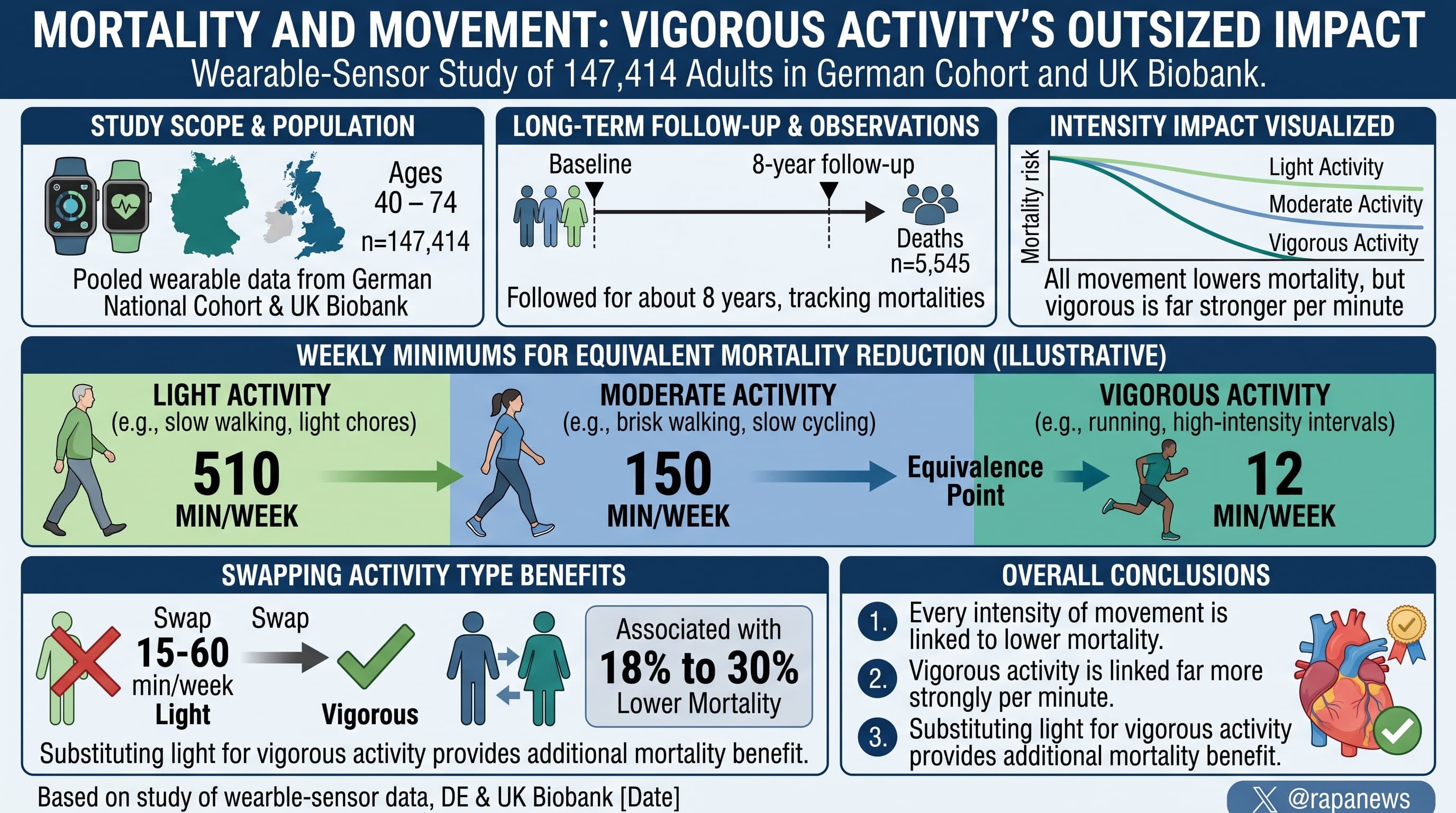
Researchers pooled wearable-sensor data from 147,414 adults aged 40 to 74 in the German National Cohort and UK Biobank and followed them for about eight years, during which 5,545 died. Every intensity of movement was linked to lower mortality, but vigorous activity was linked far more strongly per minute. Statistically, about 12 minutes a week of vigorous activity carried the same mortality association as 150 minutes of moderate or 510 minutes of light activity. Swapping 15 to 60 minutes a week of lighter activity for vigorous activity was associated with 18 to 30 percent lower mortality. The study is observational, and several of its headline numbers rest on comparisons with people who barely move at all.
Public health guidelines treat one minute of vigorous exercise as worth two minutes of moderate exercise. That ratio comes from laboratory estimates of energy cost, not from data on who lives and who dies. A German-led team has now tested it against the largest pooled set of accelerometer recordings assembled so far, and the result is nowhere near two to one.
The researchers combined two cohorts. About 52,000 Germans wore a motion sensor on the hip for a week. About 95,000 Britons wore one on the wrist. Each minute was classified as light, moderate or vigorous movement according to how hard the sensor was shaken. Participants were then tracked through death registries for an average of 7.9 years.
All three intensities were associated with lower death rates, and for each the curve fell steeply at the low end and flattened out. The differences lay in how many minutes it took. Compared with none, 150 minutes a week of moderate movement was associated with 30 percent lower mortality. Reaching the same figure took roughly 510 minutes of light movement, or about 12 minutes of vigorous movement. On that reckoning a vigorous minute counts for about twelve moderate ones, six times the guideline ratio.
The team then asked a different question. Suppose a person keeps total active time the same but shifts some of it up a gear. Moving 60 minutes a week from light to moderate was associated with about 11 percent lower mortality. Moving 15 to 60 minutes from light or moderate into vigorous was associated with 18 to 30 percent lower mortality. People who logged any vigorous movement at all had about one third lower mortality than people who logged none.
The pattern appeared in both countries and with both sensor positions, which makes it unlikely to be an artifact of one device. It also survived dropping the first one to five years of deaths, a standard check against the possibility that illness was suppressing activity.
The size of these effects is the main reason for caution. In the German cohort, the typical person with any vigorous movement recorded 1.6 minutes of it per week. A third lower mortality from under two minutes of weekly effort is not a plausible training effect. A more likely reading is that a sensor registering vigorous movement identifies a person who is still capable of it. People who never climb stairs briskly or hurry for a bus are, on average, frailer and sicker in ways that the adjustment variables capture only partly.
The authors acknowledge this. They state that the equivalences are statistical and not physiological, that 2 minutes should not be read as an effective dose, and that the design cannot establish cause. The study strengthens the case that intensity matters more than guidelines assume. It does not show that twelve hard minutes a week can replace regular exercise.
Actionable Insights
The reasonable takeaway is to include some hard effort in the week, and to treat the exact minute counts with skepticism.
- Any movement beats none. The steepest drop in risk came from leaving the least active range, at every intensity.
- Intensity appears to count for more than the official 2-to-1 rule. In this data a vigorous minute was associated with as much benefit as roughly 12 moderate minutes or 40 light minutes. The true causal ratio is probably smaller.
- Effect size in plain terms. A hazard ratio of 0.70 means 30 percent fewer deaths per year of follow-up. About 3.8 percent of participants died over eight years. Applied to that average, a 30 percent relative reduction is roughly 1.1 fewer deaths per 100 people over eight years, and an 18 percent reduction is roughly 0.7 fewer. These are my calculations from the reported totals. The paper gives no absolute risks.
- Do not treat 12 minutes a week as a prescription. It is a point on a fitted curve, not a tested dose.
- Practical route: add short bursts that make conversation difficult, such as fast uphill walking, stairs or intervals, to activity you already do. Controlled trials show that vigorous training improves aerobic fitness, and fitness is a strong predictor of survival.
Context/Source
- Open access paper: Intensity-specific physical activity and mortality in 147,414 adults: a pooled accelerometer analysis, Published: 15 September 2026
- Lead institutions: Department of Epidemiology and Preventive Medicine, University of Regensburg, and Institute of Epidemiology, Helmholtz Zentrum München, with numerous German partner centres and IARC (Lyon)
- Country: Germany (data from Germany and the United Kingdom)
- Journal: International Journal of Behavioral Nutrition and Physical Activity
- Impact evaluation: The impact score of this journal is 7.1, evaluated against a typical high-end range of 0–60+ for top general science, therefore this is a Medium impact journal.