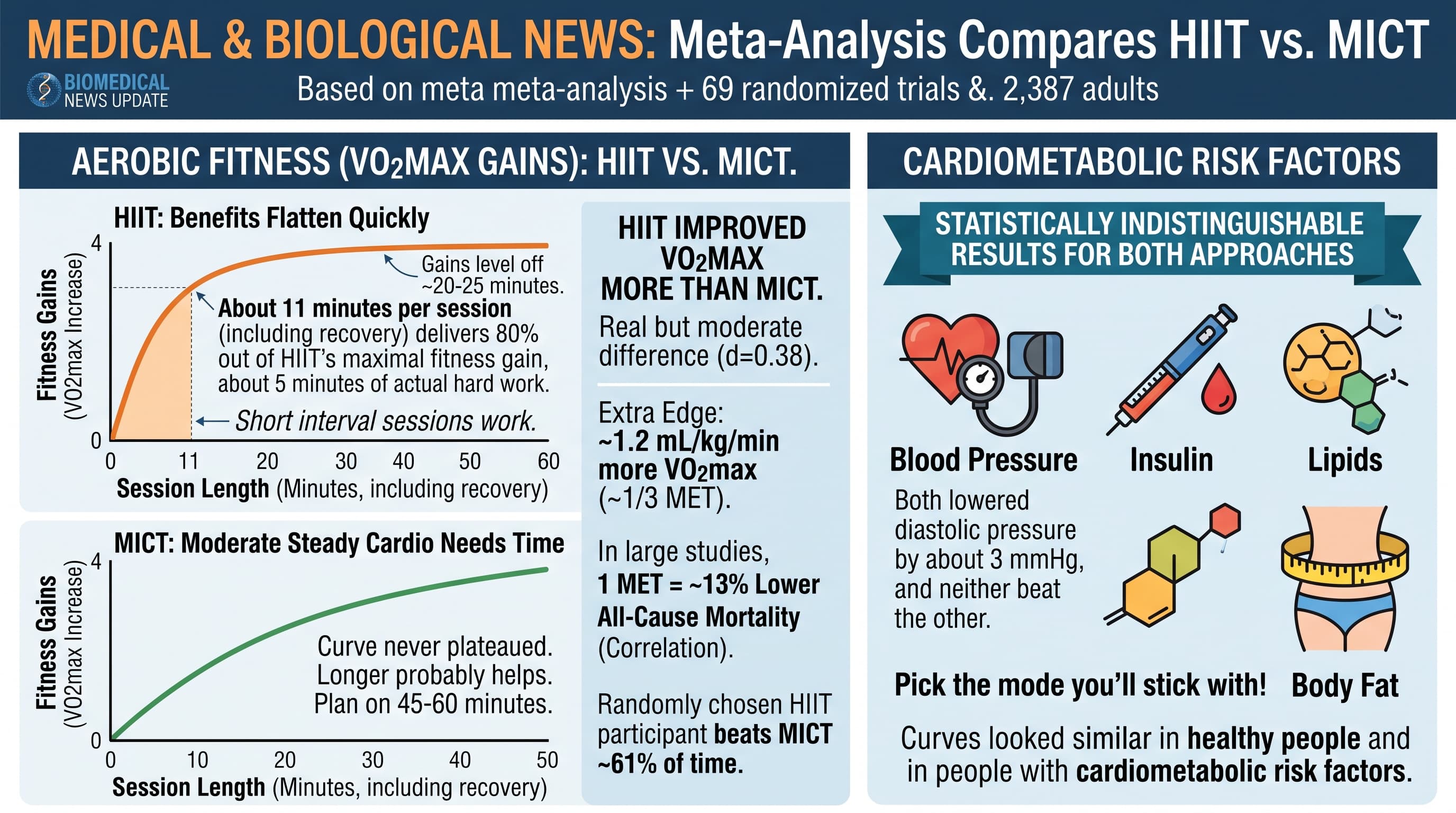
A meta-analysis of 69 randomised trials (2,387 adults) mapped how session length relates to fitness gains for high-intensity interval training (HIIT) and moderate-intensity continuous training (MICT). HIIT improved VO2max more than MICT, and its benefit curve flattened quickly. About 11 minutes per session, including recovery intervals, delivered 80% of HIIT’s maximal fitness gain. That is roughly 5 minutes of actual hard work. MICT needed about 52 minutes for a similar gain, and its curve never plateaued. For blood pressure, insulin, lipids and body fat, the two approaches produced statistically indistinguishable results. The curves looked similar in healthy people and in people with cardiometabolic risk factors.
For decades, exercise advice has been framed in minutes: 150 a week, 30 a day, more if you can. This analysis asks a sharper question. How many minutes does each session actually need to be, and does the answer depend on how hard you work?
Researchers from Tübingen, Liverpool and Nijmegen pooled 69 randomised trials that pitted interval training against steady moderate exercise. They then used dose-response modelling to trace how fitness gains change as sessions get longer. Fitness was measured as VO2max, the maximum rate at which the body can use oxygen. VO2max is one of the strongest single predictors of mortality in epidemiology.
Both styles of training worked. Interval training raised VO2max by about 4.4 mL/kg/min on average and steady training by about 2.6. The more interesting finding is the shape of the curves. Interval training showed steep early returns followed by a plateau. Half of its maximal benefit came from sessions under 6 minutes, 80% from about 11 minutes, and there was little extra gain beyond roughly 23 minutes. These times include the rest periods between efforts. Counting only the hard efforts, 80% of the benefit arrived with about 5 minutes of work per session, or about 15 minutes of work per week.
Moderate continuous exercise behaved differently. Its benefits rose in a straight line: every extra minute bought a bit more fitness, up to the longest sessions studied (about an hour). It needed roughly 52 minutes per session to match what intervals achieved in 11, which is the 4.6-fold time saving the authors emphasise. Because the MICT line never flattened, nobody yet knows where its ceiling sits.
The time advantage did not extend to metabolic health. Blood pressure, fasting insulin, triglycerides, BMI and body fat improved modestly with both approaches, and the two did not differ. A higher VO2max did not come with better blood markers. The authors suggest that VO2max depends mainly on the heart’s pumping capacity, which responds strongly to intense efforts. Metabolic markers, by contrast, respond to total energy expenditure and fuel depletion, which either approach can deliver.
The dose-response pattern was also similar in healthy volunteers and in people with overweight, prediabetes, metabolic syndrome or high-normal blood pressure. Baseline fitness and age did not change the results either. That matters because short interval protocols are often assumed to suit only fit, young people.
The caveats are substantial. No trial randomised people to different session lengths. The curves come from comparing different studies that happened to use different durations, so length is tangled up with intensity, interval structure and population. Most participants were sedentary or unfit, most trials lasted about 10 weeks, and none measured hard outcomes like heart attacks or death. The “11 minutes” figure has a 95% confidence interval stretching to 40 minutes.
What the paper shows is that for a time-limited person, intensity buys fitness more efficiently than duration, and the returns from longer interval sessions shrink quickly. It does not show that 11 minutes of intervals is all anyone needs for overall health.
Actionable Insights
- Short interval sessions work. If you’re doing intervals, gains in aerobic fitness largely level off around 20 to 25 minutes of work plus recovery. About 10 minutes, with roughly half of it at hard effort, captures most of the benefit for an unfit or moderately fit adult.
- Moderate steady cardio needs time. Plan on 45 to 60 minutes per session to approach similar fitness gains. Longer probably still helps.
- Expect a real but moderate difference. Across trials, HIIT raised VO2max by about 1.2 mL/kg/min more than MICT, roughly a third of a MET. In large observational studies, each 1 MET of fitness is associated with about 13% lower all-cause mortality. That puts HIIT’s extra edge in the range of a 4% lower mortality risk, and the full HIIT gain (about 1.25 METs) around 15%. These are correlations, not proven effects. In statistical terms, the between-group difference is small (d = 0.38): a randomly chosen HIIT participant beats a randomly chosen MICT participant only about 61% of the time.
- For blood pressure, insulin and lipids, pick the mode you’ll stick with. Both lowered diastolic pressure by about 3 mmHg, and neither beat the other.
- Mixing both across the week is a reasonable, evidence-compatible approach.
Context and Source
- Open Access Paper: Optimising Exercise Prescription: A Meta-Analysis Examining the Dose Response of Exercise Duration on Cardiorespiratory Fitness Following HIIT and MICT
- Journal: Sports Medicine (Springer), published online 12 September 2026.
- Institutions: University Hospital of Tübingen and Eberhard Karls University of Tübingen (Germany); Liverpool John Moores University and Liverpool Centre for Cardiovascular Science (UK); Radboud Institute for Health Sciences (Netherlands)
- Countries: Germany, United Kingdom, Netherlands
- Impact evaluation: The impact score of this journal is 11.0 (2025 Journal Impact Factor; 5-year JIF 13.7), evaluated against a typical high-end range of 0-16 for the sport sciences category (where the British Journal of Sports Medicine leads at about 15.5 to 16) and 0-60+ for top general science, therefore this is a High impact journal.