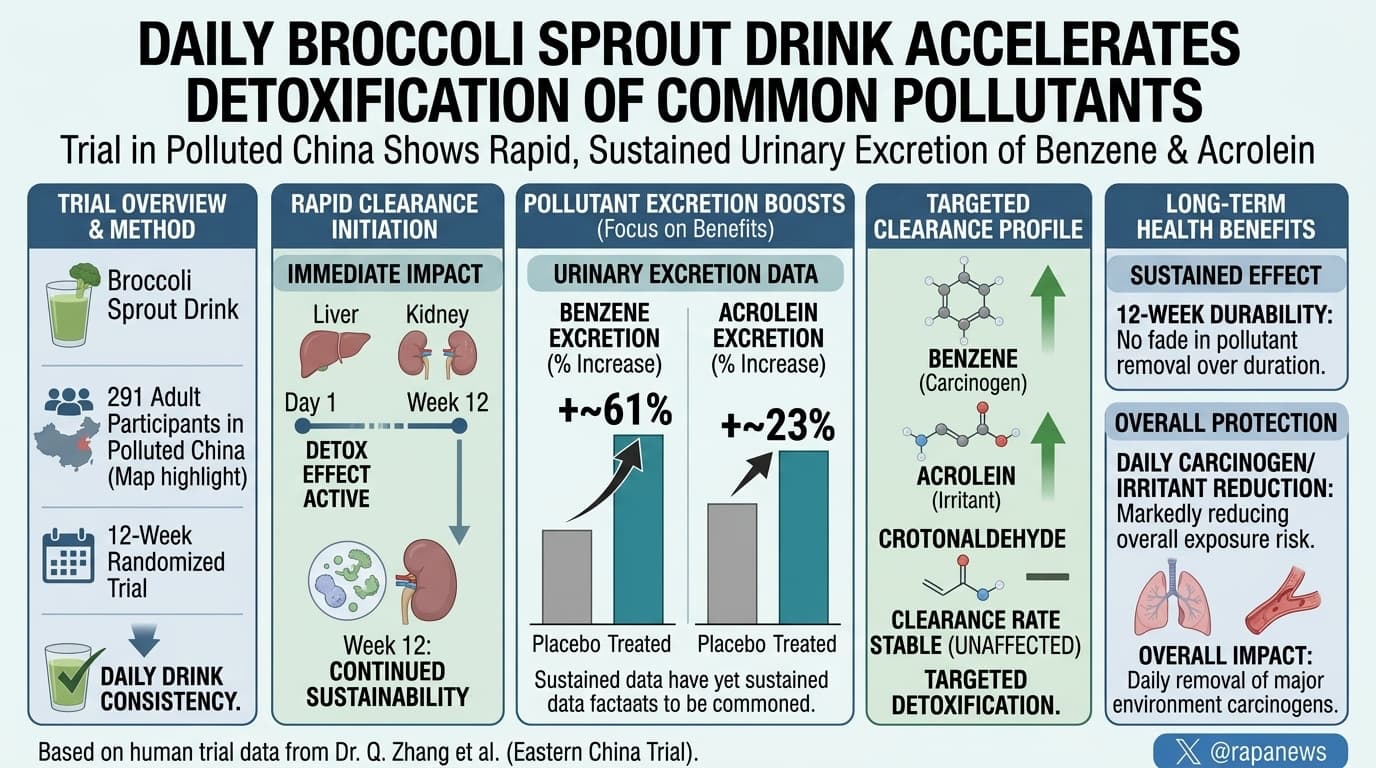
In a 12-week randomized, placebo-controlled trial of 291 adults living in a heavily polluted part of eastern China, a daily drink made from broccoli sprouts increased how much benzene (a known human carcinogen) and acrolein (a lung and blood vessel irritant) people eliminated in their urine. Benzene excretion rose by about 61 percent and acrolein by about 23 percent. The effect started on day one and did not fade over 12 weeks. A third pollutant, crotonaldehyde, was unaffected. The trial measured how fast people cleared these pollutants.
Qidong sits at the mouth of the Yangtze River. It is a farming district becoming an industrial one, and on many winter days the horizon disappears behind haze. People there breathe benzene, a proven human carcinogen, and acrolein, a reactive chemical that inflames airways and damages blood vessels. Few of them can move away or buy air purifiers. A team from Johns Hopkins, the University of Minnesota and the Qidong Liver Cancer Institute asked whether a cheap vegetable drink could help their bodies clear these chemicals faster.
The drink was made from three-day-old broccoli sprouts, which contain large amounts of glucoraphanin. When glucoraphanin is broken down, either by a plant enzyme or by gut bacteria, it yields sulforaphane. Sulforaphane is one of the most potent natural activators of NRF2, the master switch for the cell’s defensive enzymes. Among the genes NRF2 turns on are those that make glutathione and attach it to toxic molecules. The body then excretes those tagged molecules in urine as compounds called mercapturic acids.
In late 2011, 291 adults were randomly assigned to drink either the sprout beverage or a lookalike placebo every evening for 12 weeks while staff watched. Most were non-smoking women, with a median age of 53. Both drinks were flavored with pineapple and lime juice, which made this version far easier to swallow than earlier ones. Compliance was exceptional: 92 percent finished the trial, and more than half never missed a dose.
The results came quickly. From the first day, people on the sprout drink excreted about 61 percent more of the benzene mercapturic acid than the placebo group, and about 23 percent more of the acrolein version. The effect also did not fade. Many drugs lose potency as the body adapts, but here the gap held steady for all 84 days, even as regional pollution climbed about 2 percent per week into winter. Sulforaphane absorption held up too, and appeared to improve slightly over time, possibly because gut microbes adapted to the daily glucoraphanin.
Not everything worked. A third pollutant, crotonaldehyde, was unaffected, probably because human detoxification enzymes barely act on it. Genetics mattered as well. People carrying the GSTT1 gene excreted around 59 percent more benzene conjugate than people lacking it, a difference as large as the drink’s effect. The drink worked either way. A variant in the control region of the NRF2 gene appeared to strengthen the response, which hints that NRF2 is doing the work but does not prove it.
The big idea is that a food-derived compound can measurably speed up how people dispose of airborne carcinogens, and keep doing so for months. That matters for the hundreds of millions of people who cannot escape polluted air.
The study measured what people excreted, not what happened to their health. Nobody showed fewer cancers, less DNA damage or healthier lungs. The dose was also at the upper limit of what people tolerated, far above what a plate of broccoli delivers. A later trial by the same group found that half this dose did not produce a statistically significant effect. The drink is a promising lever, not yet a proven shield.
Actionable Insights
- High-dose sulforaphane can increase how fast your body clears benzene and acrolein. The drink supplied about 262 mg of glucoraphanin plus 7 mg of ready-made sulforaphane per day. Benzene clearance rose 61 percent. In plain terms, the typical person on the drink cleared more benzene than about two thirds of the placebo group, a modest effect (Cohen’s d about 0.45). Acrolein clearance rose 23 percent, a small effect (d about 0.2).
- The dose seems to have a threshold. In a 2019 follow-up trial, half this dose raised benzene clearance by only 11 percent, which was not statistically significant, and one fifth of the dose did nothing. Many commercial sprout or supplement servings supply less glucoraphanin than this trial used [Confidence: Medium]. Check the labeled glucoraphanin content and whether the product contains active myrosinase, the enzyme that converts it.
- Take it daily. The effect began on day one and lasted all 12 weeks with daily use.
- This benefit is on a biomarker, not a disease. There is no evidence yet that it lowers cancer risk or improves lung function.
- Cutting exposure, through air filtration, avoiding heavy traffic and ventilating gas stoves, remains the higher-yield step.
Context and Source
- Open Access Paper: Rapid and Sustainable Detoxication of Airborne Pollutants by Broccoli Sprout Beverage: Results of a Randomized Clinical Trial in China, (Note: This is a 2014 Paper)
- Institutions: Johns Hopkins Bloomberg School of Public Health and Johns Hopkins School of Medicine (lead), University of Minnesota Masonic Cancer Center, University of Pittsburgh, and Qidong Liver Cancer Institute
- Countries: United States and China
- Journal: Cancer Prevention Research (American Association for Cancer Research), 2014.
- Impact evaluation: The impact score of this journal is 4.9 (Scopus CiteScore), evaluated against a typical high-end range of 0 to 60+ for top general science and oncology journals, therefore this is a Medium impact journal. It is a respected AACR specialty title, but well below the elite tier.
Related Reading:
- Sulforaphane Stimulates Cells to Dump Microplastics, in a Human
- Sulforaphane & The Skin Longevity Protocol
- Can't Exercise? Sulforaphane from Broccoli Sprouts Reverses Frailty in Aging Mice
- Sulforaphane to the Rescue: Overcoming Age-Blunted Exercise Signaling via Phytochemical Stacking
- Sulforaphane: how to supplement? Forms, dose, brands, timing